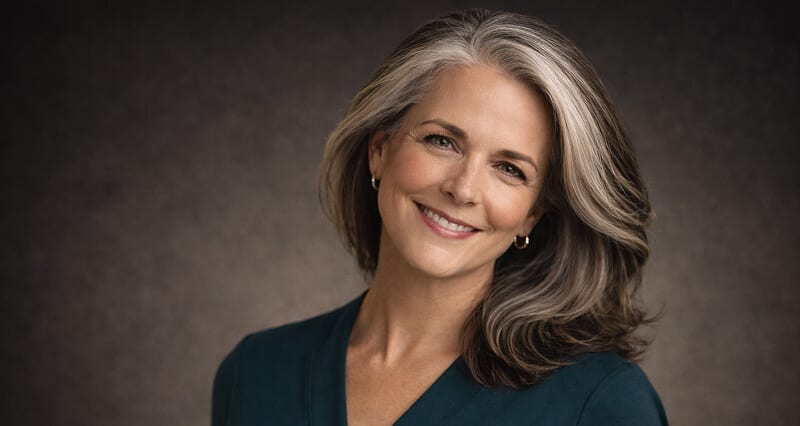
Headshots for Women Over 50: The Only Guide That Doesn't Talk Down to You
You've earned every line on your face. Your headshot should show that, not erase it.
A woman I know, a VP of operations with 28 years of experience, told me she hadn't updated her LinkedIn photo in seven years.
Not because she forgot. Because she was dreading it.
"Every time I think about getting a headshot," she said, "I imagine some photographer pointing a camera at me and asking me to 'look natural' while I sit there under fluorescent lights feeling like I'm being judged for every wrinkle."
She's not alone. And she's not wrong to feel that way.
The headshot industry has spent decades optimizing for one type of face: young, smooth, symmetrical. Most "headshot tips for women" articles are written as if every reader is 28 and preparing for their first corporate job. They talk about "youthful glow" and "fresh-faced energy" and subtle retouching that magically erases a decade.
That's not what this article is about.
This is for women over 50 who want a professional headshot that looks like them. Not a smoothed-out, de-aged, filtered version of them. The actual, accomplished, lived-in version.
Because here's what I've learned after years in the headshot space at HeadshotPhoto: the best headshots for women over 50 don't hide experience. They frame it.
The Real Problem With Most Headshot Advice
Here's where it gets messy. Google "headshot tips for women" and you'll find article after article about how to "minimize lines," "soften jawlines," and "create a youthful appearance."
The unspoken message? You have things that need fixing.
That's not advice. That's insecurity dressed up as professionalism.
Let me be clear about something. Lines around your eyes? Those are evidence that you've smiled, concentrated, laughed, and led for decades. A softened jawline? That's a face that has spoken in boardrooms and mentored dozens of younger professionals. Gray hair? That's a woman who stopped performing youth and started owning her authority.
The goal of a headshot for women over 50 is not to look younger. It's to look powerful, present, and unmistakably you.
Now, does that mean lighting doesn't matter? That outfit choices are irrelevant? That you should ignore the camera entirely?
Of course not. The details matter enormously. But they should serve you, not some imaginary standard of what a "professional woman" is supposed to look like.
Let me walk you through what actually works.
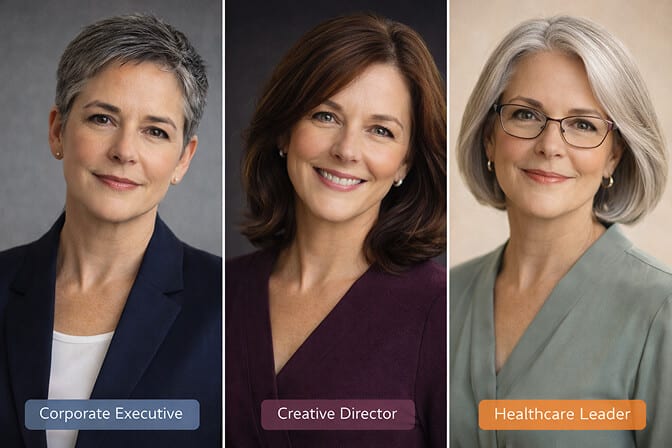
Lighting: The One Thing That Matters Most
This is where most people get it wrong. And it's the single biggest factor in whether you'll love or hate your headshot.
Harsh, direct lighting is the enemy of everyone, but it's especially unkind to mature skin. It creates deep shadows in every line and crease, exaggerating texture and making you look exhausted.
What works instead:
Soft, diffused lighting. Think overcast daylight through a large window, or studio lights with large softboxes. This type of light wraps gently around your face, filling in shadows without flattening your features.
Slight angle from above. A light source positioned just slightly above eye level and off to one side creates gentle, flattering shadows that give your face dimension without harshness. This isn't about "hiding" anything. It's about creating depth that photographs as strength.
Warm tones over cool tones. Cooler lighting can make skin look dull and tired. A slightly warm color temperature brings out natural warmth in the skin, regardless of complexion.
If you're taking your own photos at home, the simplest version of this: stand facing a large window on a cloudy day. That's it. The cloud layer acts as nature's softbox.
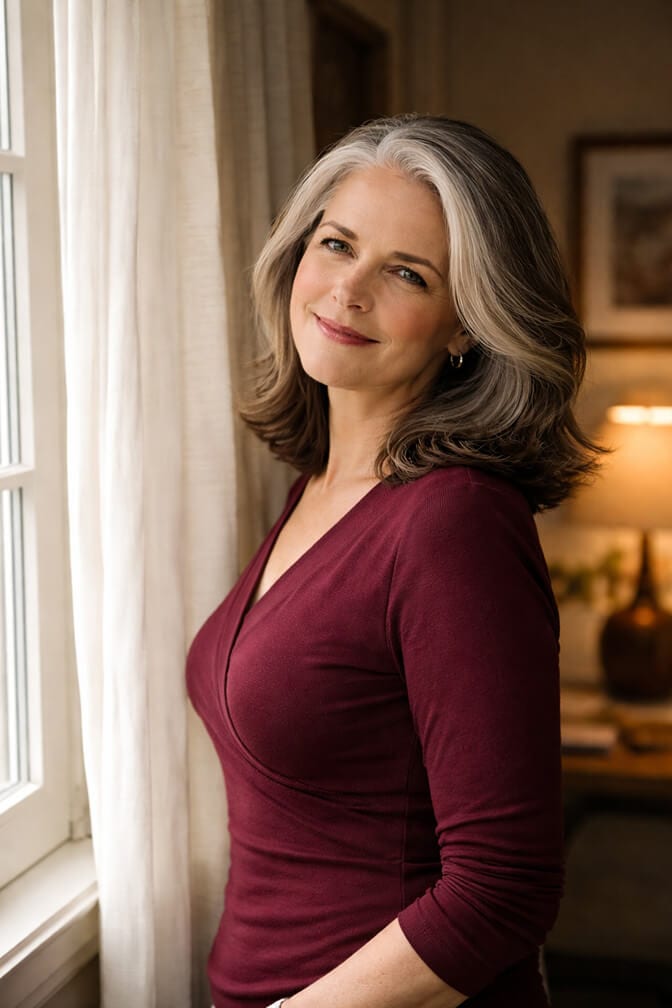
For a deeper breakdown of how lighting and angles work together, our guide on professional headshot tips and common mistakes covers this in detail.
What to Wear: It's Not About Playing It Safe
I see the same advice everywhere: "Wear navy. Wear black. Keep it simple."
That's fine. It's also boring.
Here's a better approach for women over 50: dress like the most polished version of your actual self.
If you wear bold colors in real life, wear bold colors in your headshot. A rich emerald, deep plum, or warm burgundy will photograph beautifully and communicate confidence far better than a "safe" black top that blends into every other headshot on LinkedIn.
Specific outfit tips that work for this age group:
V-necks and modest scoop necks elongate the neck and draw the eye upward toward your face. Avoid turtlenecks unless you have a longer neck. In a tight headshot crop, turtlenecks can make your head appear disconnected from your body.
Three-quarter or full-length sleeves look more polished than short sleeves in a headshot. Short sleeves can sit awkwardly at the edge of the frame and create visual distraction.
Structured layers add authority. A tailored blazer or fitted cardigan over a simple top adds dimension and signals leadership. But only if it fits well. Baggy layers make everyone look larger on camera.
Jewel tones are universally flattering for mature skin. Navy, deep teal, plum, burgundy, emerald. These create contrast without competing with your face.
Avoid pure white directly under your face. It can overexpose and create harsh bounce light onto your chin and neck. Off-white or cream is gentler.
And here's a truth nobody says out loud: your outfit should make you feel powerful when you put it on. If you feel good, it shows in your face. If you're tugging at a collar or adjusting a borrowed blazer, the camera sees that too.
For more industry-specific wardrobe advice, our complete guide on what to wear for professional headshots goes much deeper.
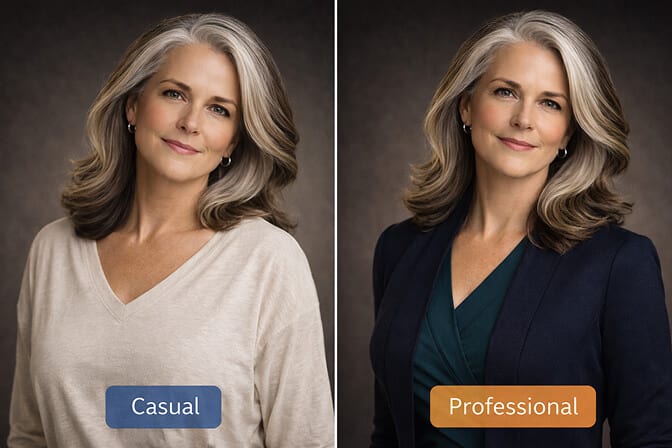
Poses That Communicate Authority, Not Stiffness
The worst pose for any woman over 50 is the one where she looks like she's trying too hard to look relaxed.
You know the one. Shoulders pulled back so hard they're practically behind you. Head tilted at an angle that's supposed to be "approachable" but reads as uncomfortable. Stiff smile that doesn't reach the eyes.
Here's what actually works:
The slight body angle. Don't face the camera dead-on. Turn your body about 30 degrees to one side, then turn your face back toward the camera. This creates a slimming effect and adds visual interest without looking contrived.
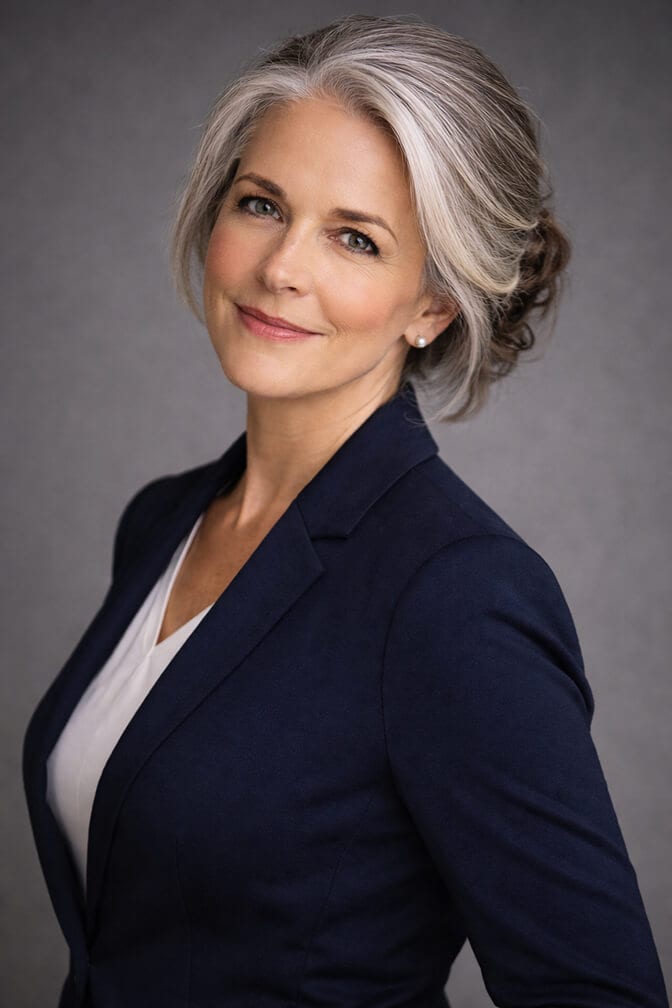
Shoulders down and relaxed. Before each shot, lift your shoulders to your ears, hold for a second, then drop them. This releases tension instantly.
The "focused confidence" expression. Not a big grin. Not a serious stare. Think about something you're proud of. A project you led. A problem you solved. That slight inner warmth translates to an expression that reads as confident and genuinely present.
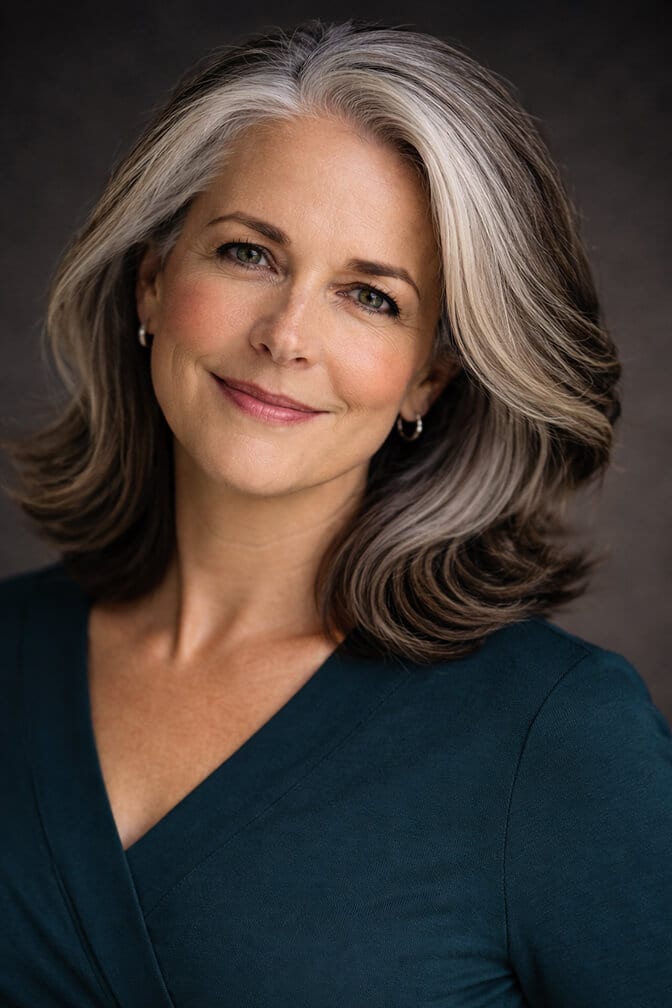
Chin slightly forward and down. This one sounds strange, but it works. Pushing your chin very slightly forward and tilting it down just a touch defines the jawline and reduces any shadow under the chin. Every portrait photographer knows this trick.
Stay with me here. The next part is where women over 50 have the biggest advantage.
The Part Nobody Tells You: Experience Photographs Better Than Youth
I've seen thousands of headshots come through our platform at Headshot Photo. And here's something I've noticed that surprises people:
The headshots from women over 50 consistently have more depth and character than those from younger professionals.
Not because of better cameras or fancier outfits. Because their faces tell a story.
A 28-year-old's headshot says, "I'm here and I'm ready." A 55-year-old's headshot says, "I've been here. I've done the work. And I'm still going."
There's a gravity to it. A presence. And when the lighting and framing are right, it's incredibly compelling.
This is why over-retouching is the worst thing you can do. When a photographer (or an AI tool) smooths every line, blurs every texture, and lifts every shadow, they don't just remove "imperfections." They remove the story. They remove the evidence of authority.
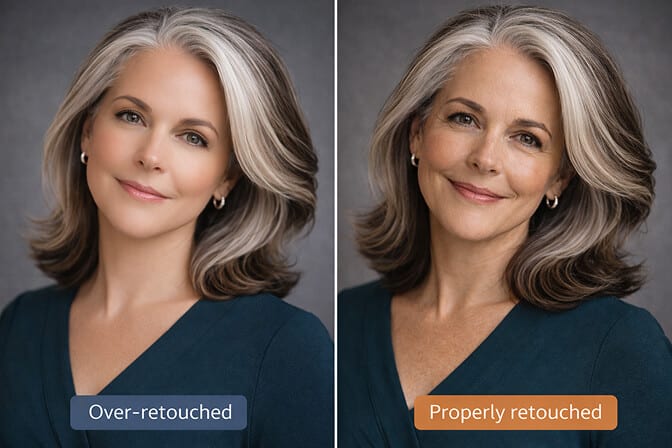
The best retouching for women over 50 removes temporary distractions (a stray hair, a blemish, a lint piece) and leaves everything that's permanent. Because the permanent things are what make you, you.
Watch: How Erin Finally Got Her Headshot After Putting It Off for 5 Years
If you've been avoiding your headshot update for years (and you're not alone), this honest review shows how one woman went from dreading the process to being genuinely surprised by her results, all from selfies she took at home. It's particularly relatable for women who've been putting this off because the whole thing felt overwhelming.
The AI Option: Why It's Especially Good for Women Over 50

But then something clicked. I started hearing from women in their 50s and 60s who tried AI headshots and said something I didn't expect:
"I finally have a headshot I like because I didn't have to perform for anyone."
That's the key insight. For many women over 50, the worst part of getting a headshot isn't the photo itself. It's the experience. Standing in a studio. Being directed by a stranger. Feeling self-conscious under bright lights while someone watches you try to "look natural."
AI headshots remove that pressure entirely.
You take a few selfies at home. In your own space. With your own lighting. In clothes you already own and feel comfortable in. No audience. No performance.
Then the AI handles the rest: lighting correction, background, professional polish.
If you want to try this approach, Headshot Photo AI headshot generator lets you upload 8 selfies and get 100 professional headshots in about 1 hour. You choose your background, outfit style, and level of formality. And because you're selecting from dozens of options, you pick the one that feels most like you, not the one a photographer happened to capture in a 45-minute session. You can explore more AI tools in this review of best AI headshot generators.
For women who've been putting off their headshot for years because the process felt intimidating, this changes everything.
Hair and Makeup: Embrace What's Yours
Let's talk about gray hair for a moment. Because it's come up in almost every conversation I've had with women over 50 about headshots.
Gray hair photographs beautifully. Silver, white, salt-and-pepper. All of it. Especially against darker backgrounds or jewel-tone clothing. The contrast is striking. Here's our guide on hairstyles for headshots.
If you're rocking your natural gray, own it in your headshot. Don't let anyone suggest you should color it for the photo. The trend in 2026 is overwhelmingly toward authenticity, and gray hair on a confident face is one of the most powerful visual signals there is.
For makeup, the rule is simple: enhance, don't transform. Here's our guide on makeup for headshots.
A light foundation that evens out skin tone. A touch of blush to add warmth. Mascara to define the eyes (black, not brown, it shows up better in photos). A natural lip color that's one shade deeper than your natural tone.
What to avoid: Shimmery eyeshadow (it settles into creases), heavy eyeliner on the lower lash line (it makes eyes look smaller), SPF-heavy moisturizers (they can create a ghostly cast under studio or flash lighting), and thick powder (it can cake and accentuate texture).
If you normally wear glasses, wear them in your headshot. They're part of who you are. Just make sure the lenses are clean and the frames don't have a reflective anti-glare coating (the purple or blue tint creates problems in photos).
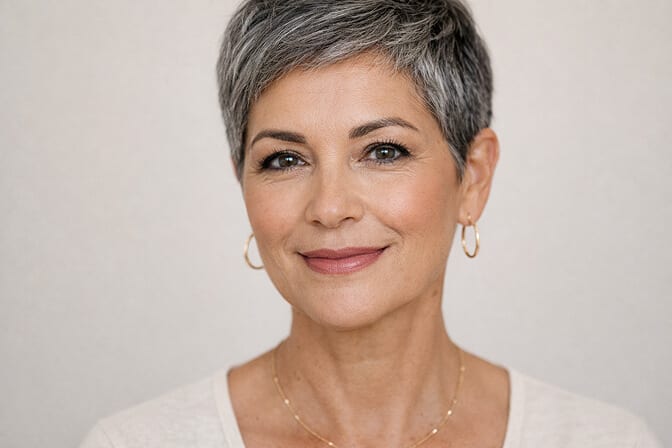
The Headshot You've Been Avoiding
Let me bring this back to the woman I mentioned at the start. The VP who hadn't updated her photo in seven years.
She eventually did get a new headshot. Not in a studio. She took six selfies near her kitchen window on a Tuesday afternoon, uploaded them to our AI tool, and had 100 professional options within minutes.
The one she chose shows her in a fitted navy blouse with small gold earrings. Soft smile. Direct eye contact. Silver-threaded hair swept to one side. Every line on her face visible and accounted for.
She told me it was the first headshot in her career where she didn't want to change anything.
That's what a great headshot for a woman over 50 looks like. Not airbrushed. Not de-aged. Not performing youth. Just a woman who looks exactly like herself on her best day.
If you've been putting off your headshot, the process is simpler than you think. Take a few selfies in good light, upload them to Headshot Photo, and see what's possible. No studio. No stranger directing you. No pressure.
Just you, looking like the accomplished professional you are.
Frequently Asked Questions
What is the most flattering lighting for headshots for women over 50?
Soft, diffused lighting works best. Think large windows on overcast days or studio softboxes positioned slightly above and to one side of your face. This type of lighting minimizes harsh shadows while still creating dimension, which helps your features look natural and defined without exaggerating texture.
How do AI headshots compare to studio photography for older women?
AI headshots in 2026 produce remarkably realistic results, with the added benefit of comfort and control. You take selfies at home without the pressure of performing for a photographer, then the AI handles lighting, background, and polish. For most professional uses like LinkedIn and company websites, AI headshots deliver excellent quality at a fraction of the cost ($34 vs. $300-500 for a studio session).
How should I do my hair and makeup for a professional headshot over 50?
Keep it natural and close to how you look on a typical workday. Light foundation, a touch of blush, black mascara, and a natural lip color work well. Avoid shimmery eyeshadow, heavy lower eyeliner, and SPF moisturizers (they ghost under lights). For hair, style it the way you normally would. If you have gray hair, embrace it, as it photographs beautifully against darker backgrounds and jewel-tone outfits.
Is it worth investing in a professional headshot when you're over 50?
Absolutely. Women over 50 are often at the peak of their careers, holding leadership roles, serving on boards, and building personal brands. A strong professional headshot communicates authority and credibility. Whether you invest in a studio session or use an AI tool, the return on a polished headshot (in terms of recruiter engagement, client trust, and professional visibility) far outweighs the cost.
Will an AI headshot tool over-retouch my face and make me look too young or fake?
Quality AI tools like HeadshotPhoto are designed to enhance, not transform. They correct lighting and background while preserving natural skin texture, facial structure, and expression. The goal is to make you look like yourself on your best day, not like a filtered version of someone else. You also get to choose from multiple options, so you can select the headshot that feels most authentic.