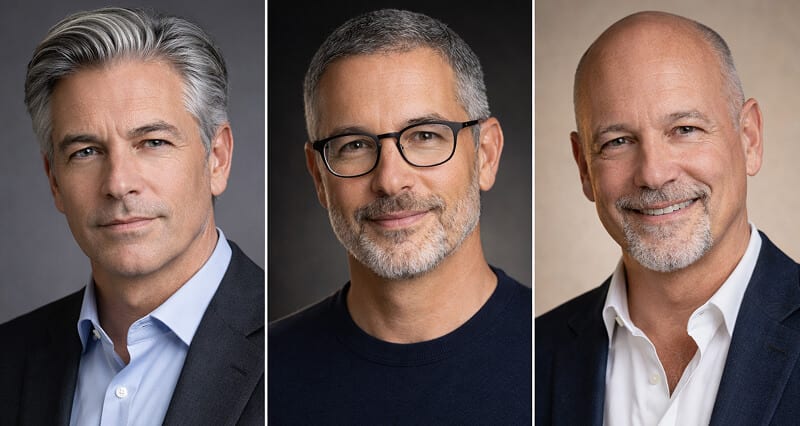
Your face has 25+ years of leadership written on it. Your headshot should show that, not sand it away.
A consultant I know, a guy who's built and sold two companies and advises Fortune 500 boards, was using a LinkedIn photo from 2014.
Not because he liked it. Because every time he thought about getting a new one, the whole thing felt like too much. Finding a photographer. Picking an outfit. Standing in a studio while some 28-year-old tells him to "relax your shoulders" and "think of something happy."
"I'd rather sit through a four-hour compliance meeting," he told me.
So he kept the old photo. The one where he had darker hair, fewer lines, and a tie he stopped wearing five years ago.
Here's the problem with that strategy: his face in 2014 didn't match his authority in 2026. Clients would meet him on Zoom and do a double-take. Conference organizers would use his decade-old headshot on speaker pages. Recruiters scanning LinkedIn saw a guy who looked like he hadn't updated his profile since the Obama administration.
His photo was actively undermining his credibility. And he didn't even realize it.
If any of that sounds familiar, this guide is for you. Not the generic "wear blue and smile" advice that every photography blog recycles. Real, specific guidance for men over 50 who want a headshot that matches the career they've actually built.
Why Most Headshot Advice Fails Men Over 50
This is where most people get it wrong. Google "men's headshot tips" and every article is written for a 30-year-old preparing for his first LinkedIn profile. "Look approachable." "Show your personality." "Don't be too formal."
That's fine advice for someone entering the workforce. It's terrible advice for a man who's been leading teams for two decades.
At 50+, the headshot brief is different. You're not trying to look friendly and eager. You're trying to look like someone who has been trusted with important decisions for a very long time.
The best headshots for men over 50 don't fight the signs of age. They frame them as evidence of authority.
Gray temples? That's the visual shorthand for "this man knows what he's doing." Character lines around the eyes? Those are earned by someone who's concentrated, solved problems, and led through pressure. A face with texture and weight? That's gravity. Literally and figuratively.
The goal isn't to turn back the clock. It's to make the clock look good.
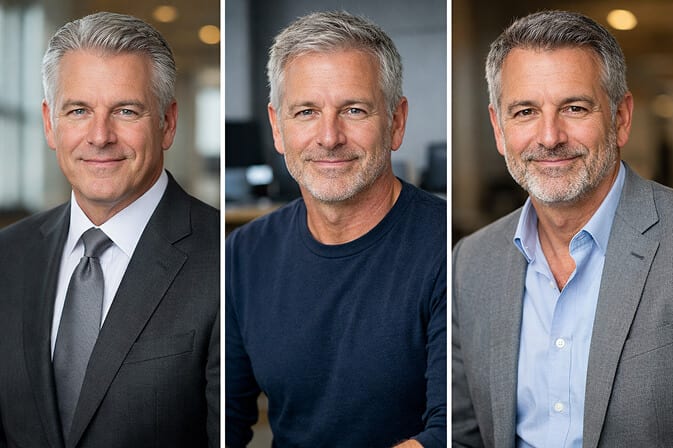
Grooming: The Part That Matters More Than You Think
Let's start where most men don't want to: the mirror.
I'm not going to tell you to get a makeover. But I am going to tell you that grooming is the single highest-ROI preparation for any headshot. More than your outfit. More than your background. More than your photographer.
Hair
If you've got a full head of hair at 50+, congratulations. Get it cut about a week before your headshot (not the day before, it'll look too sharp and unnatural). Style it the way you normally would. A headshot is not the day to try something new.
If your hair is thinning, own it. Closely cropped or fully shaved looks incredibly strong in headshots. What doesn't work: the combover. The strategic angling. The hat. A camera sees through all of it. Confidence reads better than camouflage.
If your hair is gray or going gray, leave it. Gray hair on a man over 50 is one of the most powerful visual signals in professional photography. It communicates experience, calm authority, and stability. Against a dark background or a jewel-tone shirt, it photographs beautifully.
For a detailed breakdown of hair, outfit, and grooming decisions specific to men, our comprehensive guide to professional headshots for men covers everything.
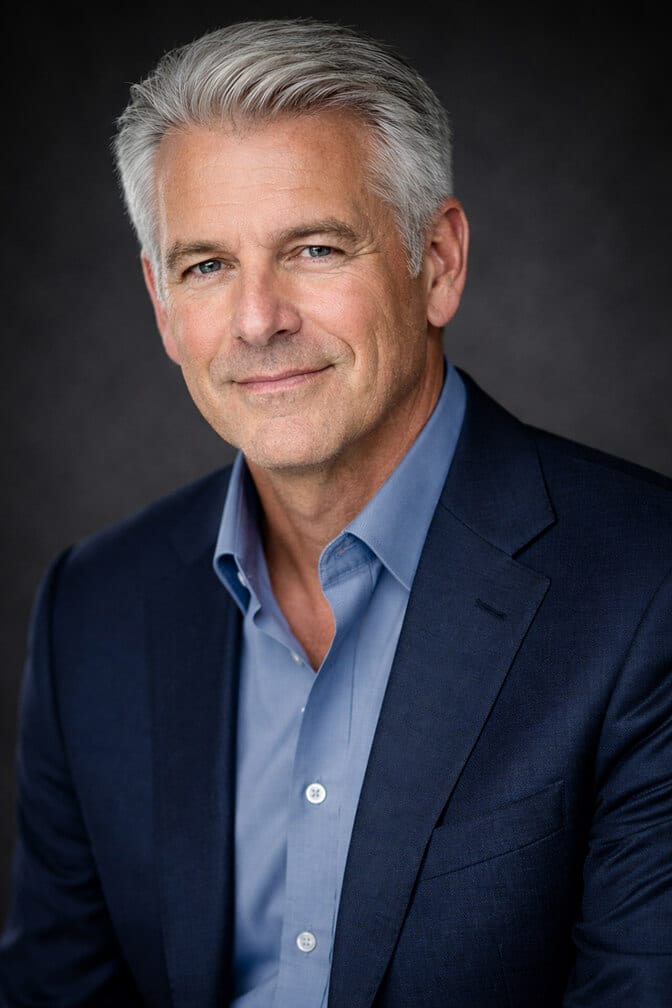
Facial Hair
If you wear a beard, trim it cleanly 1-2 days before your session. The goal is defined edges, not fresh-from-the-barber precision. If you're typically clean-shaven, shave the morning of (or afternoon, if you're shooting later) and watch for razor irritation. For more specific advice, check out our guide on beard styles for professional headshots.
The worst look? A five-o'clock shadow that's not intentional. It reads as "I didn't prepare," which is the opposite message you want your headshot sending.
Skin
This one's simple but overlooked. Moisturize the night before and morning of. Dry skin catches light in headshots and exaggerates texture in ways that don't look natural. A simple, unscented moisturizer does the job. Skip anything with SPF (it creates a ghostly cast under studio lighting or flash).
If your face tends to get shiny, bring a blotting paper or translucent powder. Sounds fussy. Looks professional.
For a complete grooming checklist, our grooming guide for professional headshots covers everything from skincare to day-of preparation.
What to Wear: The Outfit Framework for Men Over 50
Here's a mistake I see constantly: men over 50 defaulting to a full suit and tie because that's what "professional" means in their mental model.
A suit works. But it's not always the best choice.
The better framework: dress one notch above your daily professional wear, in something that actually fits.
If you wear suits daily, wear your best suit. If you're normally in business casual, a sport coat over a clean button-down or a fitted blazer with no tie hits perfectly. If you're in tech or consulting and live in crewnecks, a high-quality navy or charcoal sweater over a collared shirt creates a polished but authentic look.
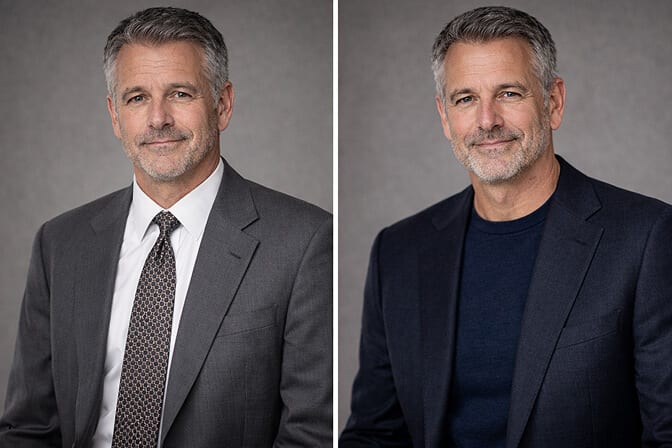
The fit matters more than the brand. A $200 blazer that fits your shoulders perfectly will outperform a $2,000 suit that's slightly too big. In a headshot crop (chest up), every wrinkle, pull, and gap is amplified. Try everything on the day before. Sit down in it. Check the collar.
Colors that work for men over 50:
Navy is the universal winner. It communicates trust, looks great against most skin tones, and pairs with almost any background.
Charcoal and dark gray project quiet authority without the heaviness of black.
Deep burgundy, forest green, or rich blue as accent colors (a tie, a pocket square, a shirt under a dark jacket) add personality without competing with your face.
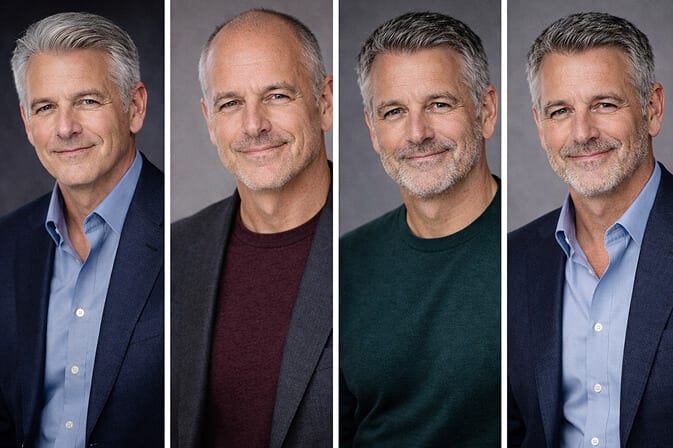
Avoid pure white shirts without a jacket. White reflects the most light and becomes the brightest part of your headshot, pulling attention from your face. If you love white, layer a dark blazer over it.
For more industry-specific wardrobe guidance, our complete breakdown on professional headshot attire goes deep into color psychology and fit.
Poses That Project Power (Without Looking Like a Stock Photo)
The word "posing" makes most men over 50 cringe. It sounds vain. Performative. Unnatural.
But posing for a headshot isn't about vanity. It's about geometry. Small adjustments in angle, posture, and chin position can dramatically change how authority reads in a photo.
The slight body turn. Don't face the camera straight on. Rotate your body about 20-30 degrees to one side, then turn your face back toward the lens. This creates a more dimensional, powerful composition than the flat, passport-style straight-on shot.
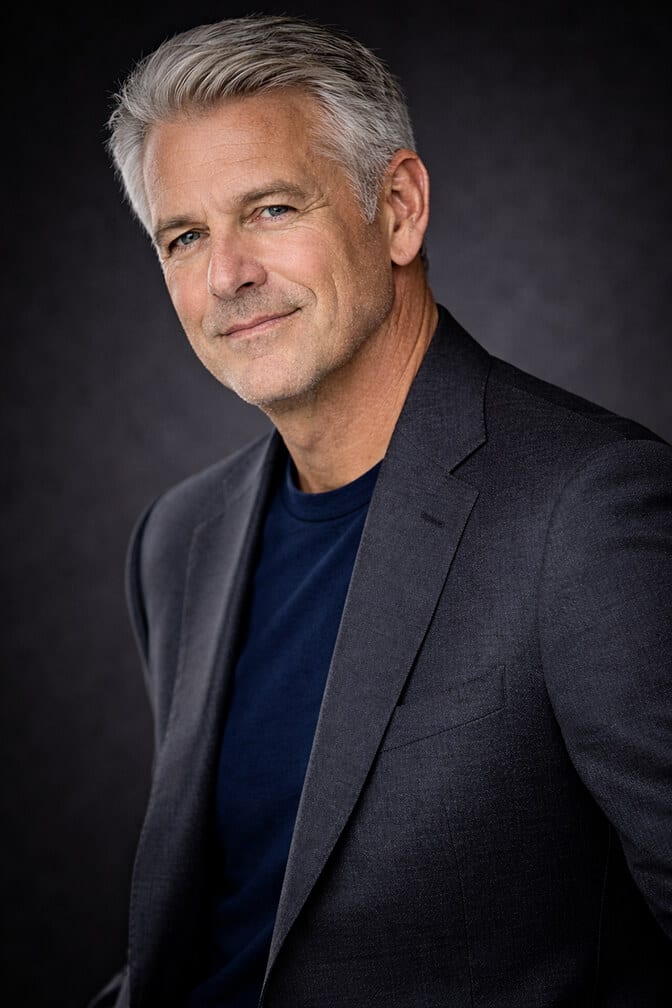
Shoulders down and engaged. Before each shot, shrug your shoulders up to your ears, hold for two seconds, then drop them. This releases tension and creates a natural, grounded posture. Stiff shoulders read as nervousness.
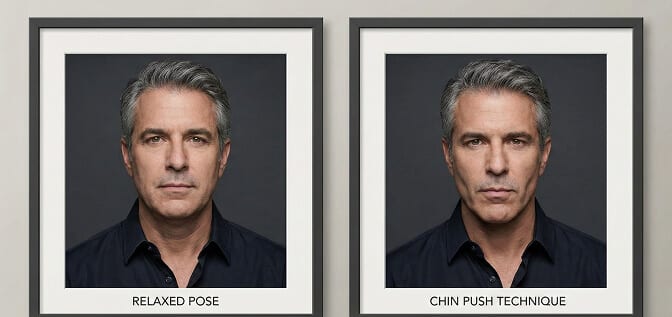
The chin push. This is the one trick every portrait photographer knows and every subject resists. Push your chin very slightly forward and tilt it down just a touch. It feels strange. It looks incredible. It defines the jawline and eliminates the double-chin shadow that overhead or flat lighting can create.
The "boardroom expression." Not a grin. Not a glare. Think about a moment where you solved a difficult problem for a client. That internal satisfaction, that quiet "I've got this" energy, that's what reads as executive presence in a headshot.
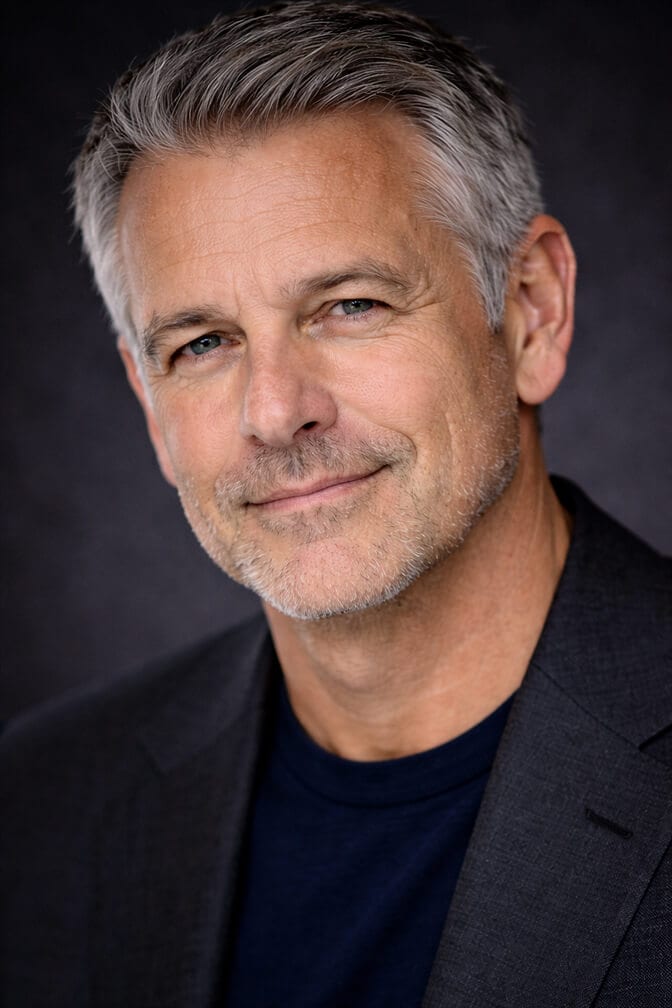
The best expression for a man over 50 isn't "say cheese." It's "I've been doing this long enough to know exactly what I'm doing."
Our guide on professional headshot tips and dos and don'ts covers expression, posing, and the most common mistakes we see across all ages. You can also explore male corporate portrait poses for more executive-specific positioning ideas.
Lighting: Why It Makes or Breaks Everything
Bad lighting is the fastest way to make any headshot look terrible. And for men over 50, the wrong lighting setup can add 10 years while the right one can make you look like you belong on the cover of a business magazine.
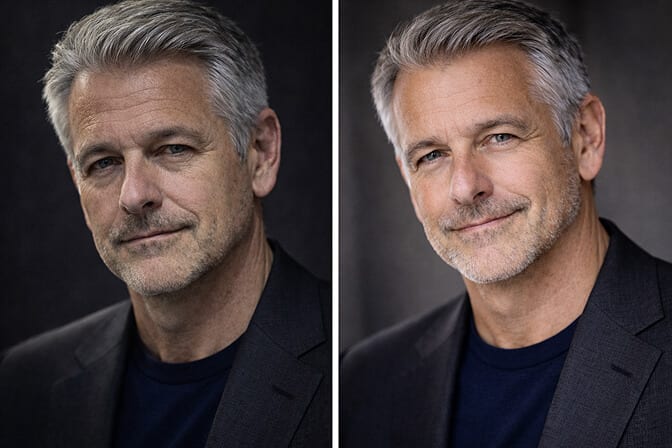
Avoid overhead lighting. Recessed ceiling lights, fluorescent panels, anything directly above you creates harsh shadows under your eyes, nose, and chin. It makes everyone look tired and gaunt.
Soft, directional light is your friend. A large light source (a big window, a studio softbox) positioned slightly above eye level and about 45 degrees to one side creates the classic "Rembrandt" lighting pattern. It's the most flattering setup for male faces because it adds dimension and structure without harshness.
If you're shooting at home, find a large window. Stand facing it. Turn off every other light in the room. That single, large, diffused light source will do more for your headshot than $10,000 of studio equipment in the wrong hands.
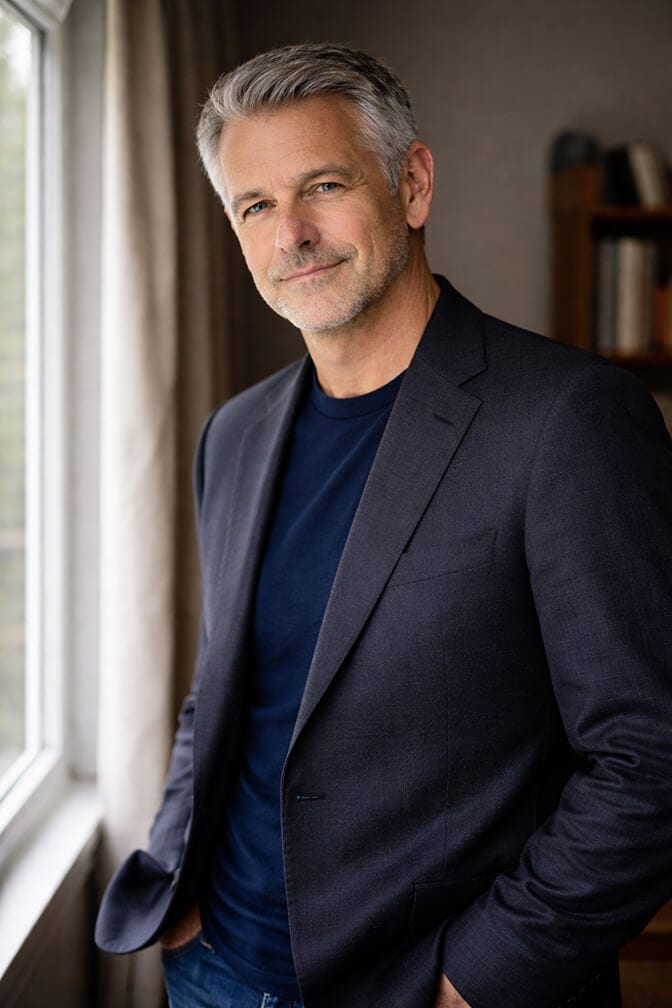
For men with deeper wrinkles or more pronounced facial texture, slightly softer (more frontal) light reduces shadow depth without flattening features entirely. It's a balance between definition and gentleness. Our detailed guide on headshot lighting for wrinkles covers this balance in depth, and our headshot lighting setup guide walks through equipment and positioning.
The Thinning Hair and Bald Head Conversation
Let's address this directly, because almost no headshot guide does.
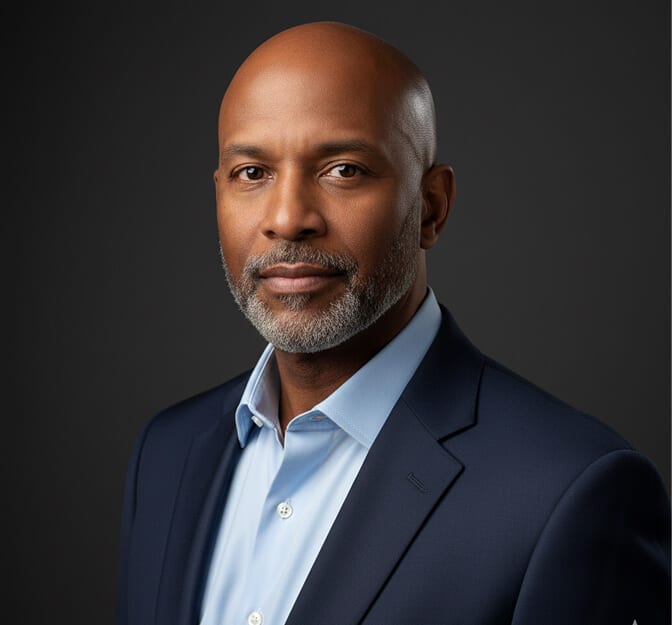
Many men over 50 are dealing with thinning hair, receding hairlines, or complete hair loss. And many of them subconsciously avoid getting a headshot because of it.
A shaved or closely cropped head photographs extremely well in professional headshots. Look at the headshots of any Fortune 500 CEO or senior partner over 50 and you'll see plenty of bald and shaved heads that project absolute authority.
What matters isn't the hair. It's the confidence.
A few practical tips:
- If you shave your head, do it the day before (not the morning of, to avoid razor bumps or redness). Apply a light moisturizer to prevent shine.
- If your hair is thinning on top, avoid lighting that comes from directly above. It will illuminate your scalp and create an unflattering contrast. Side lighting or slightly frontal lighting works much better.
- If you're somewhere in between, talk to your barber about the shortest, cleanest cut that works for your hair pattern. A close-cropped style almost always photographs better than a longer style that's trying to cover thin spots.
Nobody looking at your headshot is judging your hairline. They're judging your confidence. The headshot that reads as "I know who I am" will always outperform the one that reads as "I'm hiding something."
The AI Option: Why It Solves the Biggest Problem Men Over 50 Have
It's not the money. Men over 50 generally have the budget for a photographer.
It's the performance.
Standing in a studio, being directed by a stranger, trying to "look natural" while a camera is two feet from your face. For a demographic that values competence and control, the headshot experience is deeply uncomfortable because it puts you in a situation where you have zero expertise.
*hat's exactly why AI headshots have resonated so strongly with men in this age group.
You take a few selfies at home. Alone. No audience. No direction. No performance. Upload them to an AI tool, choose your style preferences, and get professional results in minutes.
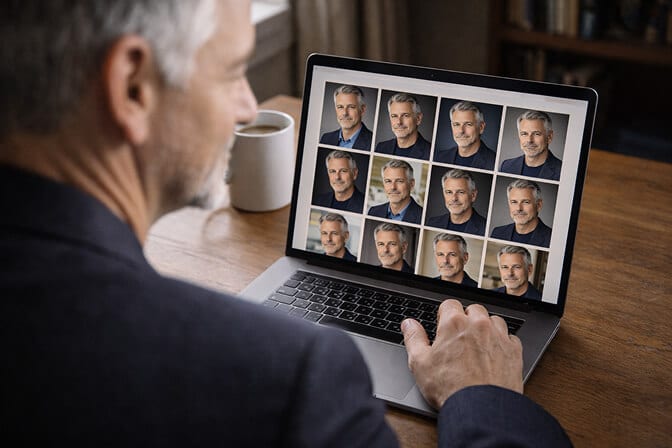
Watch: How Markus Updated His CV and LinkedIn With AI Headshots
If you've been putting off your headshot because the studio experience feels awkward, this walkthrough from Markus shows exactly what the process looks like from start to finish. He goes from casual phone selfies to polished professional results, and his honest take on the quality might surprise you. He shows how you can take professional headshots for men over 50 with the help of AI.
At Headshot Photo, this is the experience we built. Upload 8 selfies, select your background and outfit style, and get 100 professional headshots in about 1 hour. No studio. No stranger. No "say cheese."
For men over 50 who want to see the full range of headshot styles and when to use them, our breakdown of different types of headshots covers corporate, executive, LinkedIn, and personal branding options.
Retouching: The Line Between Polished and Fake
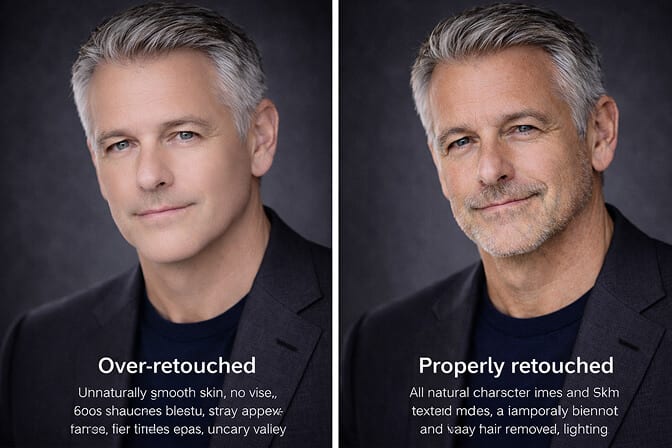
This is the part nobody tells you. And it matters enormously for men over 50.
Good retouching removes distractions. Bad retouching removes character.
The temporary stuff should go. A stray hair. A blemish. Lint on your jacket. A rogue nose hair the camera caught. Those are distractions that no one would notice in person.
The permanent stuff should stay. Lines around your eyes. The texture of your skin. The shape of your jaw. The visible evidence that you've lived and worked hard for decades.
When a headshot is over-retouched, it creates an uncanny valley effect. People look at it and something feels off. The skin is too smooth. The face doesn't match the age. It looks like a video game character, not a senior executive.
The right retouching philosophy for men over 50: you should look like yourself on your best day, not like a version of yourself from 2005.
This is another area where our blog on common headshot mistakes and how to avoid them provides useful context. Over-retouching consistently ranks among the top mistakes we see.
Glasses: To Wear or Not to Wear
If you wear glasses in your daily professional life, wear them in your headshot. Full stop. Your headshot should look like you when people meet you. If you'd walk into a meeting wearing glasses, they should be in your photo.
Two practical notes:
Clean your lenses obsessively. Under headshot lighting (studio or window light), every smudge and fingerprint becomes visible. Bring a microfiber cloth.
Watch for anti-reflective coatings. Many modern lenses have a purple or blue-green anti-glare coating. Under certain lighting, this coating creates visible colored reflections in photos. If you have a spare pair without the coating, bring them. If not, your photographer (or your AI tool) can usually mitigate this.
The Headshot You've Been Avoiding
Let me come back to the consultant from the beginning. The one using a photo from 2014.
He eventually updated his headshot. He took eight selfies on a Sunday morning in his home office, near the window, wearing a navy blazer he already owned. Uploaded them to Headshot Photo. Had 100 options by lunch.
The one he chose shows him with his current gray hair, his current face, and his current energy. No tie. No performance. Just a man who looks exactly like someone you'd trust with a high-stakes decision.
He told me that three people commented on his updated LinkedIn photo within the first week. One of them was a potential client.
That's what a great headshot does for a man over 50. It doesn't make you look younger. It makes you look current, credible, and exactly like the person someone would want leading their project, advising their board, or running their company.
You've spent decades building authority. Your headshot should finally show it.
If you've been putting it off, take 1 hour today. Upload a few selfies to Headshot Photo's AI headshot generator and see what's possible. No studio. No performance. Just you, looking like you, on your best day.
Frequently Asked Questions
What makes a good headshot for a man over 50?
A good headshot for a man over 50 balances professionalism with authenticity. It should feature soft, directional lighting that adds dimension without creating harsh shadows, a well-fitted outfit in solid colors (navy, charcoal, or dark jewel tones), and a natural expression that conveys quiet confidence. Most importantly, the photo should look like you today, not a filtered version from a decade ago.
How do AI headshots compare to studio photography for older men?
AI headshots produce remarkably professional results in 2026, at a fraction of the cost and time. Studio sessions typically run $200-500 and require scheduling, travel, and performing for a photographer. AI tools like HeadshotPhoto cost around $34, take 1 hour, and let you take input selfies in the comfort of your own space. For LinkedIn, company websites, and digital profiles, AI headshots deliver excellent quality without the performance pressure many men over 50 dislike about studio sessions.
How should I handle thinning hair or baldness in my headshot?
Own it with confidence. Closely cropped or shaved heads photograph powerfully in professional headshots. The key is proper lighting: avoid overhead light sources that illuminate the scalp, and use side or slightly frontal lighting instead. Moisturize to prevent shine, and shave or trim the day before your shoot (not the morning of) to avoid irritation. Nobody evaluating your headshot is focused on your hairline. They're reading your confidence and professionalism. Here's our guide on bald head professional headshots.
Is it worth paying for a professional headshot when you're over 50?
Absolutely. Men over 50 are typically in senior roles, consulting, serving on boards, or building personal brands. A strong headshot signals credibility and currency. Whether you invest in a studio session or use an AI generator, the return on a polished, current headshot is significant. LinkedIn profiles with professional photos receive substantially more views and connection requests. At this career stage, an outdated or missing headshot is costing you opportunities.
Will AI headshot tools make me look too young or over-edited?
Quality AI tools like HeadshotPhoto are built to enhance, not transform. They correct lighting and backgrounds while preserving your natural skin texture, facial structure, gray hair, and expression. The goal is to produce a photo that looks like you on your best day, not an artificially smoothed version. You also get to review and select from many options, so you choose the headshot that feels most authentic.