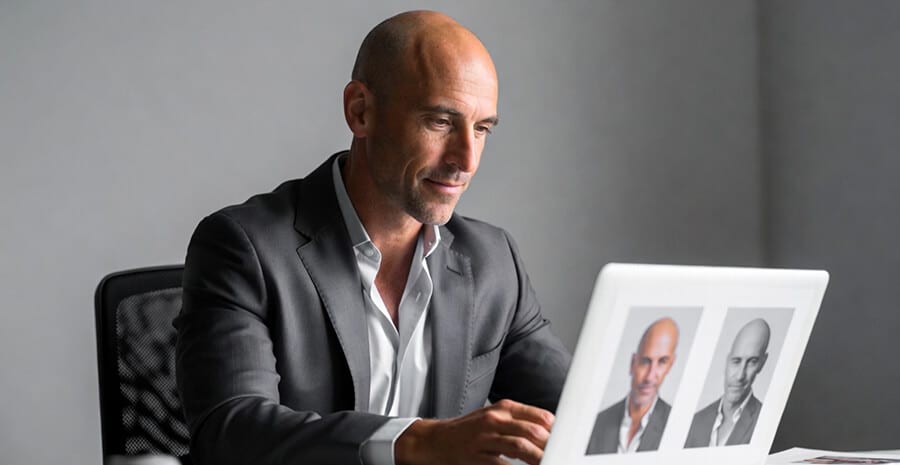
Because "just powder your head" isn't helpful when you don't know what that means
I remember the exact moment I wanted to throw my laptop across the room.
It was 11 PM. I'd spent the last three hours scrolling through the "professional" headshots my photographer had sent over. In every single one, my head looked like a chrome dome at noon in the Sahara.
Hot spots. Glare. A white streak across my skull that made me look like I was about to announce the next SpaceX launch.
I'd paid $400. Taken time off work. Ironed a shirt I hadn't touched since 2019. And the result? Unusable.
Here's the thing nobody told me: bald heads require completely different lighting setups than heads with hair. And most photographers especially the ones charging $150 for "corporate headshots" don't know the difference.
They use the same three-light setup they use for everyone. Hair light included. Yes, hair light. On a head with no hair.
This is where most people get it wrong.
Why Your Last Headshot Looked Like a Lightbulb
Let me explain what's happening technically, because once you understand it, you'll never let a photographer blow out your dome again.
Hair absorbs light. A bald scalp reflects it.
When light hits hair, those thousands of strands scatter the photons in different directions. The result is soft, diffused light that the camera handles easily.
But skin? Skin is essentially a curved mirror. Especially if there's any oil, sweat, or moisture. The light bounces straight back at the camera, creating what photographers call "hot spots" those blown-out white areas where detail disappears entirely.
The physics doesn't care about your feelings. Angle of incidence equals angle of reflection. If the light source is above you (as it usually is in standard setups), it bounces off your curved scalp and shoots directly into the lens.
The key insight: You don't need less light. You need light from a different direction or you need to change the surface properties of your head.
Stay with me here, because this is where it gets practical.
What Actually Works: The Five Things I Wish I'd Known
After that disaster session, I became obsessed. Talked to photographers. Read forum threads from 2006. Tested everything on myself.
Here's what I learned:
1. Soft Light Is Non-Negotiable
Hard light creates sharp shadows and concentrated reflections. Soft light wraps around your head and spreads evenly.
The difference? A hard light source is small relative to your face (like a bare bulb or direct flash). A soft light source is large (like a big softbox close to you, or window light on a cloudy day).
When you're booking a photographer, ask them one question: "What's your key light setup for bald clients?"
If they say "same as everyone else" or look confused, walk away. Seriously.
A photographer who knows what they're doing will mention:
- Large softboxes positioned at face level or lower
- No hair light or rim light on the top of your head
- Background separation achieved through background lighting, not head lighting
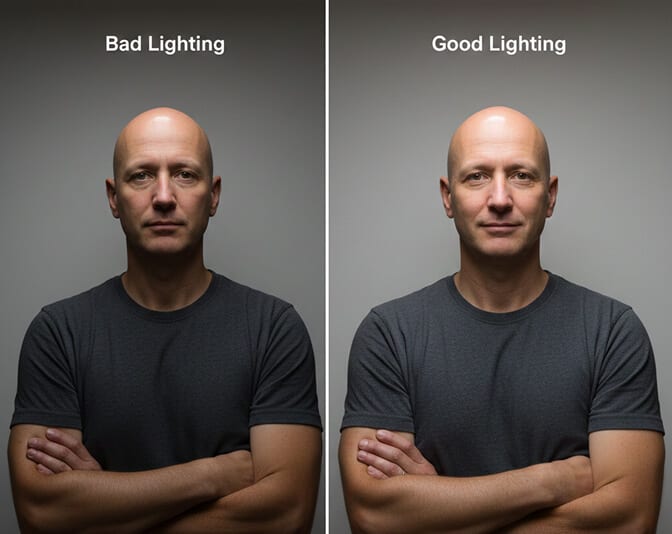
2. Lower the Key Light
This is the single most impactful change.
In a standard portrait setup, the main light (key light) sits above the subject at roughly 45 degrees. This works fine when hair diffuses the light hitting the top of the head.
For us? It creates a reflective runway across our skulls.
The fix: Drop the key light to face level or slightly below. This ensures light hits your face where it should without glancing off the top of your head.
If you're shooting outdoors, this means avoiding midday sun entirely. Early morning or late afternoon (golden hour) puts the sun at a lower angle. Overcast days? Even better.
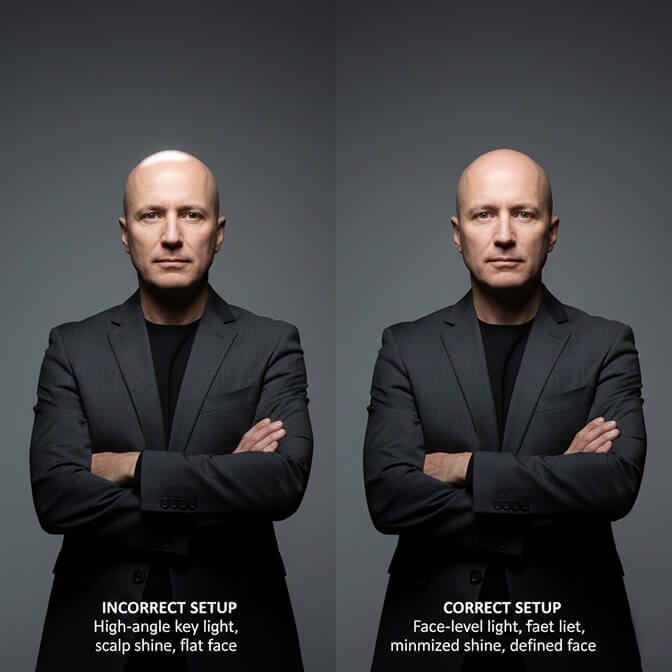
3. Kill the Hair Light
I cannot stress this enough.
Hair lights exist to separate the subject's head from the background by creating a rim of light around the hair. Without hair, that light has nowhere to diffuse. It just blasts your skin.
If your photographer insists on separation lighting, they should use a background light instead illuminating the backdrop behind you rather than your head.
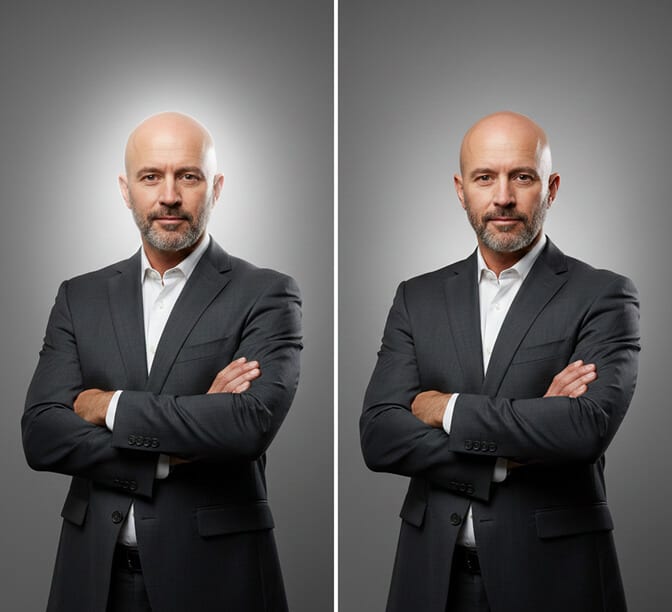
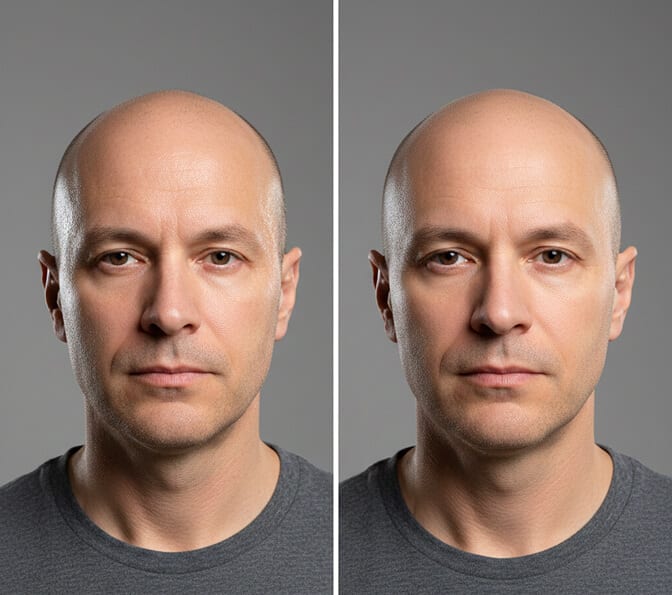
4. Prep Your Head (And No, This Isn't Weird)
Here's the part nobody talks about because it feels awkward.
Translucent powder works. It reduces surface oils without changing your skin tone. You can find it at any drugstore look for "mattifying powder" or "setting powder."
Don't overthink it. Pat some on your scalp 20 minutes before the shoot. If you're uncomfortable calling it makeup, call it anti-shine prep. Nobody needs to know.
Pro tip: Avoid moisturizers on the day of your shoot. Many contain ingredients that make skin more reflective. You want your head dry and matte.
Shave fresh the morning of if you normally stay clean-shaven. A day's stubble catches light differently than a smooth head. Consistency matters.
5. Choose Your Background Wisely
This one surprised me.
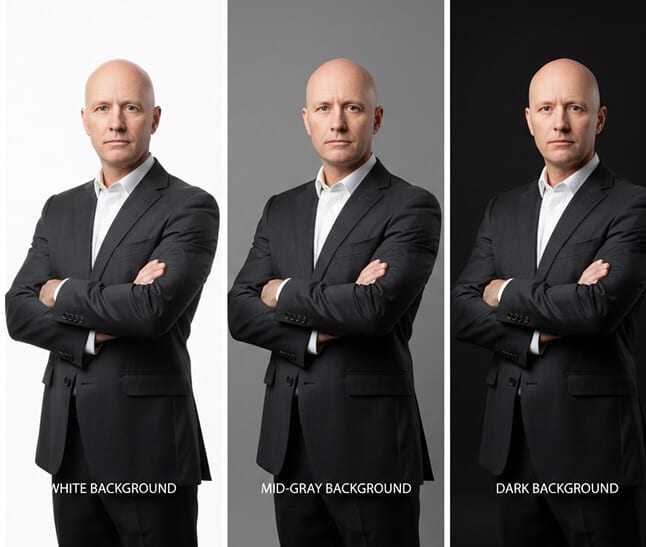
Without hair creating natural separation between your head and the background, color contrast becomes critical.
If you have lighter skin, darker backgrounds work better. If you have darker skin, lighter backgrounds create clearer definition.
A white background + fair skin + bald head = disaster. You'll fade into the backdrop like a ghost.
The Part Nobody Tells You: Being Bald Is Actually an Advantage
Here's where I'm going to push back on the entire narrative.
Most photography advice treats baldness as a problem to solve. Something to minimize. A lighting challenge to overcome.
I think that's backwards.
Bald heads photograph incredibly well when lit properly.
Think about it. No flyaways. No bad hair days. No awkward cowlicks or thinning patches. Every pixel of attention goes to your face your expressions, your eyes, your confidence.
The issue isn't your head. It's the lazy approach most photographers take.
When someone knows how to light a bald subject correctly, the results are often better than traditional headshots. More striking. More memorable. More distinctly you.
I've seen corporate headshots where every person with hair looks identical same side part, same boring lighting, same forgettable expression. The bald executives stand out.
Embrace it.
What About AI Headshots?
But here's the thing.
You could spend hours finding a photographer who understands bald lighting. You could schedule the session, prep your head, show up, and hope they get it right.
Or you could skip all of that.
AI-generated headshots have gotten absurdly good. And here's the part that matters for us: the lighting problem disappears entirely.
When AI generates your headshot, it's not physically bouncing light off your skull. It's creating an image from scratch based on your features. Which means no hot spots. No glare. No chrome dome disasters.
I'm not saying every AI headshot is perfect. But I've generated professional photos in 1 hour that would have taken me months to schedule, $500 to pay for, and still might have ended with blown-out highlights.
If you've been burned by bad lighting before or you just want professional photos without the hassle generate your AI headshots here and see for yourself.
What to Ask Your Photographer If You Go Traditional
If you do choose to work with a photographer, here's your checklist. Print this out if you need to.
Before booking:
- "What's your experience photographing bald clients?"
- "Can you show me examples of bald subjects in your portfolio?"
- "What key light setup do you use for bald heads?"
At the session:
- Ask them to show you a test shot early and check for hot spots
- Request they eliminate or minimize any hair/rim light
- Ask them to use background lighting for separation instead
Come prepared:
- Fresh shave (if that's your style)
- Mattifying powder applied 20 minutes before
- No moisturizer on your scalp that day
- Mid-tone clothing (black and white both have issues stick to blues, grays, or deep colors)
If your photographer gets annoyed by these questions, they're the wrong photographer. Someone who knows their craft will appreciate a prepared client.
The Confidence Factor
Let me end with something that's not about lighting at all.
The single biggest factor in how your headshot turns out isn't the equipment, the powder, or the background color.
It's how you feel in front of the camera.
I've seen technically perfect headshots that look lifeless because the person was uncomfortable. And I've seen "imperfect" shots with visible shine that look incredible because the subject owned it.
Being bald isn't a flaw. It's a look. 57% of men experience noticeable hair loss by age 50, and plenty more choose to shave before it gets there. You're in good company.
The goal of a professional headshot isn't to hide who you are. It's to show the best version of who you already are confidently.
Get the lighting right. Prep your head. Choose the right background.
Then walk in as if you belong there.
Because you do.
Frequently Asked Questions
What is the best lighting for bald head photography?
Soft, frontal lighting works best for bald subjects. Use a large softbox or diffused light source positioned at face level or slightly below, never directly above. Eliminate hair lights entirely and use background lighting for subject separation instead.
How do I reduce shine on a bald head for photos?
Apply translucent mattifying powder to your scalp 20-30 minutes before your photo session. Avoid moisturizers on the day of the shoot, and ask your photographer to check for hot spots in test shots before proceeding.
Are AI headshots good for bald people?
Yes, AI headshots actually eliminate the lighting challenges that plague traditional photography of bald subjects. Since AI generates images digitally rather than capturing light reflection, there are no hot spots or glare issues. Services like HeadshotPhoto.io can produce professional results in minutes without the risk of lighting problems.
What should a bald man wear for professional headshots?
Stick to solid, mid-tone colors like navy blue, charcoal gray, or deep burgundy. Avoid pure white (which creates background blending issues) and solid black (which can wash out fair skin). Ensure your clothing is well-fitted and wrinkle-free.
How do professional photographers light bald heads differently?
Experienced photographers lower their key light to face level, eliminate hair/rim lights entirely, and use background lights instead for separation. They also typically use larger diffusion sources positioned closer to the subject to wrap light evenly without creating concentrated reflections.