What NOT to Wear for a Professional Headshot (The Mistakes That Quietly Wreck Your Photo)
Most people don't fail their headshot by looking bad. They fail it by wearing something that fights the camera. Here's the full list.
A guy walked into a shoot once wearing his favorite shirt.
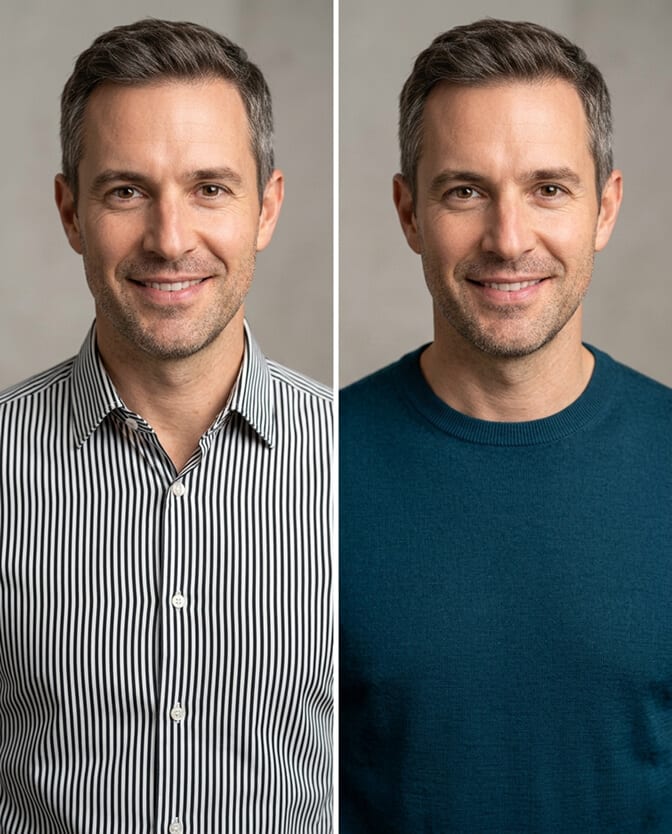
Thin black-and-white pinstripes. Crisp. Sharp in the mirror. He loved it.
On camera, those stripes started to shimmer. A wavy, rainbow ripple crawled across his chest in every single frame. We tried different angles, different lighting, nothing fixed it. He had to borrow a plain sweater from a colleague to finish the session.
He never saw it coming. And that's the whole problem with headshot wardrobe mistakes.
You don't notice them in the mirror. The camera notices them for you, at the worst possible time.
So let me give you the full list of what NOT to wear, and the reason behind each one. Not vague "avoid busy stuff" advice. The actual mechanics of why these choices fail.
First, why your clothes matter more than you think
Here's the part most people underestimate.
Your clothing is the second thing a viewer notices, right after your face. It shapes their impression of you before they read a single word of your bio.
A headshot is often the first introduction someone gets on your profile, your company page, your speaker bio. People decide in about two seconds whether you look credible and worth connecting with. Your outfit is doing half that work whether you planned it or not.
So getting it wrong isn't a small miss. It's a credibility tax you pay on every profile view.
Let's make sure you don't.
1. Busy patterns and fine stripes
This is the number one mistake, and it's not close.
Plaids, small checks, thin stripes, houndstooth, busy prints. They all create visual noise that drags attention away from your face. Your face is the subject. The pattern becomes a competing subject.
But there's a worse problem than distraction. Fine repeating patterns cause moire on digital cameras. That shimmering, rainbow distortion my pinstripe friend learned about the hard way. It happens when the pattern fights the camera sensor, and here's the brutal part: it cannot be fixed in editing. Once it's there, the shot is dead.
Wear instead: solid colors. Deep, muted versions of shades you already like.
2. Large logos and graphics
A logo gives the viewer something to read instead of someone to connect with.
Brand logos, sports teams, university names, big graphic prints. They cheapen the image and pull the eye. Worse, they date your photo instantly. That conference logo from five years ago is going to look strange on your profile next year.
This is where most people get it wrong. They think a subtle logo is harmless. On a tightly cropped headshot, nothing is subtle. Keep it clean and logo-free, and let your face do the talking.
3. Pure white
White feels clean and safe. It betrays you on camera.
Against a light background, white clothing blends in and washes you out. Under studio lighting it can blow out into a bright patch that steals attention. If you want crisp and light, go off-white or a soft pale gray instead of stark white.
4. Pure black (yes, really)
This one surprises people, because black feels like the ultimate professional default.
Under studio lighting, black absorbs light and photographs flat and dull. It obscures detail and texture, so your outfit looks like a dark void instead of clothing. Against a dark background it gets worse, creating a "floating head" effect where your body disappears.
Black can work with expert lighting and the right backdrop. But it's high-risk. Charcoal gives you ninety percent of black's authority with almost none of its danger.

5. Neon and ultra-bright colors
Hot pink, electric blue, neon green, bright orange.
These do two bad things at once. They reflect colored light back up onto your skin, giving your face a strange tint. And they shout louder than you do, so the viewer remembers the shirt, not the person.
Save the bold neon for your weekend. Reach for muted mid-tones (navy, burgundy, forest green, charcoal) that photograph cleanly across skin tones. If you want a full ranking of the shades that work, our guide to the best color to wear for a headshot and the headshot colors that photograph best and worst both go deeper.
6. Anything that matches your skin tone
This is the silent killer nobody warns you about.
When your clothing color sits too close to your complexion, your face and chest blur into one flat shape. You lose definition. You look washed out even when the lighting is perfect.
Always put visible contrast between your top and your skin. If you're fair, that beige sweater is working against you. If you're deep-toned, that warm brown might be doing the same.
7. Ill-fitting and wrinkled clothing
Camera lenses are unforgiving.
Every wrinkle, every pull, every gap at a button shows up sharp on screen. A shirt that fits great standing still can bunch the second you sit or turn slightly. And clothing that wrinkles easily, like unstructured linen, can look messy even when everything else is right.
Steam or press everything. And here's a quieter trap: never wear something brand new. If it's stiff or uncomfortable, that discomfort leaks straight into your expression. You'll look tense and you won't know why.
8. Overly trendy pieces
Your headshot should work for a year or two, sometimes longer.
A super-trendy cut or this-season color might feel sharp today and look dated fast. Timeless almost always outperforms trendy in a photo that's meant to last. When in doubt, classic and simple wins.
9. Anything that doesn't match your industry
Here's a mistake even well-dressed people make. They dress for a generic idea of "professional" instead of for their field.
A finance VP in a hoodie looks careless. A creative director in a stiff three-piece suit looks costumed. The fix is simple: dress one notch above your normal workday. If you live in t-shirts, go to a clean button-down or crew-neck. If you're already in button-downs, add a blazer. If you wear suits daily, wear your best one.
The goal is polished, not disguised. For field-by-field examples, see what to wear for professional headshots for men and women, plus which corporate outfits actually work.

A few smaller traps worth naming
Plunging or fussy necklines. Headshots crop tight, so necklines matter more than you'd expect. Higher, structured necklines photograph cleanly. Very low ones can look odd once cropped. Simple shapes win.
Statement jewelry. Big dangling earrings and chunky necklaces compete with your face. Small studs, a delicate chain, a classic watch. That's the level.
Glasses with glare. If you wear them daily, wear them, people should recognize you. Just watch for reflection. Anti-glare coating solves most of it.
Here's the thing about traditional shoots
With a normal photographer, your wardrobe is a one-shot bet.
You pick an outfit, you drive over, you sit down. If the color washes you out or the pattern shimmers, you've burned the session. You're rebooking, repaying, and waiting.
That pressure is exactly why people freeze in front of their closet.
With Headshot Photo, the bet changes. You upload your photos once and generate looks across multiple colors and styles without re-shooting anything. If charcoal works better than navy on you, you'll see it side by side instead of guessing. If a tone washes you out, you swap it in seconds. The cost of a wardrobe mistake drops to nearly zero. You can see how Headshot Photo handles wardrobe and styling and test a few looks before committing to one.
It doesn't replace knowing the rules. But it does mean one bad shirt no longer costs you a whole afternoon.
What I wish more people understood
Here's the truth under all nine rules.
Great headshot wardrobe isn't about looking impressive. It's about removing distractions so your face can do its job.
Every mistake on this list does the same thing in a different costume. The pattern, the logo, the neon, the skin-tone match, they all pull the eye away from the one place it should land: your eyes.
Get the clothing out of the way, and something quiet happens. The viewer stops noticing your outfit and starts noticing you. That's the entire point.
So skip the busy shirt. Skip the stark white and the heavy black. Wear a solid, well-fitted, mid-tone color that contrasts with your skin, and looks like you on a really good day.
If you want to get it right the first time without a closet meltdown or a wasted shoot, you can get your professional headshot with Headshot Photo in about ten minutes and try multiple looks before you pick the keeper. No reshoots. No regret. Just a photo that finally looks like you.
Frequently Asked Questions
1. What should you not wear for a professional headshot?
Avoid busy patterns and fine stripes (they distract and can cause moire), large logos or graphics, pure white (washes you out), pure black (photographs flat and can create a floating-head effect), neon or ultra-bright colors, and anything that matches your skin tone. Also skip ill-fitting, wrinkled, or brand-new clothing, since discomfort and creases show clearly on camera.
2. Why can't you wear stripes or patterns in a headshot?
Fine repeating patterns like pinstripes, plaids, and small checks create visual noise that pulls focus from your face, and they can trigger a moire effect on digital cameras. Moire is a shimmering rainbow distortion that cannot be fixed in editing, which can ruin an otherwise great shot. Solid colors are almost always the safer choice.
3. Is black or white better to avoid for a headshot?
Both carry risk. Pure white blends into light backgrounds and can blow out under studio lighting, while pure black absorbs light, photographs flat, and can make your body disappear against dark backgrounds. Charcoal gray is the safer middle ground that keeps authority without the danger.
4. How do I know if my outfit fits well enough for a headshot?
Check it sitting down and turning slightly, not just standing in the mirror, because lenses reveal every wrinkle, pull, and gap. Steam or press the garment first, and never wear something brand new, since stiffness and discomfort show up in your expression. Well-fitted, structured fabrics photograph far better than loose or wrinkle-prone ones.
5. Is it worth using AI to avoid headshot wardrobe mistakes?
Yes, especially if you're unsure what flatters you. With Headshot Photo you upload your photos once and generate looks across multiple colors and styles, so you can compare options and avoid a wash-out or a distracting pattern before committing. It removes the one-shot risk of a traditional session for a fraction of the cost.