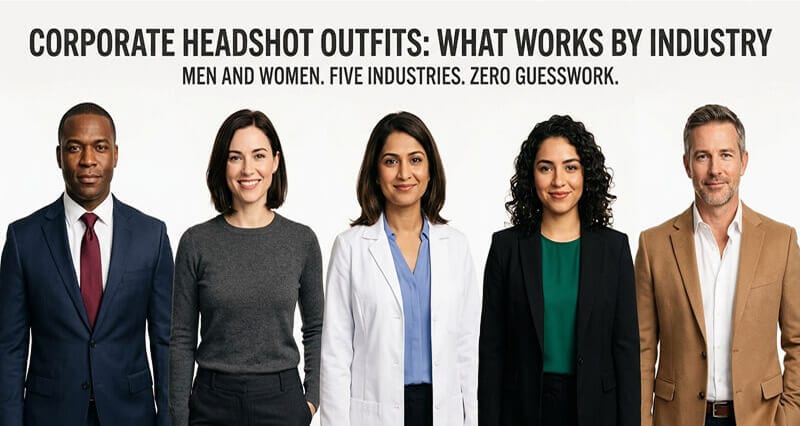
Your headshot shows 3 inches of clothing. Here's how to make those 3 inches tell the right story for your specific industry.
A marketing director changed her LinkedIn headshot last year. Same photographer. Same studio. Same lighting. Same expression.
The only difference? Her outfit.
In the old photo, she wore a bright coral top with a statement necklace. In the new one, she wore a navy V-neck blouse under a charcoal blazer.
Her connection requests increased by 40% in the first month.
She told me she was sure it was the expression. I pulled up both photos. The expressions were nearly identical. The outfit changed the story the photo was telling.
That coral top said "I'm fun and creative." The navy blazer said "I make decisions and you can trust me." Both are fine messages. But she works in B2B enterprise sales. Her prospects needed the second message.
Your headshot outfit isn't about looking good. It's about looking right. Right for your industry. Right for your audience. Right for the story you need your photo to tell in the 100 milliseconds someone spends forming a first impression.
Here's what works, organized by the context that actually matters.
The Universal Rules (Before We Get Industry-Specific)
These apply to everyone, regardless of gender or industry.
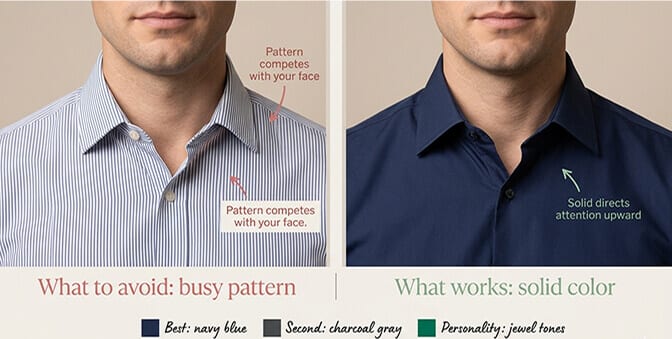
Solid colors photograph better than patterns. Thin stripes create a visual distortion called moire on digital cameras. Busy patterns compete with your face for the viewer's attention. In a tight head-and-shoulders crop, even a subtle plaid becomes loud. Stick to solids.
Fit matters more than price. A $40 shirt that fits perfectly will outperform a $400 jacket with drooping shoulders. In a headshot crop, the camera amplifies every gap, pull, and wrinkle. Check your outfit in a mirror at head-and-shoulders level. If anything bunches, gaps, or sags in that frame, choose something else.
Navy blue is the single best color for headshots. This isn't opinion. The IJERT color-trust study tested 32 subjects across 30 color variations and found blue-purple tones received the highest trust ratings of any color range. Navy reads as competent, reliable, and professional across every industry.
Charcoal gray is the safest second choice. Versatile, professional, and creates clean contrast against most backgrounds.
Jewel tones add personality. Emerald, burgundy, teal, and plum photograph beautifully and create strong visual separation, especially on deeper skin tones.
The outfit formula: Fit + Color + Neckline = a headshot that works. Get those three right and the rest is details.
What to avoid universally: Pure white as your main visible layer (it reflects light and can wash you out), neon or very bright colors (they cast color onto your skin), logos and branded clothing (they distract and date the photo), and anything you've never worn before (discomfort shows in your expression).
Finance and Law
Still the most formal industries for headshots. The standard hasn't moved much, just gotten slightly softer.
Men: Dark suit (navy or charcoal) with a pressed white or light blue dress shirt. Tie is industry-dependent: required at most large law firms and investment banks, optional at boutique firms and fintech. If wearing a tie, keep it conservative: classic stripes, small dots, or solid in a complementary tone. Make sure the knot is tight and centered.
Women: Structured blazer or tailored jacket over a solid-colored blouse. V-neck or scoop-neck underneath creates a flattering frame. Dark neutrals (navy, charcoal, black) with a light-colored blouse underneath provides the contrast that photographs well. A warm accessory (burgundy earrings, copper scarf) can soften a very formal look without undermining authority.
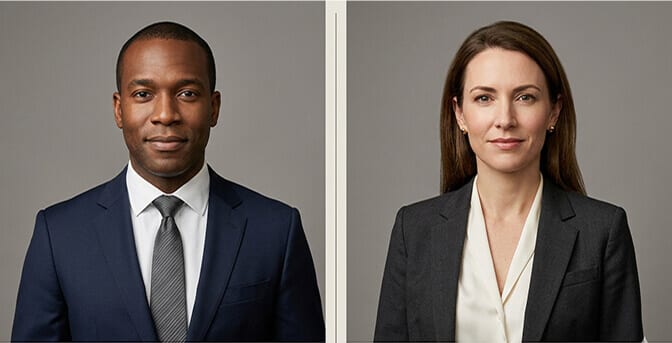
Colors to reach for: Navy, charcoal, black with white or light blue accents.
Colors to avoid: Bright colors, pastels, anything that reads as "casual Friday."
Technology and Startups
The biggest shift from traditional corporate headshot norms. Full suits look out of place at most tech companies below the executive level. The current standard is polished business casual: intentional but not stiff.
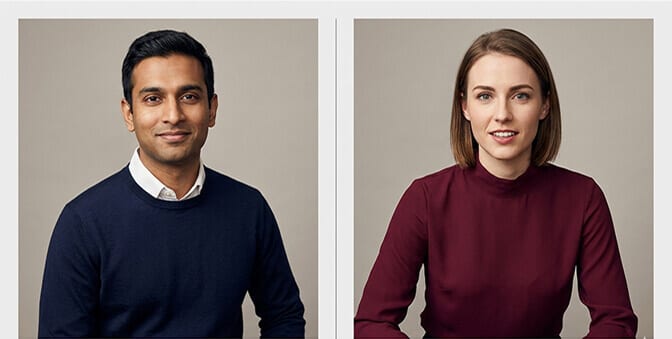
Men: Fitted crewneck sweater in navy, charcoal, or slate is the default. It's clean, modern, and says "I build things" without trying too hard. Collared button-down (with or without a blazer) is the next tier up. Optional blazer for leadership roles. Skip the tie entirely unless you're C-suite at a publicly traded tech company.
Women: Quality blouse in a jewel tone or neutral. Fitted cardigan or modern blazer if you want structure. Turtlenecks and mock-necks work well in tech and photograph cleanly. The bar is "polished but not corporate." Think of what you'd wear to a board meeting at a company where nobody wears suits to board meetings.
Colors to reach for: Navy, slate, olive, burgundy, charcoal. Muted earth tones work well here.
Colors to avoid: Anything that looks "finance." A full black suit with a white shirt at a tech startup signals "I don't understand this culture."
For more non-blazer options that work in tech and creative contexts, our guide to fun headshot ideas covers creative alternatives.
Healthcare
The white coat is the most powerful wardrobe element in any headshot. It's the universal visual signal of medical authority and it does the heavy lifting for you.
Men: White lab coat over a dark dress shirt (navy, charcoal, or deep blue). No tie needed for most specialties. Surgeons and ER physicians can wear clean, well-fitted scrubs. Psychiatrists and therapists often skip the white coat for a business-casual blazer that feels more approachable.
Women: White lab coat over a soft blouse in blue, green, or muted earth tones. Avoid bright colors or busy patterns under the coat because they compete with the white. Simple jewelry. Clean neckline visible above the coat's lapels. Non-clinical roles (administration, HR) should dress as their peer group does.
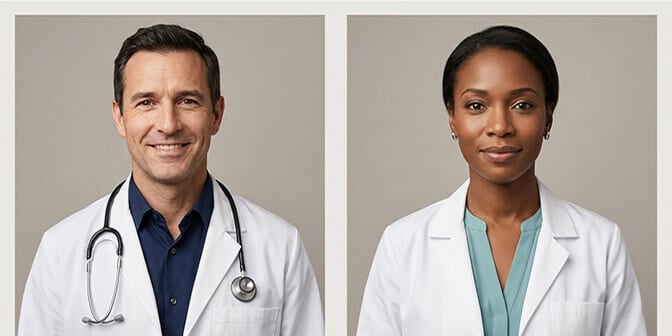
The white coat rule: If your peers wear it, wear it. If you're a pediatrician and your practice page shows everyone in lab coats, match the standard. Our guide to medical headshots for female professionals covers healthcare-specific wardrobe in more detail.
Colors to reach for (under the coat): Soft blues, greens, earth tones.
Colors to avoid: Anything that fights the white coat for attention. Bright red, neon yellow, and loud patterns create visual competition.
Real Estate
Real estate headshots are uniquely personal because agents ARE the brand. Warmth and approachability matter more here than in most industries, but the standard is still clearly professional.
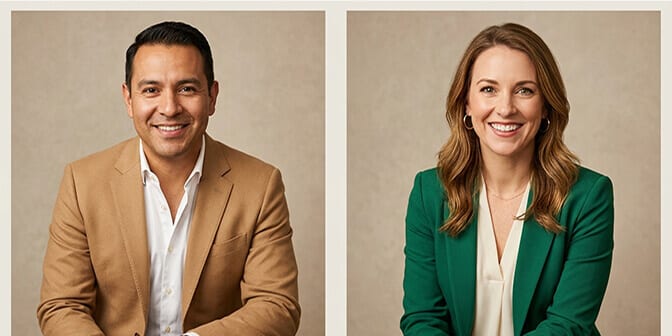
Men: Blazer over an open-collar button-down. The top button undone signals approachability without sacrificing professionalism. Navy, charcoal, or a warm-toned blazer (camel or tan) all work. The level of formality should match your target market: luxury market agents lean more formal; first-time buyer agents lean warmer.
Women: Fitted blazer or structured blouse in a jewel tone or warm neutral. V-neckline photographs particularly well here. Statement accessories (a quality watch, simple earrings) add personality. The goal is "I'd trust this person with the biggest purchase of my life" combined with "I'd actually enjoy working with this person."
Colors to reach for: Navy, burgundy, emerald, warm neutrals. Colors that are rich and inviting rather than stark and corporate.
Colors to avoid: Anything too casual (denim, t-shirts) or too stark (all black).
Creative Industries
Design, marketing, media, and the arts give you the most freedom, and the most rope. Personality is expected in your headshot. But "creative" doesn't mean "anything goes."
Men: Bold colors and interesting textures signal creative confidence. Mustard, deep red, olive, and burgundy all photograph beautifully. A well-fitted turtleneck or textured knit says "creative director." A leather jacket says "I don't follow rules" (which can be exactly right for certain roles). Just avoid the camera killers: neons and tight patterns still cause technical problems.
Women: This is where statement pieces, bold necklines, and expressive color choices genuinely help. Rich saturated colors (emerald, sapphire, burnt orange) work beautifully. Textured fabrics add visual interest in the crop. The key is intentionality: your outfit should look like a deliberate style choice, not like you grabbed whatever was closest.
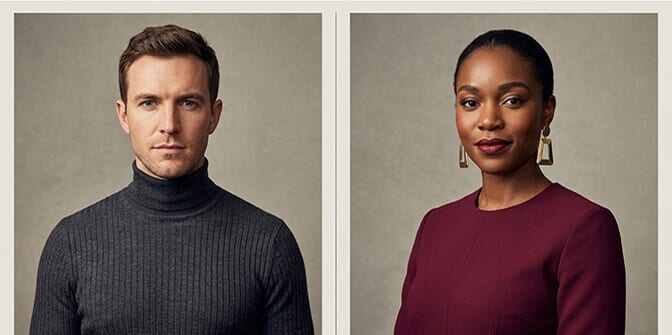
Colors to reach for: Anything bold and saturated. Jewel tones, warm earth tones, rich neutrals.
Colors to avoid: Standard corporate dark suits (you'll look like you're attending the wrong meeting).
The Neckline Guide (Nobody Talks About This)
This is where most people get it wrong.
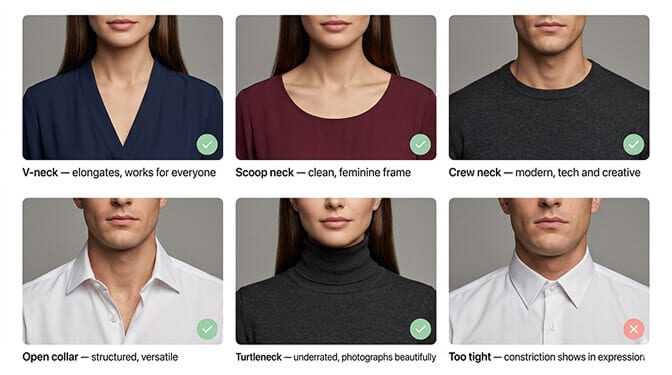
In a headshot crop, your neckline is the frame around your face. The wrong neckline can shorten your neck, add visual weight, or direct attention away from your eyes.
V-necks elongate the neck and create a slimming frame. They work for virtually everyone and photograph well across genders and industries. If in doubt, V-neck is the answer.
Scoop necks and boat necks frame the face cleanly and work well for women in most professional contexts.
Crew necks (sweaters, quality t-shirts) work well in tech and creative industries. They create a clean horizontal line below the face.
Collared shirts (open or buttoned) add structure and formality. They're the default for men in traditional industries and work equally well for women.
Turtlenecks and mock-necks are underrated. They create a smooth, unbroken line from shoulders to chin and photograph beautifully. Particularly good in darker colors against lighter backgrounds.
What to avoid: Very low necklines expose too much skin in the crop area, pulling attention downward away from your eyes. Very high, tight necklines (a buttoned-up shirt with a tight collar) can look constricting and uncomfortable, and that tension shows in your expression.
Outfit chosen? At Headshot Photo, you can upload casual selfies in your selected outfit and get studio-quality headshots with professional lighting and clean backgrounds in about 1 hour. No studio visit, no appointment. The AI preserves exactly what you're wearing while optimizing everything else.
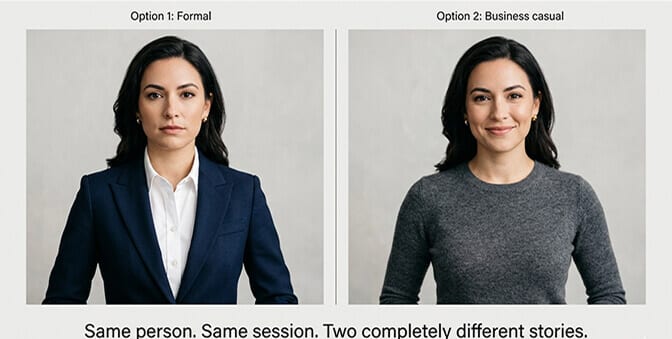
The "Bring Two Options" Rule
Bring at least two outfit options to any headshot session, or upload photos in multiple outfits if using AI.
Option 1: Your formal choice (blazer, structured top, suit jacket).
Option 2: Your business-casual choice (sweater, open-collar button-down, fitted knit top).
This gives you flexibility. What looks great in your closet mirror might not work on camera. What you think is "too casual" might actually be the more authentic, approachable version. Having options eliminates the stress of committing to one outfit before seeing it through the lens.
For guidance on hairstyles that complement these outfits, our guide to headshot hairstyles for women covers what works by hair length and industry.
One Last Thing
That marketing director whose connection requests jumped 40%? I asked her if she felt like herself in the navy blazer photo.
"More than in the coral top, honestly," she said. "The coral was what I wanted to wear. The navy was what my clients needed to see."
That's the distinction. Your headshot outfit isn't about personal expression. It's about strategic communication. You're telling your audience, in the 3 inches of fabric visible in the frame, that you belong in their world.
Dress for the meeting you want to be in. Then let the headshot do the rest.
At Headshot Photo, you can try multiple outfit looks and get studio-quality results from each in minutes. Upload selfies in your blazer, your sweater, your lab coat. Compare the output. Pick the one that tells your story. No photographer required.
For the complete headshot preparation guide beyond just clothing, our corporate headshot checklist covers expression, background, and lighting alongside outfit guidance.
Frequently Asked Questions
What are the best corporate headshot outfits for women?
The best corporate headshot outfits for women depend on industry. In finance and law, a structured blazer over a solid-colored blouse in navy, charcoal, or ivory works best. In tech, a quality blouse or fitted sweater in a muted tone is the standard. In creative industries, bold colors and statement pieces are welcome. Universally, V-necklines photograph well, solid colors outperform patterns, and long sleeves create the cleanest frame.
How do corporate headshot outfits for men compare across industries?
In finance and law, men should wear a dark suit (navy or charcoal) with a pressed white or light blue shirt and conservative tie. In tech, a fitted crewneck sweater or collared button-down replaces the suit. In healthcare, a lab coat or clean scrubs is standard. In creative industries, textured knits, turtlenecks, and bold colors show personality. The constant: solid colors, impeccable fit, and navy or charcoal as the safest base.
How do I choose the right headshot outfit color for my skin tone?
Test warm versus cool tones against your face in natural light. If cream and earth tones look natural on you, choose warm options like burgundy, olive, or rust. If white and silver look cleaner, go with cool tones like navy, plum, or slate. Generally, mid-tone and jewel-tone solids photograph best across all skin tones. Navy blue is universally flattering and the single highest-rated color for trust and competence in professional photography.
Is it worth buying new clothes specifically for a corporate headshot?
Not usually. Your headshot should look like you on your best professional day, not like a costume. If you own well-fitted solid-colored pieces that match your industry standard, those will work perfectly. If everything you own is patterned, wrinkled, or ill-fitting in the head-and-shoulders crop, investing $50-$100 in a quality solid-colored top or blazer is worthwhile since you'll use it professionally beyond just the headshot.
Can AI headshot generators work with any outfit I'm wearing?
Yes. AI headshot generators like Headshot Photo preserve the outfit you're wearing in your uploaded reference photos while optimizing lighting, background, and skin rendering. Upload selfies in your chosen professional outfit and the AI generates studio-quality headshots featuring that exact clothing. This means you can try multiple outfits and see the results without scheduling separate sessions for each look.