
Some fields are quietly torching their first impressions. If you work in one of them, this is your wake-up call (and your fix).
We see the "before" photos every day. People send us what they're currently using on LinkedIn so we know what to fix.
And after enough of them, a pattern shows up that has almost nothing to do with the person. It has to do with their industry.
A marketer sends a clean, well-lit shot and asks us to "just tweak it." A brilliant civil engineer sends a cropped wedding photo with a stranger's shoulder still in frame. Same ambition. Wildly different starting point.
Here's the weird part. The gap between the best and worst industries on LinkedIn is not about vanity or budget. It's about culture. Some fields treat your face as a business asset. Others treat it as an afterthought. Let me show you who's losing, why, and how to climb out of the bottom.
The industries quietly losing the photo game
Analyses that have graded thousands of real LinkedIn profile photos keep landing on the same losers. Education, government, and retail consistently score at the bottom for photo quality and polish.
The no-photo problem is even starker. In one study, roughly 36% of healthcare professionals and 32% of government employees had no profile photo at all. Not a bad photo. No face. On a platform where a missing photo reads as a spam account, that's a self-inflicted wound.
A missing photo doesn't say "private." It says "incomplete." And people scroll right past incomplete.
Government and retail workers were also the most likely to commit the classic sins: the selfie, the cropped group shot, the obvious do-it-yourself job, at rates near one in four.
This is where most people get it wrong. They assume "my industry doesn't care about LinkedIn photos." But the people viewing your profile (recruiters, clients, partners) care exactly the same amount no matter what field you're in. The 100 millisecond judgment doesn't check your job title first.
Who's winning (and what they know that you don't)
The top of the table is boringly predictable. Marketing, advertising, and PR win, usually by a wide margin. Real estate is right behind, often the single highest-graded field. HR and recruiting round out the top.
Notice the through-line? Every one of those is a client-facing, brand-obsessed industry where your face literally is the product. Law and management tend to score well too, for the same reason: outward impressions are part of the job.
Here's a quieter finding that stuck with me. The longer someone stays at the same employer, the worse their photo tends to get. People get comfortable, stop updating, and let a decade-old shot ride. Meanwhile the better-connected someone is, the better their photo, probably because a big network usually comes with access to decent photography.
So the real dividing line isn't creative versus technical. It's does your world reward keeping your face current, or let you forget about it. If you're in a field that lets you forget, that's not protection. That's a blind spot. We went deeper on how these snap judgments quietly shape outcomes in our piece on how photos affect hiring decisions.
Why the "safe" industries produce the worst photos
Government has real constraints. Strict rules about what can be posted publicly push people toward posting nothing, and nothing loses.
Retail skews younger and earlier-career, so the personal-branding habit hasn't formed yet. The selfie feels normal because everything else in their life is a selfie.
Education and healthcare are mission-driven cultures where "how I look online" feels self-indulgent next to the actual work. Understandable. Also costly, because a professor applying for a grant or a nurse moving into leadership gets judged by the same 100 millisecond reflex as everyone else.
But then something clicks for people once they see it. The photo isn't ego. It's the handshake you're not in the room to give.
Okay, you're in a bottom-tier industry. Here's the toolkit to fix it.
You don't need your whole field to change. You just need your photo to stop dragging you down. Here's the stack, ranked by where to start.
1. Tonfotos (find your best raw material first)
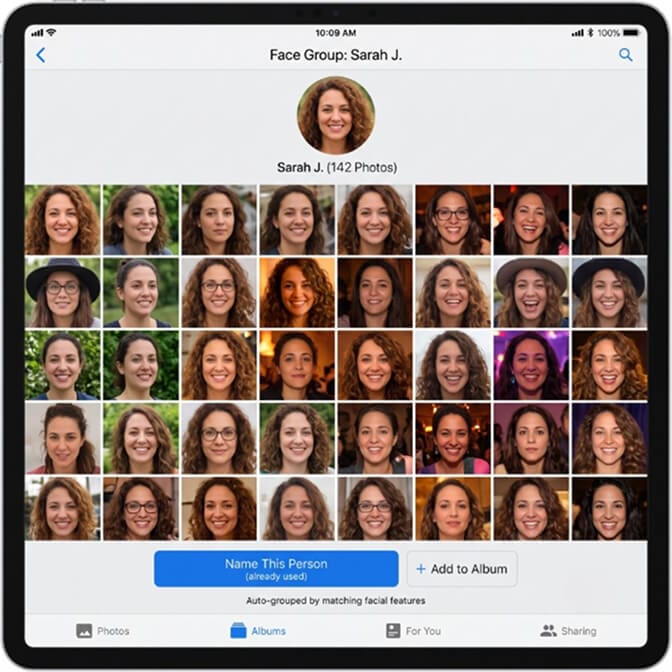
Before you spend a dollar, find out what you already have. Most people own a usable photo of themselves and have no idea where it is. This is where Tonfotos comes in at number one.
General information. Tonfotos is a photo and video archive manager for Windows, Mac, and Linux. Its AI face recognition automatically pulls every photo of one specific person out of your entire messy library, so you can see every shot of you in a single view and shortlist the two or three with real potential. It also kills duplicates and sorts everything by date and location, all stored locally instead of behind a monthly cloud fee.
Pros. Surfaces candidates you forgot existed. Perpetual license, no subscription (free tier, then $59 personal, $159 family). Your archive stays on your own machine.
Cons. It organizes and finds, it does not shoot or retouch. If none of your existing photos are good enough, it can only tell you that faster.
2. Headshot Photo (create a professional shot when your camera roll fails you)
For a lot of people in these industries, the honest answer is nothing in the archive works. You've never had a real headshot taken. That's the exact gap we built for.
General information. Headshot Photo turns a handful of ordinary selfies into studio-grade professional headshots in about 10 minutes, with control over background, wardrobe, and lighting. No scheduling, no studio, no half-day off work.
Pros. Fast and far cheaper than a photographer, and it gives you a range of looks to pick from. If you're worried about whether that's allowed, our take on whether AI headshots are acceptable on LinkedIn covers the honest answer.
Cons. You still need to feed it clear, recent selfies. It amplifies what you give it.
3. The natural-light do-it-yourself shot
No budget at all? Stand facing a window, phone at eye level, plain wall behind you, and have someone take twenty frames. It beats every selfie and every cropped group photo instantly. Our step-by-step on how to take a good LinkedIn photo walks the whole setup.
Pros. Free, and window light is genuinely flattering. Cons. Fiddly, and results swing on your patience and your helper's steady hand.
4. Your network as a sanity check
Send your top two options to three or four blunt people and ask which one they'd hire. Pros. Free, and it catches problems you're blind to. Cons. Small sample, and polite friends lie. Ask for the harsh version.
If you'd rather skip the archaeology and just have a professional shot in hand today, you can see Headshot Photo pricing and generate a full set this afternoon.
What actually separates a good headshot from a bad one
Whatever industry you're in, the fundamentals don't change.
Attire. Slightly more formal reads as more competent. A blazer or a crisp collar carries weight in a tiny circle.
Expression. A genuine smile with a little teeth consistently tests best. The dead-serious stare that "feels professional" usually reads as cold.
Framing and background. Face filling most of the frame, plain and uncluttered behind you. Busy backgrounds compete with the only thing that matters, which is your face.
Boring and clear beats clever and cluttered, every single time. Your photo gets seen far more than it gets studied.
Here's the takeaway I actually care about. Being in a "low-scoring" industry is not a life sentence. It's an opening. When everyone around you is using a cropped selfie from 2015, one clean, current headshot makes you look like the most serious person in the room before you say a word. The bar is on the floor. Step over it.
Ready to stop being a bottom-tier statistic? Upload a few selfies to Headshot Photo, generate professional options in about 10 minutes, and put a photo up that finally matches how good you are at your job. Your industry's low standards are your easiest advantage.
Frequently Asked Questions
Which industries have the worst LinkedIn photos?
Analyses of thousands of LinkedIn profiles consistently put education, government, and retail at the bottom for photo quality and polish. Healthcare and government also have the highest rates of no photo at all, with roughly a third of professionals in each showing no face. The pattern tracks with how much a field rewards personal branding, not how skilled the people are.
How do the best and worst industries compare on LinkedIn photos?
The top fields are client-facing and brand-driven: marketing and PR, real estate, and HR and recruiting lead, with law and management close behind. The bottom fields tend to have strict posting rules, younger or earlier-career workforces, or mission-first cultures that treat photos as an afterthought. Same platform, very different habits.
How do I fix a bad LinkedIn headshot fast?
First, search your own photo library for any decent existing shot, then either clean it up or replace it. If nothing works, a natural-light photo against a plain wall or an AI headshot from a few selfies gets you a professional result in minutes. The goal is a clear, current, head-and-shoulders shot with a real smile.
Is a professional headshot worth it if my industry doesn't care about LinkedIn?
Yes, and arguably more so. The people viewing your profile (recruiters, clients, partners) judge your photo the same way regardless of your field, so a strong shot stands out even further when your peers are using selfies. In a low-standard industry, one polished photo is an easy, visible edge.
Are AI headshots good enough to compete in these industries?
For most professionals, yes, as long as the result still looks like you and skips the over-smoothed plastic finish. The aim is a photo that matches you on a video call, not a flawless stranger. Feed the tool clean, recent selfies and choose the natural-looking outputs.