
Headshot Poses for Women: 12 Flattering Angles (With Examples)
The posing secrets photographers use on every shoot, explained so you can actually use them.
I once watched a brilliant woman, a VP of operations, almost cry over a headshot.
Not because the lighting was bad. Not because her outfit was wrong. But because she stood dead square to the camera, shoulders rigid, chin tucked into her neck, and the result made her look like a hostage in a passport photo.
She thought the problem was her face.
It wasn't. It was her angle.
Here's the thing nobody tells you: the most photogenic people aren't blessed with better faces. They just know where to put their shoulders. Posing is a skill, not a gift. And once you understand the handful of rules below, you can repeat them forever.
So let's go through the 12 angles that actually work, why they work, and how to pull each one off, even if you've spent your whole life hating photos of yourself.
First, the one rule that changes everything
Before any specific pose, understand this: squaring straight at the camera is what makes people look stiff and wider than they are.
A slight turn does the opposite. When you angle your body roughly 10 to 45 degrees away from the lens and let one shoulder lead, you create depth. Your frame narrows. Your posture reads as relaxed instead of braced.
Almost every flattering headshot starts with a body that is turned, not squared.
Keep that in your back pocket. Most of the poses below are just variations on it.
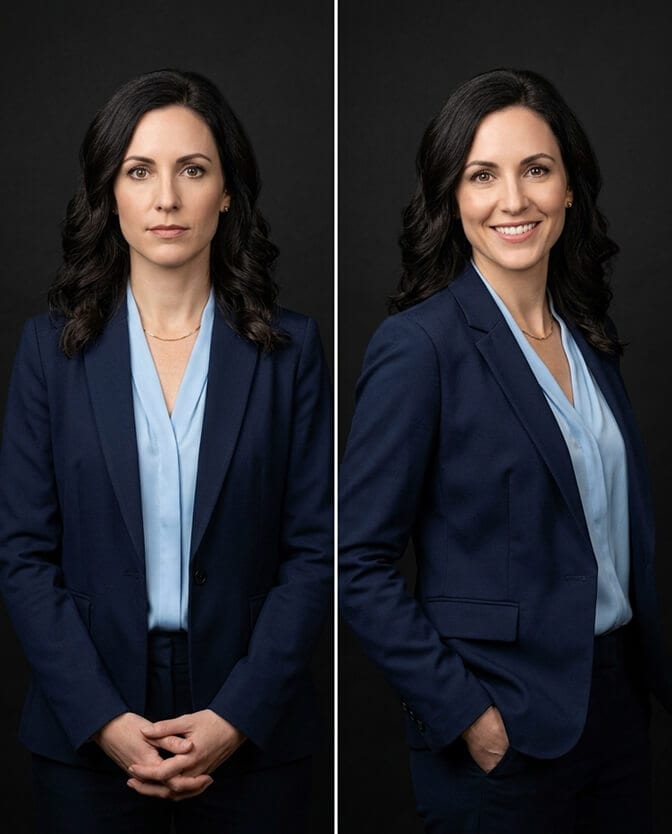
1. The classic three-quarter turn
This is the workhorse. Turn your body about 45 degrees away from the camera, then bring your face back toward the lens.
Your torso points one way, your eyes another. That small twist is what makes the shot feel alive instead of posed.
If you only learn one pose, learn this one.
2. The straight-on power look
Yes, I just told you squaring off can look stiff. But done with intention, a direct front-facing pose reads as authority.
The trick is the rest of the body. Relax the shoulders down and back. Lean in slightly from the waist. A straight-on shot with engaged posture says "I'm in charge." A straight-on shot with collapsed posture says "please let me leave."
3. The shoulder lead
Drop one shoulder slightly toward the camera and let it become the closest point to the lens.
This single move slims the upper body and adds a natural diagonal line through the frame. It's subtle. It's also the difference between a snapshot and a headshot.
4. The chin forward and down
This one feels deeply unnatural and looks fantastic.
Push your forehead slightly toward the camera and bring your chin a touch forward and down. It sounds like a recipe for a double chin. It's actually the opposite. Extending the neck this way defines your jawline and removes the soft area under the chin.
Practice it in a mirror first. It feels wrong. Trust it anyway.

5. The slight camera-above angle
Where the camera sits matters as much as where you stand.
A lens positioned just slightly above your eye line is universally flattering. It opens the eyes, slims the jaw, and softens everything below. Shooting from below does the reverse, so keep the camera at or just above eye level.
6. The relaxed seated lean
Sitting changes the whole energy of a shot. Lean forward from the hips, forearms resting, weight slightly into the camera.
Leaning in signals interest and confidence. Leaning back signals the opposite. This pose works beautifully for warmer, approachable branding, the kind coaches and consultants want.
7. The good-side turn
Most faces are not symmetrical, and almost everyone has a side they prefer.
Spend two minutes in a mirror. Turn slowly. One side will feel more "you" than the other. Orient that side toward the camera and you'll instantly like more of your shots. This is the cheapest posing upgrade there is.
8. The soft over-the-shoulder
Turn your body almost fully away, then look back over your near shoulder toward the lens.
It creates a candid, glance-caught-in-motion feel. Done well it's elegant and modern. Done too far it tips into glamour-shot territory, so keep the turn gentle.
The goal is "she just turned to say something," not "she's posing for a perfume ad."
9. The hand near the face (used carefully)
A hand can add warmth and humanity, but it's the easiest pose to overdo.
Rest fingers lightly along the jaw or near the chin. Never press, never cup, never make a fist under the cheek. The hand should look like it landed there for half a second, not like it's holding your head up.

10. The open posture
Cross your arms and you build a wall. Open your posture and you build a bridge.
Keep arms uncrossed, shoulders open, chest relaxed. Closed body language reads as defensive even when you're smiling. This is less a "pose" and more a setting you leave on the whole time.
11. The genuine micro-laugh
Forget "say cheese." The most magnetic expressions come a half-second after a real laugh.
Think of something that actually amuses you. Let the laugh start, then let it settle into a soft smile as the shutter clicks. A real expression beats a perfect angle every time. The eyes give it away when it's fake.
12. The neckline-aware frame
Your wardrobe shapes the pose more than you'd think.
A V-neck or scoop neckline draws the eye upward to your face and lengthens the neck. A high, tight collar can make you look boxed in. Choose the neckline first, then pose into it. The two work together or they fight each other.
If you've read this far, you've probably realized something uncomfortable: getting all 12 of these right in a single sitting is genuinely hard. Photographers spend years learning to coach people into them. You get maybe one nervous afternoon.
That's the gap a lot of women fall into. You know the theory now, but the studio clock is ticking and your shoulders forget everything.
This is where the modern path gets interesting. Instead of nailing every angle live, you can feed a handful of normal selfies into Headshot Photo and get back a full set of professionally posed, studio-lit shots, with the three-quarter turns and chin-forward angles already applied for you. If you want to see how the styles and pricing work, take a look at Headshot Photo pricing before your next big profile update.
It's not about replacing the knowledge above. It's about not needing perfect nerves to use it.
The part nobody tells you about "flattering"
Here's where most posing guides quietly mislead you.
They imply there's one universally perfect angle. There isn't. Flattering means flattering for your face, your shoulders, your story. A 25-year-old founder and a 55-year-old attorney do not pose the same way, and they shouldn't.
If you want angle-specific help for softening the area under the chin, our breakdown of headshot angles for a double chin goes deeper than I can here. And if you're building a profile that needs to read as senior and credible, the guide to LinkedIn headshots for women pairs perfectly with these poses.
The poses are the grammar. Your face is the sentence. You still get to decide what it says.

A quick word on confidence
Every photographer will tell you the same secret. The best pose in the world collapses if your eyes look scared.
Confidence isn't a facial expression. It's posture, breath, and the half-second before the shutter. Drop your shoulders. Exhale. Think of one person you trust. The eyes soften, and suddenly the angle does its job.
If that part is your real struggle, we wrote a whole piece on how to look confident in photos that's worth ten minutes of your time.
Because here's the truth I keep coming back to: the camera was never the enemy. The angle was just untrained.
Get your professional headshot without the nervous afternoon
You now know more about posing than most people who walk into a studio. If you want even more ideas, including environmental and seated shots, see our full guide to professional headshot poses.
But if you'd rather skip the awkward shoot, the scheduling, and the hope-it-works-out gamble, you can upload a few selfies and let Headshot Photo generate a full set of polished, properly posed headshots in a few hours. The angles in this article, applied for you, without booking a shoot.
Get your professional headshot with Headshot Photo and see what your good side actually looks like.
Frequently Asked Questions
What are the most flattering headshot poses for women?
The most flattering headshot poses for women start with a slight body turn of 10 to 45 degrees rather than facing the camera straight on. Add a leading shoulder, a chin pushed slightly forward and down to define the jawline, and a camera angle at or just above eye level. These small adjustments do more than any single "perfect" pose.
How is posing for a professional headshot different from posing for a regular photo?
A regular photo forgives almost anything because the focus is on the moment, not your face. A professional headshot is the opposite. Every angle, from your shoulder line to your chin position, is read closely, so deliberate posing and a turned body matter far more than they would in a casual snapshot.
How do I pose for a headshot if I hate having my photo taken?
Start with two things you can control: turn your body slightly away from the camera and exhale right before the shot. Then think of something that genuinely makes you laugh so your expression lands naturally instead of frozen. Most people who "hate" photos were simply squaring off and holding their breath.
How much does it cost to get professionally posed headshots?
A traditional studio session can run anywhere from a couple hundred dollars upward, plus scheduling and travel. AI options like Headshot Photo apply professional posing automatically from your selfies for a fraction of that. You can see current options on the Headshot Photo pricing page.
Are AI headshots good enough to look professionally posed?
Yes, when the tool is trained on real professional photography. Quality AI headshots apply the same angles a photographer would coach you into, including three-quarter turns, defined jawlines, and flattering camera height. The results read as genuine studio work, not as an obvious filter, which is exactly what a credible profile needs.