
Your double chin is a camera problem, not a body problem. Here's exactly how to fix it before, during, or completely after the shoot.
Let me tell you about the email that changed how we think about headshots.
It came from a woman named Rachel. She was a VP at a consulting firm. Smart, successful, confident in every meeting she walked into.
But she'd been avoiding updating her LinkedIn headshot for three years.
"I know I need a new one," she wrote. "But every time I sit for a photo, all I see is my double chin. I've deleted more headshots than I've kept. I'm embarrassed to even book a photographer because I know I'll hate the results."
Rachel didn't have a confidence problem. She had a camera angle problem.
And she's far from alone. The number one insecurity people mention before headshot sessions isn't wrinkles, weight, or bad skin. It's the double chin. By a mile.
Here's what nobody told Rachel, and what I wish someone had told her years ago:
The double chin you see in photos almost never matches what people see when they look at you in real life. It's a distortion created by camera position, lens compression, and posture. Most people who hate their chin in photos don't even have a noticeable double chin in person.
This isn't feel-good fluff. It's physics. And once you understand the physics, you can fix it in about two seconds.
Why Cameras Create Double Chins That Don't Exist in Real Life
Here's the science, kept simple.
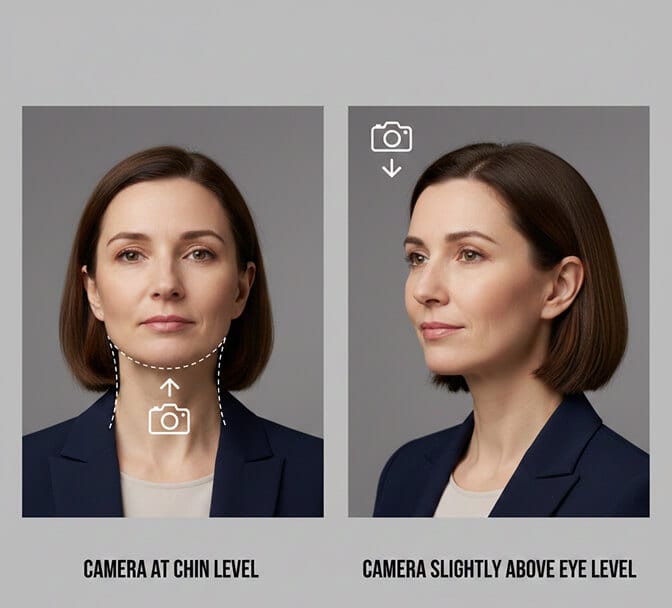
When a camera is positioned at or below your chin level, it captures the underside of your jaw. Any natural softness between your chin and neck gets compressed into a flat plane. The camera sees width that your eyes, looking at you from a natural conversational angle, would never notice.
This is why selfies taken with a phone held at chest level produce horrific double chins on people who don't have one. The camera is literally shooting upward into the least flattering angle of your face.
Add in the fact that most people instinctively pull their chin back when a camera appears (a natural "bracing" reaction), and you've got the perfect double chin storm. Chin back + camera low = maximum visibility of the area you're most self-conscious about.
The double chin in your photos is a combination of camera angle and unconscious chin positioning. Fix either one and it mostly disappears. Fix both and it's gone.
Understanding this changes everything. Because it means you're not fighting your body. You're fighting physics. And physics has predictable, repeatable solutions.
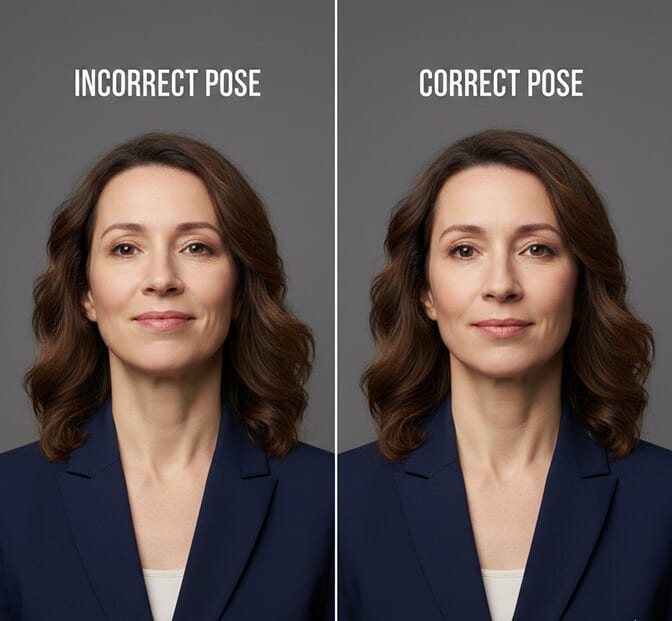
Trick #1: The Turtle (Push Your Forehead Forward)
This is the single most effective technique for minimizing a double chin in any headshot. Every professional headshot photographer uses it. And once you learn it, you'll use it in every photo for the rest of your life.
Imagine you're a turtle gently extending your head from your shell. Push your forehead slightly toward the camera while keeping your chin level or tilted very slightly downward.
What happens? The skin along your jawline stretches taut. Your jaw sharpens. The soft area under your chin pulls tight. The double chin virtually disappears.
The key is subtlety. Push forward about an inch. Maybe two. Any more and you'll look strained. The adjustment should be invisible to anyone standing next to you but dramatically visible in the final photo.
Common mistake: People tilt their chin UP to try to stretch their neck. This backfires completely. Now the camera shoots up into your nostrils, and the double chin is still there because you stretched upward, not forward. Keep the chin level. Push forward, not up.
Photographer Peter Hurley popularized calling this "the turtle," and it's become the industry standard for flattering headshot poses. Practice it in your phone's front camera right now. The difference will shock you.
Trick #2: Camera Slightly Above Eye Level
This is the angle trick that changes everything.
When the camera is below your eye line, it shoots upward. This is the worst possible angle for a double chin because it captures the entire underside of your jaw.
When the camera is at or slightly above your eye level, the downward angle compresses the chin area and hides everything underneath your jawline. Your face looks slimmer. Your jaw looks more defined. And the double chin becomes nearly invisible.
You don't need much elevation. Having the photographer raise the camera a few inches above your natural eye line is enough. Going too high creates that distorted "selfie from above" look where your forehead dominates.
If you're doing a DIY headshot: Set your phone or camera on a tripod at forehead height, not chin height. This one adjustment eliminates most double chin concerns on its own.
If you're working with a photographer: Simply ask, "Can you shoot from slightly above my eye level?" Any professional will understand exactly why you're asking and will be happy to adjust. You don't need to explain your insecurity. It's a standard technique.
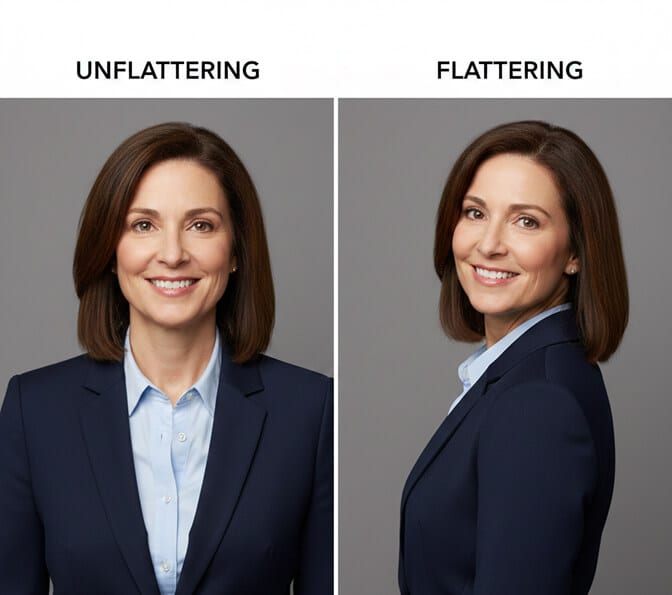
Trick #3: The 45-Degree Body Turn
Here's something most double chin advice articles miss entirely.
Your body angle affects how your chin photographs. When you stand square to the camera, your chin is presented at its widest. When you turn your body about 45 degrees and rotate your head back to face the lens, several things happen simultaneously.
Your neck elongates because of the twist. Your jawline presents at a more angular, defined position. And the area under your chin falls into a natural shadow created by the angle change.
The combination of a body turn + the turtle + a slightly elevated camera is what separates truly flattering headshots from mediocre ones. Any single technique helps. All three together make double chins essentially invisible.
For more on the body angle technique and how it creates slimming poses for headshots, we've got a dedicated guide.
Trick #4: Strategic Lighting (The Shadow Solution)
Light creates shadows. Shadows hide things. This is your friend.
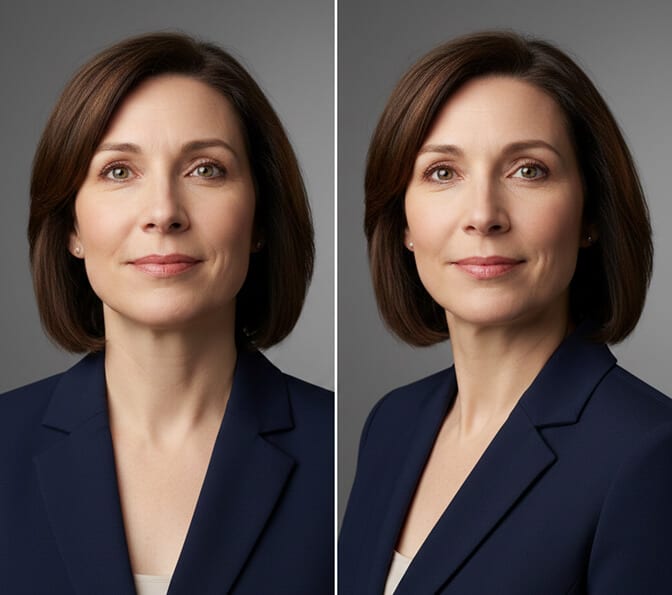
When the primary light source is positioned slightly above and in front of you, it casts a natural shadow under your chin and along the underside of your jaw. This shadow conceals the double chin area far more effectively than any posing technique alone.
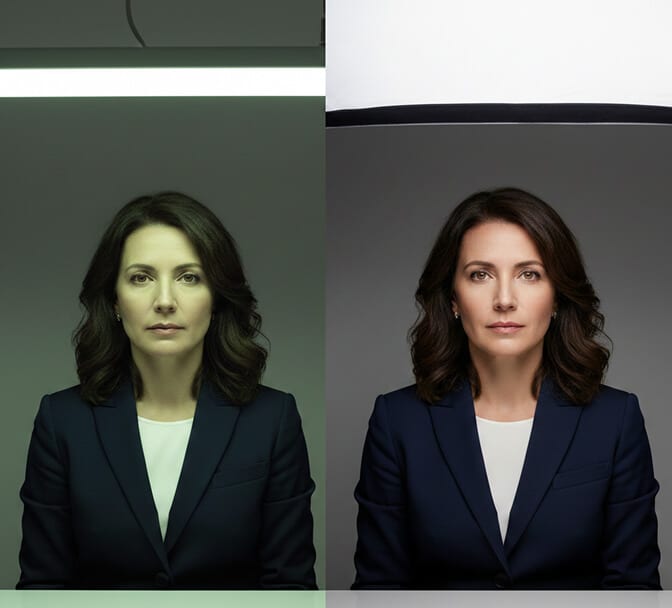
The opposite is also true. Light from below (like overhead fluorescent lights reflecting off a desk, or a flash mounted low on a camera) fills in those shadows and makes the double chin MORE visible.
This is why conference room headshots are the worst. Overhead fluorescents bounce off tables and light your face from below. It's the most unflattering lighting setup possible for anyone with chin concerns.
If you're shooting at home, face a window with the light coming from slightly above your eye level. This creates the natural top-down shadow pattern that photographers spend thousands of dollars to replicate in studios.
For more on how light affects your face in headshots, our guide to headshot lighting covers the full breakdown.
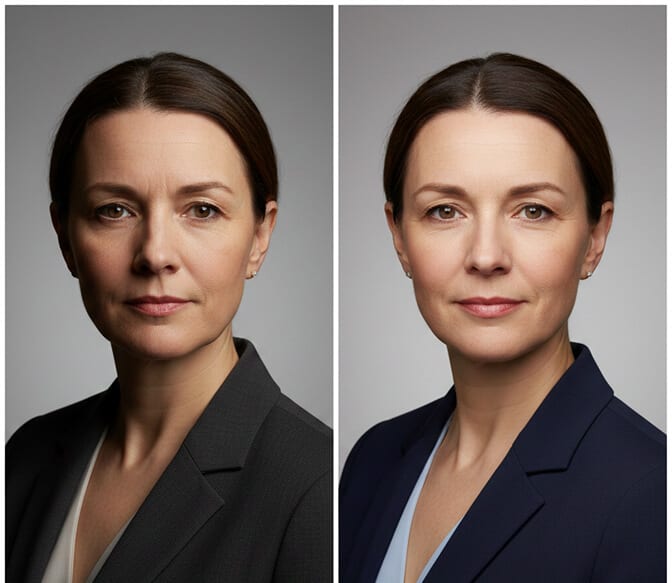
Trick #5: What You Wear Matters
This one surprises people, but clothing actually affects how your double chin photographs.
Light-colored shirts and blouses reflect light upward into the chin area. This bounced light fills in the shadows that were helping to conceal your double chin. It's the photographic equivalent of shining a flashlight under your jaw.
Dark tops absorb light and maintain the shadow under your chin. They also create a visual separation between your face and body that makes your jawline appear more defined.
V-necks elongate the neck and draw the eye downward, away from the chin area. Round necklines and turtlenecks cut a horizontal line that can emphasize fullness around the jaw.
Scarves and high collars are tricky. They can hide the neck entirely, but they can also push up against the chin and make it look worse. Use with caution.
For a deeper dive into what to wear for headshots that flatter your specific body type, we've written the definitive guide.
The Part Nobody Talks About: The Anxiety Is Worse Than the Chin
Stay with me here, because this matters more than any posing trick.
The biggest problem with double chins and headshots isn't the double chin itself. It's the anxiety that builds up around it.
People postpone headshots for years. They decline to be in company team photos. They use a headshot from 2019 because they liked their jawline back then. They walk into photographer studios already tense, already self-conscious, already bracing for disappointment.
And that tension shows in the final photos. Stiff expression. Forced smile. Visible discomfort. The anxiety about one feature ends up ruining the entire headshot.
The best headshot isn't the one with the most hidden chin. It's the one where you look relaxed, confident, and genuinely like yourself.
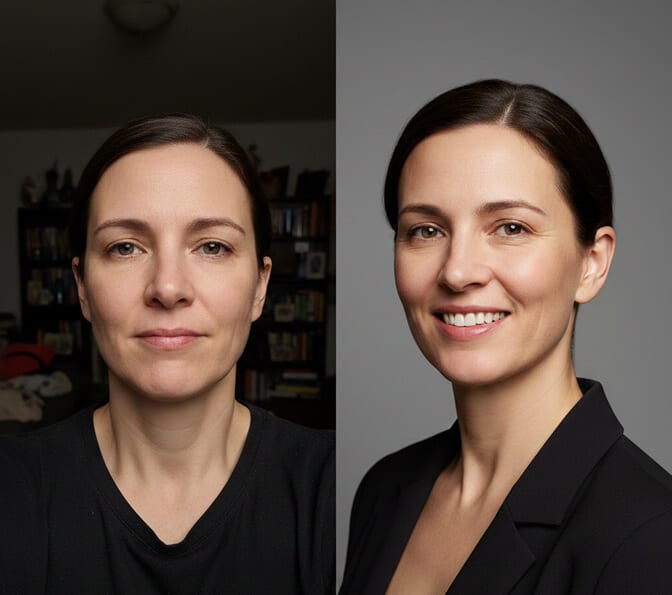
This is why we built HeadshotPhoto. Not because AI is a magic chin eraser. But because removing the in-person session removes the anxiety. You upload a few casual selfies from your own home, on your own time, with no photographer watching. The AI, trained on millions of professionally shot portraits, handles the angles, the lighting, the jawline definition, all of it automatically.
No standing in front of a stranger while worrying about your chin. No deleting 47 photos because you hated every one. No postponing your LinkedIn update for another six months.
If you've been putting off a headshot because of how your chin photographs, try HeadshotPhoto. Upload a few selfies. See what the AI produces. You might be surprised at how good you look when the anxiety isn't in the picture.
Quick Cheat Sheet: Double Chin Angles for Any Situation
Getting photographed by a pro:
- Ask for the camera slightly above your eye level
- Do the turtle: push your forehead forward slightly, chin level
- Turn your body 45 degrees, rotate head back to camera
- Wear a dark top with a V-neck or open collar
- Ask the photographer to raise the key light a bit
Taking a DIY headshot:
- Set camera/phone at forehead height on a tripod
- Face a window with light from above
- Stand at an angle to the camera
- Wear dark clothing
- Take 20+ shots with slight chin variations
Using AI:
- Upload well-lit selfies where your face is visible
- Include different angles in your uploads
- HeadshotPhoto optimizes jawline angles and lighting automatically
- No posing required
One Last Thing
Rachel, the VP who'd been avoiding headshots for three years? She eventually tried the AI route. Uploaded five selfies she took by her kitchen window on a Saturday morning.
When she saw the results, she called her assistant and said, "Update everything. LinkedIn, the company site, my email signature. All of it. Today."
Her chin looked exactly like it does in person. Not thinner. Not Photoshopped. Just properly lit, properly angled, and free from the distortions that cheap cameras and bad angles had been creating for years.
She didn't change her body. She didn't lose weight. She didn't get surgery.
She just finally got a headshot that saw her the way her colleagues already do.
That's what the right angle does. Not magic. Just physics. Applied with a little bit of care.
Frequently Asked Questions
What is the best headshot angle for hiding a double chin?
The best angle is slightly above eye level, with the camera positioned a few inches higher than your natural eye line. This downward angle compresses the chin area and hides everything underneath your jawline. Combined with the "turtle" technique (pushing your forehead slightly forward while keeping your chin level), this eliminates most double chin visibility in headshots.
How do AI headshots compare to traditional photography for double chin concerns?
AI headshot generators like HeadshotPhoto are trained on millions of professionally angled portraits and automatically apply optimal camera angles, lighting, and jawline positioning. The key advantage is eliminating the in-person anxiety that causes people to tense up and pull their chin back. You upload casual selfies from home and the AI handles the technical optimization.
How do I pose to avoid a double chin during a headshot session?
Three techniques combined work best: push your forehead slightly toward the camera while keeping your chin level (the turtle), turn your body 45 degrees and rotate your head back to face the lens, and ask the photographer to shoot from slightly above eye level. Wear a dark top with a V-neck to maintain shadow under the chin and avoid light-colored shirts that bounce light upward.
Is it worth paying for professional retouching to fix a double chin in headshots?
Light retouching that enhances natural jawline definition is reasonable and typically costs $20-50 per image. Heavy retouching that removes the chin entirely often looks fake and creates a disconnect when people meet you in person. A better investment is getting the angle and lighting right in the first place, either through a skilled photographer or an AI generator, so minimal retouching is needed.
Can AI headshots define my jawline without looking fake?
Yes. AI headshot generators don't erase your chin or digitally sculpt your face. They apply the same camera angles and lighting techniques that professional photographers use to naturally define the jawline. The result looks like a professional took your headshot in a studio with optimal positioning, not like someone ran your face through a filter. Your features stay real; the distortions get removed.