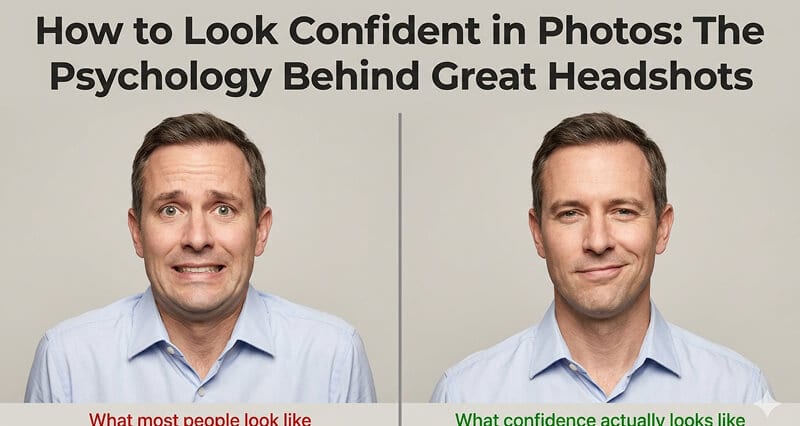
How to Look Confident in Photos: The Psychology Behind Great Headshots (5 Techniques That Work)
Confidence on camera isn't something you're born with. It's five specific things you do with your face and body. Here's the science and the how-to.
I watched a CEO freeze in front of a camera last year.
Not a junior employee. Not someone new to public speaking. A CEO. A person who runs board meetings, pitches investors, and commands rooms full of people who make decisions worth millions.
She sat on the stool, the photographer said "look here," and everything changed. Her shoulders climbed toward her ears. Her smile went from natural to dental-commercial. Her eyes went wide. Her hands gripped the sides of the stool like she was on a roller coaster.
The photos looked exactly how she felt. Terrified.
Here's the weird part. Thirty minutes later, after the photographer walked her through a few specific adjustments, her photos looked like a completely different person. Same face. Same clothing. Same lighting. Completely different energy.
The difference wasn't talent. It wasn't "being photogenic." It was five physical adjustments, each backed by psychology research, that changed how her face and body communicated confidence to the camera.
Those five adjustments work for everyone. And they take about 2 minutes to learn.
Why Your Brain Makes You Look Awkward on Camera
Before the techniques, you need to understand why this happens. Because knowing the "why" makes the "how" much easier.
Researchers from USC's Psychology and Human Behavior Department put it perfectly: "Photographs cause us to focus on the gap between the true self and the idealized self." The moment a camera points at you, your brain becomes hyper-aware of the distance between how you want to look and how you think you actually look.
That awareness creates anxiety. Anxiety creates tension. And tension is visible in every single photo.
Your shoulders rise. Your jaw clenches. Your smile becomes forced. Your eyes go wide. Your posture stiffens. Every one of these is a physical anxiety response that your body produces automatically, and every one of them is read by viewers as "this person is not confident."
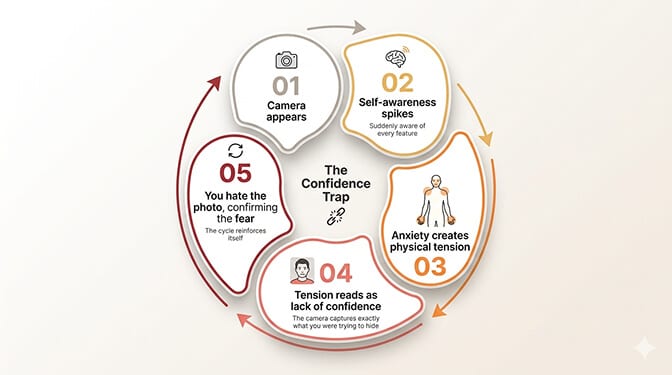
The good news: confidence in photos isn't about feeling confident. It's about removing the physical tension that signals anxiety. You don't have to feel relaxed. You just have to look relaxed. And that's a learnable skill.
Technique #1: The Squinch (Eyes Signal Confidence)
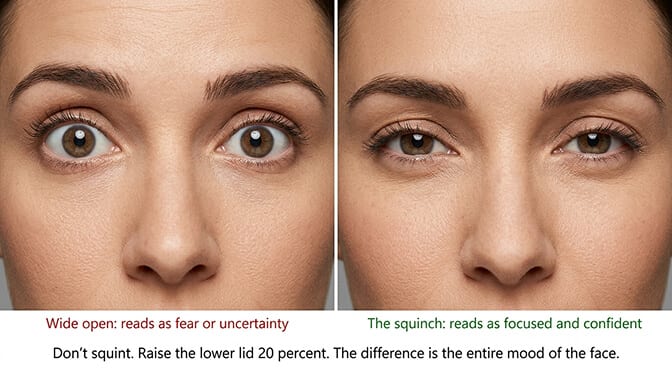
The psychology: Wide-open eyes are universally read as fear, surprise, or vulnerability. It's hardwired into human perception. When someone's eyes are wide, your brain registers "this person is threatened." A slight narrowing of the lower eyelids, in contrast, signals assessment, focus, and confidence. Think of the difference between a deer in headlights and a person sizing up a situation they're about to handle.
Photographer Peter Hurley coined the term "squinch" for this specific technique, and Photofeeler's data confirms it: photos with slightly narrowed eyes consistently score higher on confidence ratings than photos with wide-open eyes.
How to do it: Don't squint. That closes the eyes too much and looks aggressive or suspicious. Instead, raise your lower eyelids just slightly, about 20% of the way toward a squint. Think of the expression you make when you're looking at something interesting across the room. Engaged, slightly narrowed, focused. Not staring. Not squinting. Somewhere in between.
The test: Practice in a mirror. Take a photo with your eyes naturally open. Take another with the slight squinch. The difference in perceived confidence is immediate and significant.
Technique #2: The Duchenne Smile (Your Mouth Is Only Half the Story)
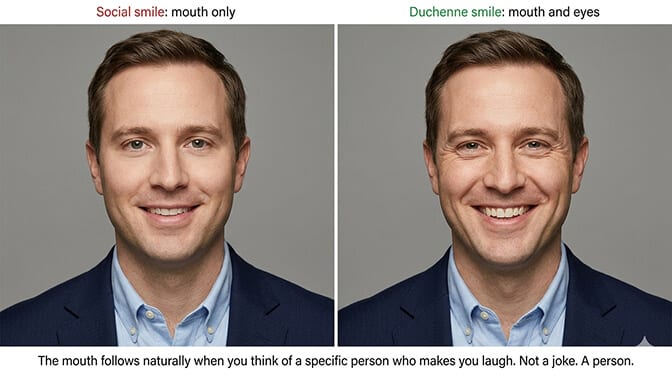
The psychology: Psychologist Paul Ekman identified the difference between a genuine smile (which he named after neurologist Guillaume Duchenne) and a social or forced smile. The difference is simple and powerful: a real smile involves the eyes. A fake smile only involves the mouth.
In a Duchenne smile, the muscles around the eyes contract, creating small crinkles at the outer corners (crow's feet). This eye engagement is the single most important signal of genuine warmth and confidence in a photograph. Viewers can't articulate why one smile looks real and another looks forced, but they can feel it. And what they're feeling is the presence or absence of eye engagement.
How to do it: Don't think about your mouth. Think about something genuinely pleasant. A memory that makes you feel warm. A person you enjoy being around. A compliment that surprised you. The mouth will follow naturally. What you're really doing is triggering the orbicularis oculi muscle around the eyes, which only contracts during genuine positive emotion. You can't fake it by pulling your mouth wider.
The shortcut: Think of a specific person who makes you laugh. Not a joke. A person. Your brain associates that person with genuine warmth, and the Duchenne response follows automatically.
For more on expression techniques across different face shapes, our guide to headshots for women over 50 covers expression coaching that applies to everyone.
Technique #3: The Shoulder Drop (Tension Is Visible)
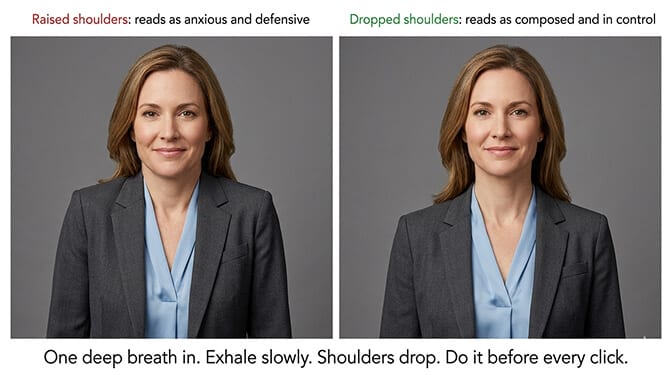
The psychology: Raised shoulders are the body's default stress response. When you're anxious, your trapezius muscles contract and your shoulders climb toward your ears. This is an unconscious protective posture, and in a photo, it reads as: "This person is uncomfortable. This person would rather be somewhere else."
Dropped, relaxed shoulders signal the opposite: ease, composure, and control. They communicate that you belong in front of the camera. That you're not threatened by the situation.
How to do it: Right before the photo is taken, take one deep breath in through your nose. As you exhale slowly through your mouth, consciously drop your shoulders as far down as they'll go. You'll feel your trapezius muscles release. Your neck will appear longer. Your jaw will soften. Your entire upper body will look more relaxed.
This isn't a one-time adjustment. Tension creeps back. Do it before every click if you're in a photo session. Make it a habit.
Technique #4: The Chin Push (Jawline Signals Authority)
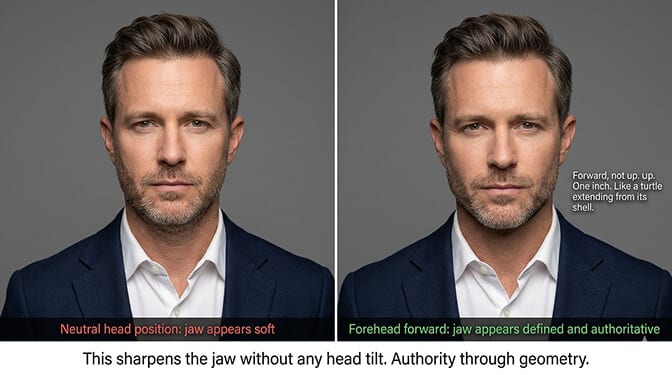
The psychology: A defined jawline is one of the strongest visual signals of authority and decisiveness in human perception. Research on facial features and perceived competence consistently shows that faces with strong jaw definition are rated as more trustworthy and capable. This isn't about face shape. It's about how the jaw reads in a 2D photograph.
A receding chin or soft jaw angle, which happens naturally when your head is in a neutral position, reads as passive or uncertain. A slightly forward chin creates definition and shadow along the jawline that reads as composed and authoritative.
How to do it: Push your forehead slightly toward the camera while keeping your chin level. The movement is maybe one inch. It should feel like a turtle extending gently from its shell (photographer Peter Hurley's description, again). This stretches the skin along your jawline, creating a more defined, confident profile without any head tilt that would look unnatural.
The key: Forward, not up. Pushing your chin UP exposes the underside of your nostrils and creates an unflattering angle. Pushing your forehead FORWARD keeps your face parallel to the camera while sharpening the jaw.
For more on this technique and how it works specifically for different face types, our headshot angles for double chin guide covers the full breakdown.
Technique #5: The Emotional Anchor (Feel Something Real)
The psychology: This is the technique that separates good headshots from great ones, and it's entirely internal.
Psychologist Amy Cuddy's research (2012, later refined) showed that your internal emotional state affects your external physical presentation. When you feel confident, your body naturally adopts open, relaxed postures. When you feel anxious, it contracts.
But the reverse also works. Psychologists call this the "facial feedback hypothesis." The physical act of producing confident body language can trigger the corresponding emotional state. Smile genuinely and you actually begin to feel warmer. Drop your shoulders and you actually begin to feel calmer.
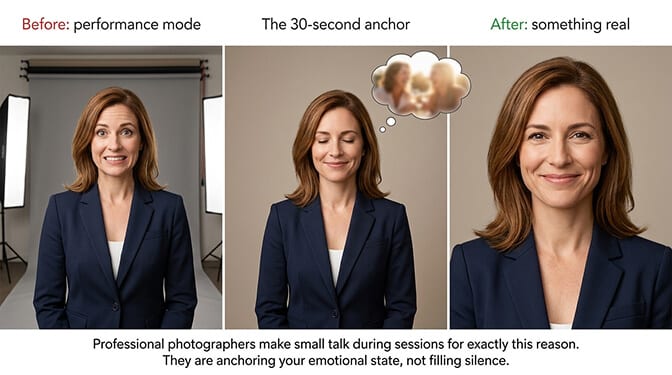
How to do it: Before the photo (or while uploading selfies for AI generation), spend 30 seconds anchoring yourself in a specific emotional state. Not "try to feel confident." That's too abstract. Instead:
Think of a specific moment when you succeeded at something. A project that went well. A presentation that landed. A deal you closed. A conversation where you said exactly the right thing.
Let that memory play in your mind for 30 seconds. The emotion will express itself in your face naturally. Your eyes will soften. Your jaw will relax. Your posture will open. You'll look like someone who has handled something similar to this before.
This is what professional photographers do when they talk to you during a session. They're not making small talk. They're anchoring your emotional state so your face reflects something real rather than the anxiety of being photographed.
The five techniques in one sentence: Squinch your eyes slightly, smile with your eyes not just your mouth, drop your shoulders, push your forehead forward an inch, and think of a moment you handled well. That combination produces a photo that reads as confident, warm, and competent. Every time.
Why This Matters More Than You Think
Princeton research found that people form judgments about competence, trustworthiness, and likability within 100 milliseconds of seeing a face. Your headshot gets less than a tenth of a second to communicate who you are.
LinkedIn profiles with professional photos get 14x more views. Recruiters have told 71% of candidates they were passed over partly due to poor profile photos. And Photofeeler data shows that photos rated high on "confidence" also score higher on "competence" and "likability," the three traits that drive professional outcomes from a headshot.
Confidence in a photo isn't vanity. It's the single highest-ROI skill you can develop for your professional image.
These five techniques work whether you're sitting in a photographer's studio, standing in front of a friend's camera, or uploading selfies for AI generation. At Headshot Photo, the AI is trained on professional photography principles and preserves the confidence signals in your input photos. Upload selfies where you've applied these techniques and the results will reflect it. Studio-quality headshots from casual photos in about 1 hour.
One Last Thing
That CEO who froze in front of the camera? The final headshots from her session are now on her company's website, her LinkedIn, and in every pitch deck her team sends out.
She told me later: "I don't look confident in those photos because I felt confident that day. I felt terrified. I look confident because someone taught me what to do with my face."
That's the secret nobody tells you. The most confident-looking people in professional photos aren't naturally photogenic. They've just learned what to do with their eyes, their mouth, their shoulders, their chin, and their thoughts.
You can learn it too. It takes 2 minutes. And once you know it, you can't unknow it.
Every photo you take from now on will be better.
At Headshot Photo, professionals get studio-quality headshots from selfies in minutes. Apply these five techniques when taking your input photos and the AI will preserve every confidence signal. No photographer needed. No camera anxiety to fight.
For the complete preparation checklist covering outfit, background, and lighting alongside these expression techniques, our professional headshots for men guide covers the full framework.
Frequently Asked Questions
1. What is the psychology behind looking confident in photos?
Confidence in photos is perceived through five specific visual signals: slightly narrowed eyes (squinch), a genuine Duchenne smile that engages the eye muscles, relaxed dropped shoulders, a forward chin position that defines the jawline, and an authentic emotional expression triggered by thinking of a real positive memory. Viewers process these signals in under 100 milliseconds, forming impressions of competence and trustworthiness before they consciously evaluate the photo.
2. How does a confident headshot expression compare to a friendly or approachable one?
A confident expression emphasizes the eyes (squinch, direct gaze, Duchenne crinkle) and jaw definition (chin forward), while an approachable expression emphasizes the mouth (warmer, wider smile) and relaxed, open body language. The best professional headshots combine both: confident eyes with a warm mouth and relaxed shoulders. This dual signal reads as "competent AND likable," which is the ideal combination for LinkedIn, company websites, and professional bios.
3. How do I look confident in photos if I hate having my picture taken?
Camera anxiety is physical before it's emotional. Focus on the five physical adjustments: exhale and drop your shoulders, engage your lower eyelids in a slight squinch, think of a specific success to anchor your expression, push your forehead forward an inch, and let the smile happen from the eyes. These techniques work regardless of how nervous you feel because they address the visible tension that makes anxiety show up in photos. Practice in a mirror for 5 minutes before any session.
4. Is it worth learning confidence techniques for AI headshots, or do they only matter for in-person sessions?
These techniques matter equally for AI headshots. AI headshot generators like Headshot Photo learn from the selfies you upload. If your input photos show relaxed shoulders, engaged eyes, and a natural expression, the AI preserves those signals in the professional output. Bad input (stiff posture, wide eyes, forced grin) produces bad AI output regardless of how sophisticated the technology is. Better selfie technique directly produces better AI headshots.
5. Can AI headshots make me look more confident than my input photos?
AI can optimize lighting, background, and professional framing, but it can't manufacture confidence signals that aren't in your original photos. The squinch, the Duchenne smile, the relaxed shoulders, and the jaw position all need to be present in your selfies. What AI does well is remove the environmental factors (bad lighting, cluttered backgrounds, phone distortion) that can undermine confidence signals that ARE present. Think of AI as amplifying your best expression, not creating one from scratch.