Why Do I Look Different in Photos vs the Mirror? The 5 Scientific Reasons (and What You Can Do About It)
Neither the mirror nor the camera is lying. They're both telling you different truths. Here's the science behind the disconnect you've noticed your entire life.
It happened again last Tuesday.
I looked in the mirror before a meeting. Thought I looked fine. Good, even. Hair cooperating. Face doing its job. Confidence somewhere above average.
Then a colleague snapped a group photo.
I looked at it and my first thought was: Who is that tired, slightly crooked, weirdly proportioned person standing where I was standing?
My second thought: Has the mirror been lying to me my entire life?
If you've ever felt this, you're not imagining it. You genuinely DO look different in photos than you do in the mirror. And the reason isn't vanity, bad lighting, or a lousy camera. It's physics, optics, and psychology working together to create two fundamentally different versions of your face.
Here are the five scientific reasons why. And fair warning: once you understand them, you'll never look at a photo of yourself the same way again.
Reason #1: The Mirror Shows You Backwards (And Your Brain Loves It)
This is the big one. The reason most people feel a gut-level discomfort when they see photos of themselves.
A mirror flips your face left to right. When you raise your right hand, the mirror shows it on the left. When you smile and one side of your mouth lifts slightly higher than the other (and it does, for almost everyone), the mirror shows that asymmetry reversed.
This reversed version is the face you've seen thousands of times. While brushing your teeth. While doing your hair. While checking your outfit. Every single day for your entire life.
Your brain has built a deep, stable preference for this version. Psychologists call it the mere-exposure effect, a phenomenon first documented by Robert Zajonc in 1968. The more you see something, the more you like it. You've seen your mirror face more than any other image in your life. Your brain has decided: this is what I look like.
A photograph shows you the non-reversed version. The version everyone else sees when they look at you. But because you rarely see yourself this way, it looks wrong. Slightly off. Like someone put your features in the right general area but got the details subtly wrong.
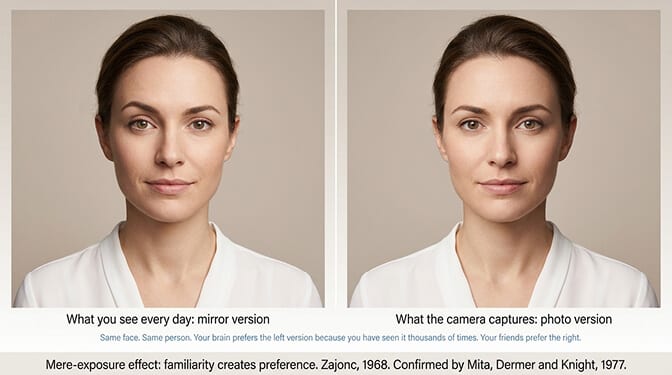
Here's the counterintuitive part: your friends think the photo version looks like you. You think it looks wrong. You're both right. You're just familiar with different versions of the same face.
Research by Mita, Dermer, and Knight (1977) confirmed this directly. When shown both mirrored and true images, people consistently preferred their own mirrored image while their friends preferred the true (photo) image. Neither group was wrong. They just preferred the version they were most used to seeing.
Reason #2: Your Phone Camera Is Distorting Your Face (Literally)
This one is physics, not psychology.
Most smartphone cameras use wide-angle lenses. These lenses are great for fitting scenery into a frame. They're terrible for faces.
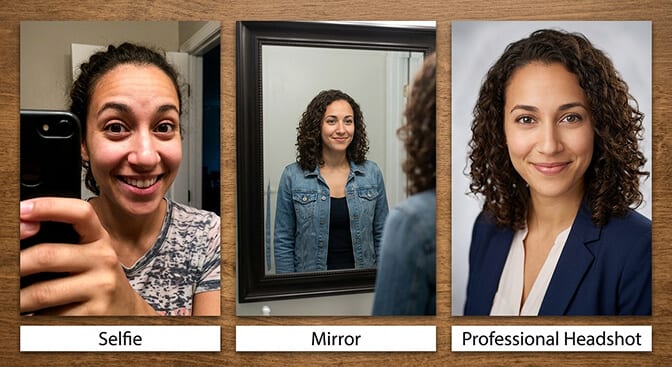
A wide-angle lens exaggerates whatever is closest to the camera. When you hold your phone at arm's length for a selfie, your nose is the closest thing to the lens. The result: your nose looks 20-30% larger than it actually is. Your forehead may look wider. Your chin may look narrower. The proportions of your face shift in ways that don't match what you see in the mirror or what people see in real life.
A 2018 study published in JAMA Facial Plastic Surgery found that selfies taken at 12 inches from the face increased perceived nasal width by 30% compared to photos taken at 5 feet. This isn't a filter. This isn't bad lighting. It's optical distortion from the lens being too close to your face.
Professional portrait photographers know this. They use longer focal length lenses (85mm, 105mm, 135mm) specifically because these lenses compress facial features in a way that looks more natural and flattering. The further the camera is from your face, the less distortion occurs.
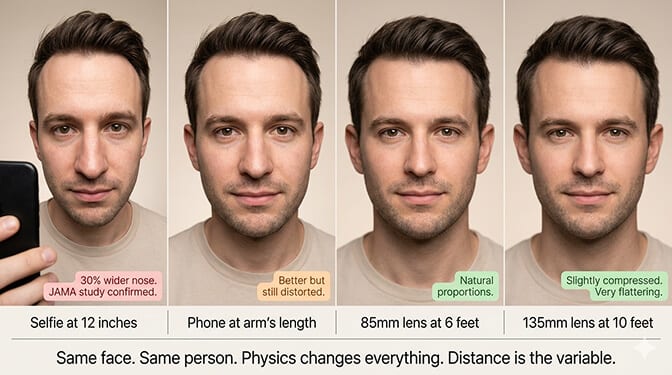
This is why you look different in a bathroom selfie versus a photo someone takes of you from across the table. The distance changes the optics, which changes your face.
For tips on how to minimize this distortion in your own photos, our guide to headshot angles for double chin covers camera positioning that flatters rather than distorts.
Reason #3: The Frozen Face Effect
Stay with me here, because this one is less obvious but equally important.
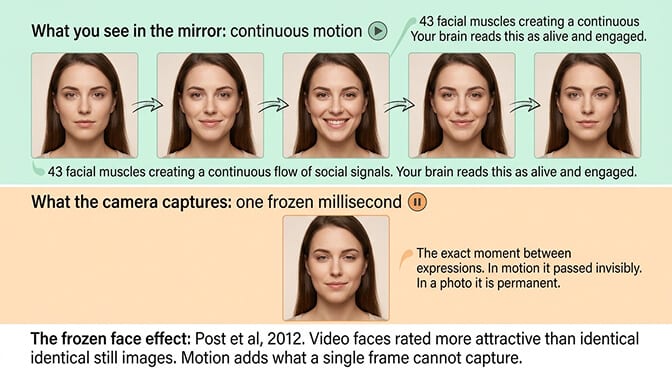
When you look in the mirror, you're seeing a live, moving, three-dimensional version of yourself. Your face is animated. Your expressions shift subtly. Your eyes move. Your micro-expressions create a continuous flow of social signals that your brain processes as "this person is alive and engaged."
A photograph freezes one millisecond of that flow. One frame. One expression. One exact configuration of your 43 facial muscles captured at one precise instant.
Psychologists call this the frozen face effect. A 2012 study by Robert Post and colleagues found that faces shown in video were rated as more attractive than the same faces shown as still images. Motion adds liveliness that a single frame can't capture.
This is why you often look "off" in candid photos. The camera caught you between expressions, or at the exact moment you were transitioning from one micro-expression to another. In motion, that moment passed invisibly. In a photo, it's frozen forever as a permanent, slightly awkward snapshot.
The mirror never does this to you because the mirror shows you in constant motion. You never catch yourself between expressions in a mirror.
Reason #4: 3D Face on a 2D Surface
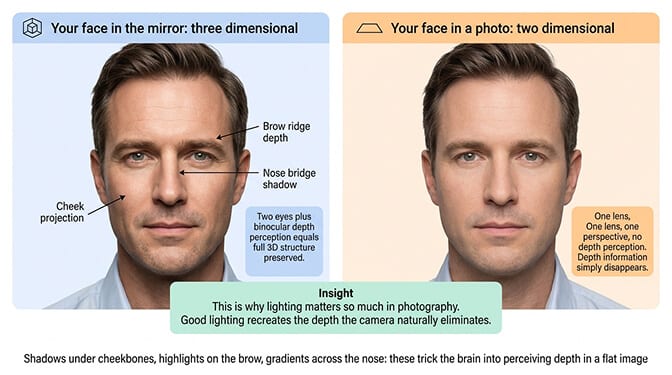
Your face exists in three dimensions. A photograph captures it in two.
That compression eliminates depth cues that make your face look the way you expect it to. The subtle curves of your cheeks, the projection of your nose, the way your brow ridge creates shadow over your eyes: these three-dimensional features create the face you know. When they're flattened into a 2D image, the depth information disappears.
Your mirror doesn't have this problem because you're seeing your face in real three-dimensional space (via the reflection). Your two eyes provide binocular depth perception. The mirror preserves the 3D structure of your face.
A camera has one lens. One point of perspective. No depth perception. The result is a flatter, less dimensional version of your face that looks subtly wrong compared to the 3D version you know from the mirror.
This is partly why lighting matters so much in photography. Good lighting recreates the sense of dimension that the camera naturally eliminates. Shadows under the cheekbones, highlights on the brow, subtle gradients across the nose: these lighting cues trick the viewer's brain into perceiving depth in a flat image.
Reason #5: You Control the Mirror. The Camera Controls You.
Here's the part nobody tells you.
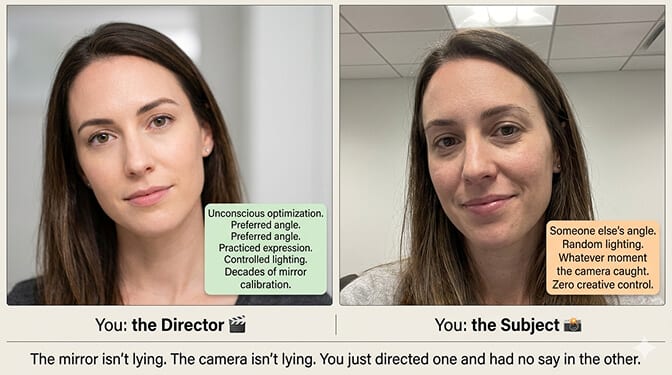
When you look in a mirror, you unconsciously optimize. You tilt your head to your most flattering angle. You adopt your preferred expression. You stand at the distance where your face looks the way you expect it to. You do this automatically, without thinking about it, because you've spent decades learning which angle and expression you prefer.
A photograph removes all of that control. Someone else chose the angle. The lighting was whatever the room provided. The moment was whatever the camera captured. The distance was wherever the photographer (or phone) happened to be.
You went from being the director of your own face to being a subject in someone else's frame. And that loss of control is jarring.
The mirror isn't lying. The camera isn't lying. You just have creative control over one and zero control over the other. The version you prefer is the one you directed.
So Which Version Is the "Real" You?
Neither. And both.
The mirror shows a reversed, 3D, dynamically lit, self-directed version of you. The camera shows a non-reversed, 2D, frozen, lighting-dependent, lens-distorted version of you. Neither is a perfect representation. They're both approximations viewed through different physical and psychological lenses.
But here's what actually matters: other people see the camera version. Not exactly (they see you in 3D, in motion, with depth), but closer to the camera version than the mirror version. Your friends, your colleagues, your clients, your LinkedIn connections: they all see the non-reversed, true-image version of your face.
The disconnect you feel when you see a photo isn't because the photo is wrong. It's because the photo is unfamiliar. And "unfamiliar" feels wrong to your brain even when it's accurate.
What This Means for Your Professional Photos
Understanding this science doesn't just explain the discomfort. It points directly to solutions.
- Use longer focal lengths (or distance). Whether you're DIY-ing with a phone or working with a photographer, more distance between the camera and your face means less distortion. Set a timer and step back rather than taking a close-up selfie. Professional photographers use 85mm+ lenses for a reason.
- Optimize your lighting. Good lighting recreates the 3D depth perception that 2D photos naturally eliminate. Soft, diffused light from a large source (a window, a softbox) fills in harsh shadows and makes your face look dimensional rather than flat.
- Take more photos. The frozen face effect means any single photo is a lottery ticket. The more you take, the more likely you are to capture a frame where your expression is natural and your features are at their best.
- Look at the photo version of yourself more often. The mere-exposure effect works in both directions. The more you see your non-reversed face in photos, the more familiar (and comfortable) it becomes. Taking lots of selfies isn't vanity. It's literally retraining your brain's familiarity bias.
This is one of the reasons AI headshot generators produce results that many people prefer over traditional photography. At Headshot Photo, the AI is trained on professional photography principles: proper focal length simulation, optimal lighting angles, and natural skin rendering. The result is a headshot that looks like you at your best, not the distorted selfie version or the unfamiliar candid version, but the version that's closest to how the people around you actually experience your face.
For an in-depth guide on getting the best possible photos from your phone, check out our professional headshot tips guide. And if you're considering an AI headshot instead, see our best AI headshot generators comparison.
One Last Thing
That group photo from last Tuesday? I looked at it again this morning.
It still doesn't look like "me." Not the "me" I see in the mirror. But I've started to notice something. The person in that photo looks like the person my friends describe. Like the person my colleagues see on Zoom calls. Like the person walking through the office.
Maybe the photo isn't getting me wrong. Maybe the mirror has just been giving me a slightly more flattering edit of reality for my entire life. And maybe that's okay. Because both versions are still me.
The question isn't which version is "real." They both are. The question is: when you need a professional photo that represents you to the world, is the photo capturing you at your best? Or is it catching you in a random millisecond with distorted proportions under fluorescent lighting?
That's the part you can control. And controlling it takes less effort than you think.
At Headshot Photo, you can get professional headshots that represent the best version of how you actually look, not the selfie distortion, not the mirror flip. Upload a few casual photos and get studio-quality results in about 1 hour.
For a complete guide on how to prepare for any headshot situation (photographer, DIY, or AI), our corporate headshot checklist covers expression, outfit, background, and lighting.
Frequently Asked Questions
1. Why do I look different in photos than in the mirror?
You look different because of five factors working simultaneously: the mirror shows a reversed image you're familiar with (mere-exposure effect), cameras use wide-angle lenses that distort facial proportions, photos freeze one millisecond of your dynamic expressions (frozen face effect), 3D features get flattened to 2D, and you lose the unconscious self-direction you have in a mirror. None of these make the photo "wrong." They make it a different representation than you're used to seeing.
2. Which is more accurate, how I look in the mirror or in photos?
Neither is perfectly accurate. The mirror shows a reversed, 3D image with controlled lighting and self-direction. Photos show a non-reversed, 2D image with potential lens distortion. Other people see something closer to the photo version (non-reversed) but in 3D and in motion. The most accurate representation of how others experience your face is a professional photo taken at proper distance (5+ feet) with a portrait-length lens and natural lighting.
3. How do I look better in photos if cameras distort my face?
Increase the distance between the camera and your face to reduce wide-angle lens distortion. Use natural, diffused lighting (face a window) to add dimension. Take many photos and select the best expression. Avoid direct flash. Use the rear camera on your phone (higher quality than the front camera). For professional photos, work with a photographer who uses 85mm+ lenses, or use an AI headshot generator like Headshot Photo that simulates optimal focal length and lighting.
4. Is it worth getting a professional headshot if I look bad in casual photos?
Absolutely. Most people who "look bad in photos" are actually experiencing lens distortion, poor lighting, and unflattering angles, not poor features. Professional photography (or AI headshot generators) control all three of these variables: proper focal length eliminates distortion, professional lighting adds flattering dimension, and expert framing captures your best angle. The result is a photo that represents how you actually look, not the distorted selfie version.
5. Can AI headshots make me look like myself better than a selfie does?
Yes, and the science explains why. AI headshot generators trained on professional photography principles simulate proper focal lengths (eliminating wide-angle distortion), optimal studio lighting (adding 3D dimension), and professional framing. The result is closer to how people experience your face in real life than a close-range selfie taken with a wide-angle phone camera. You still look like you. You just look like the version of you that doesn't have physics working against it.