
Unphotogenic vs Non-Photogenic: Is There a Difference?
Two words for the same insecurity. One of them is in the dictionary, one of them isn't quite, and neither one means what you think it means.
It started with a text argument.
A friend insisted she was "non-photogenic." I told her the word was "unphotogenic." She told me to mind my own business. Then we both went quiet and started typing into search bars like two people who suddenly weren't sure who was right.
Turns out, we were both right. And both missing the point entirely.
Here's the weird part. The word you pick to describe your camera struggles doesn't matter nearly as much as the belief hiding underneath it. So let's settle the grammar, then settle the actual problem.
The Short Answer
"Unphotogenic" and "non-photogenic" mean essentially the same thing. Both describe someone or something that doesn't look good in photographs.
If you want to be technical, "unphotogenic" is the one that made it into the dictionary. It's a recognized word with a recorded history going back to the 1930s. "Non-photogenic" is a more casual construction, built on the fly by sticking "non" in front of "photogenic."
Both are understood by everyone. Both are used constantly. Neither will get you corrected by anyone except a pedantic friend over text.

So if you came here just for the spelling-bee answer, there it is. Use whichever one feels right.
But stay with me, because the more interesting question isn't which word is correct. It's why either word feels true about you in the first place.
Where the Words Actually Came From
"Photogenic" is older and stranger than you'd guess.
Before it ever meant "looks good in photos," it had to do with light itself. The roots literally point to "produced by light." For a long stretch, the word leaned scientific, describing things that generate or emit light, not people who look cute on Instagram.
The "looks good when photographed" meaning is the one that took over in everyday speech. And once "photogenic" meant that, the opposites followed naturally. Add "un" and you get the dictionary version. Add "non" and you get the conversational cousin.
The fact that "photogenic" originally meant "made by light" is the whole secret. Photos are not made by your face. They're made by light hitting your face.
Hold onto that. We'll come back to it, because it quietly dismantles the entire idea of being unphotogenic.
Here's Where Most People Get It Wrong
People treat "unphotogenic" like a permanent trait. A category you're born into. A genetic coin flip you lost.
That's the misread.
Both words only ever describe an outcome, not a property. They describe what happened in a specific photo under specific conditions. They say nothing about a fixed quality baked into your bones.

Here's the proof. The exact same dictionary that defines "unphotogenic" is careful to note that the word doesn't mean a person is unattractive. It only means a particular photo didn't flatter them. A delicious cake can be unphotogenic. A gorgeous building can be unphotogenic. Attractiveness and photographability are two different measurements.
You are not unphotogenic. You have unphotogenic photos. That's a completely different problem, and it's a fixable one.
If you want the full breakdown of the psychology and physics behind why that happens, we went deep on it in our piece on why you might feel like you're not photogenic.
The Part Nobody Tells You
When you call yourself "non-photogenic," you're usually describing one of a few very specific, very mechanical failures. None of them is you.
Bad lighting that throws harsh shadows across your face. A wide-angle phone lens held a foot away that fattens your nose. A single frozen frame catching you mid-blink or mid-word. An unflattering angle shot from below.
Every one of those is a condition, not a characteristic.
Change the condition, change the outcome. The same face that looked "unphotogenic" in a fluorescent-lit selfie can look genuinely great in soft window light from a respectful distance.
Nobody is unphotogenic in good light. They're just rarely photographed in it.
This is why professional models aren't a different species. They've simply learned which conditions work for their face, and they recreate those conditions on purpose. That's a skill. Skills transfer.
Why the Distinction Matters More Than You'd Think
Okay, so the two words are basically synonyms. Why write a whole post about it?
Because the language you use on yourself becomes the belief you carry. And the belief you carry shows up on your face the next time a camera points at you.
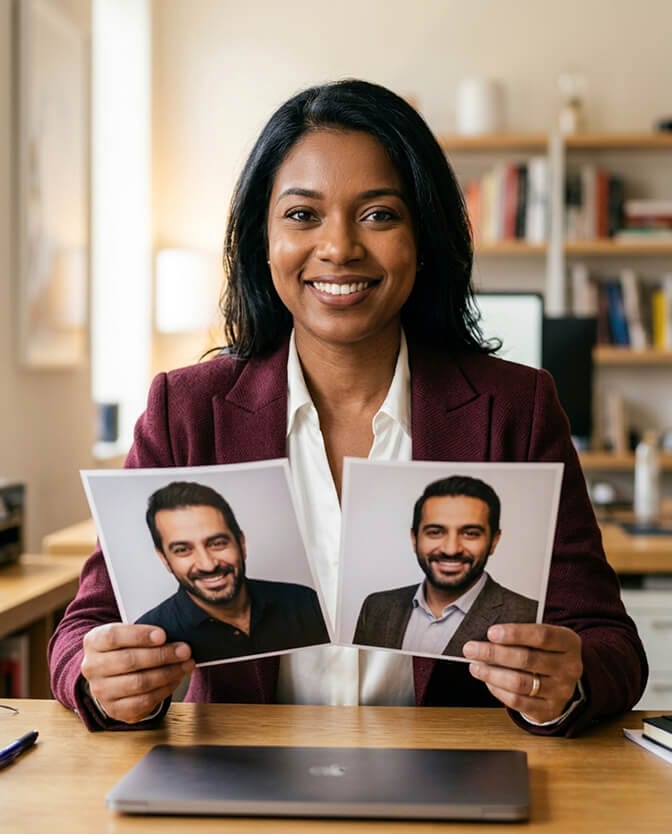
If you've decided you are "an unphotogenic person," you walk into every photo braced, tense, expecting the worst. That tension is visible. The camera catches it. The bad photo confirms the belief. The belief tightens you up further next time.
It's a loop. And the exit from the loop starts with swapping a fixed-trait word ("I am unphotogenic") for a conditional one ("that photo didn't work").
If you're tired of fighting that loop with your phone's front camera, this is roughly where we come in. A good AI headshot tool removes every one of those mechanical failures for you. It manages the lighting, the lens distance, and the hundreds of frames, then hands you the versions that actually look like you. You can see how affordable professional headshots can be and skip the whole tense-selfie cycle.
What I Wish More People Understood
Words shape what we believe is possible.
"Unphotogenic" and "non-photogenic" both sound like diagnoses. Like something a doctor confirmed. They feel permanent because they're adjectives, and adjectives sound like they describe a fixed state.
But peel back the grammar and you find something much lighter. You find a description of a photograph, taken once, under conditions that happened to be unkind. Nothing more.

Change the light. Change the distance. Take more frames. Or let a tool do all three for you. Suddenly the "unphotogenic" person is looking at a photo they actually like, wondering where that camera-shy version went.
If you want to understand the deeper perception trick that makes your photos feel wrong even when they're fine, our explainer on why your AI headshot sometimes doesn't look like you connects the last dots.
The Honest Takeaway
So, unphotogenic versus non-photogenic. Is there a difference?
Grammatically, barely. One is the dictionary version, one is the casual version, and they point at the same idea. Pick whichever sounds right in your sentence.
But here's what I actually want you to walk away with. Neither word is a verdict on your face. They're both just descriptions of photographs that didn't get the conditions right.
You were never the problem. The light was. The lens was. The angle was. The single frozen second was.
Fix those, and the word you've been quietly calling yourself stops fitting. Because it never really fit in the first place.
Now go take a photo in good light, from a few feet back, and take twenty of them. One of those is the real you. Probably more than one. Or let us handle it.
Frequently Asked Questions
1. What does unphotogenic mean?
Unphotogenic means not looking attractive in photographs. It is a recognized dictionary word that describes a person, object, or place that does not photograph well under certain conditions. Importantly, it does not mean someone is unattractive in real life. It only describes how a specific photo turned out.
2. Is there a difference between unphotogenic and non-photogenic?
Not really. Both terms describe someone or something that does not look good in photos, and people use them interchangeably. Unphotogenic is the version found in dictionaries, while non-photogenic is a more casual construction. Either one is understood and acceptable in everyday use.
3. How do I stop being unphotogenic?
Focus on the conditions, not your face. Use soft, even lighting, put more distance between you and the camera to avoid lens distortion, and take many photos so you catch a natural expression. Being photogenic is a skill you can build, not a fixed trait you are stuck with.
4. Is being unphotogenic the same as being unattractive?
No, and this is the biggest misconception. Photogenic and attractive are two separate measurements. Plenty of attractive people photograph awkwardly under bad conditions, and plenty of average-looking people light up a lens. A bad photo reflects the lighting, angle, and timing, not your real-life appearance.
5. Can AI headshots help if I think I'm non-photogenic?
Yes. A quality AI headshot tool removes the exact mechanical problems that make people feel non-photogenic by managing lighting, lens distance, and generating many frames at once. It then surfaces the photos that genuinely look like you. Clear, well-lit source selfies give you the most accurate and flattering results.