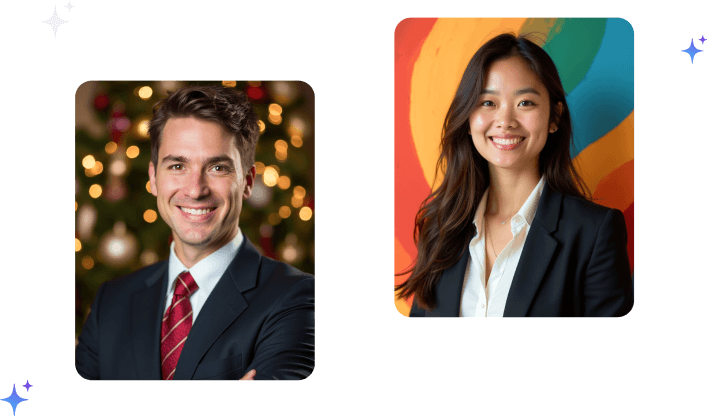
Why Am I Not Photogenic? The Science of Photo Anxiety
You're not unphotogenic. Your brain just hates surprises, and the camera is full of them. Here's what's actually happening.
You take the photo. You look at it. And your stomach drops a little.
That's not me. My nose isn't that big. Do I really look like that?
So you take another. And another. Twelve photos later you're still hunting for the one that matches the person you see in the mirror every morning. None of them do.
Here's the weird part. The problem was never your face. It was the gap between two versions of you that your brain has quietly been keeping score of for years.
Let me explain what's actually going on, because once you understand it, photo anxiety loses most of its grip.
"Photogenic" Is a Myth We All Bought
Let's kill the word first.
Being photogenic isn't a gift some people are born with and you missed out on. It has nothing to do with how attractive you are in real life. Plenty of stunning people photograph awkwardly, and plenty of average-looking folks light up a lens.
Photogenic just describes how well your features translate through a camera. That's it. It's a translation problem, not a beauty problem.
And translation can be learned. Which means the entire premise of "I'm just not photogenic" is built on sand.
Stay with me, because the why is genuinely fascinating.
The Mirror Has Been Lying to You (Nicely)
Every day you look in the mirror. And every day you see a flipped version of your face.
Your part is on the wrong side. Your slightly higher eyebrow is on the opposite side. The little asymmetries every human face has are all reversed.
You've seen this flipped version tens of thousands of times. Your brain has decided that is what you look like.
The face you love in the mirror is a face nobody else has ever seen. It's reversed.
Then a camera captures you the way the world actually sees you, unflipped, and your brain throws a small tantrum. Not because the photo is ugly. Because it's unfamiliar.
Psychologists have a name for this. It's called the mere exposure effect, first described by a researcher named Robert Zajonc. The idea is simple: we prefer what we see most often. Familiarity feels like attractiveness.
So you don't dislike your photo because you look bad in it. You dislike it because it looks unusual to you... while looking perfectly normal to everyone else.
This is where most people get it wrong. They read the discomfort as "I'm not photogenic" when the honest translation is "I'm not used to seeing myself this way."
Then the Camera Adds Its Own Distortions
The mirror flip is the psychology. Now here's the physics, and this part is even more freeing.
A camera lens is not your eye. It bends and flattens reality in ways your vision never does.
The biggest culprit is the selfie. When you hold a phone roughly a foot from your face, the wide-angle front lens exaggerates whatever is closest to it. Usually that's your nose. Research on this "selfie distortion" effect found it can skew your facial proportions by nearly 30 percent.
Thirty percent. Your nose isn't bigger. The lens lied.

This is why professional photographers stand back and use longer lenses. An 85mm lens or more compresses your features gently and flatters them. The same face, shot from a respectful distance, looks like a completely different (and better) person.
If you've ever wondered why you look fine in a friend's photo but strange in a selfie, that's your answer. It was the distance and the lens the whole time. We broke down all five of these factors in our deeper piece on why you look different in photos versus the mirror.
The Frozen Face Effect
Here's one nobody talks about.
Your face is not a still object. It moves constantly. Micro-expressions, the way your smile builds, the life in your eyes... your real charm lives in motion.
A photo freezes a single millisecond out of that motion. And most milliseconds are awkward. The half-blink. The mid-word mouth. The expression caught between two real expressions.
Any single photo is a lottery ticket. Most tickets lose. That's not your face failing. That's statistics.
This is why a photographer takes hundreds of frames to get the handful that work. They're not fixing you. They're buying more lottery tickets until one lands on the version of you that's already there.
You're not unphotogenic. You've just been judging yourself on your worst frozen millisecond and calling it the truth.
Where Photo Anxiety Actually Comes From
Now stack it all up.
You have a brain that prefers your mirror-flipped face. A camera that distorts your proportions. A single frozen frame that catches an awkward in-between moment. And a 2D image that flattens the 3D depth your features have in real life.
Four forces, all working against you at once, every time you get photographed.

No wonder the camera makes your chest tighten. Your discomfort is a completely rational response to a stacked deck.
And here's the relief: none of those four forces say anything about how you actually look. They're all artifacts of the medium, not flaws in the face.
When you internalize that, the anxiety softens. You stop reading "this photo feels off" as "I am unattractive" and start reading it as "the camera did its usual thing."
What I'd Actually Do About It
You can fight all four forces with small, boring fixes.
Get distance between you and the lens. Step back, use a timer, stop shooting from twelve inches away. Find soft, even light from a window or a large source so your face keeps its dimension. Take many more photos than feels reasonable, so the lottery works in your favor. And look at the true, unflipped version of yourself more often, because the mere exposure effect runs both ways. The more you see your real face, the more you'll like it.
If you want a deeper checklist on expression, posture, and lighting before any shoot, our guide on how to look better in photos walks through it step by step.
But here's the honest shortcut. Most people don't have the patience to learn lighting and lens distance just for one good profile photo.
That's the entire reason we built Headshot Photo. You upload a few casual selfies, and the system handles the distance, the lighting, and the hundreds of frames for you, then surfaces the versions that actually look like you on a good day. If you've been losing afternoons to the photo lottery, you can see how Headshot Photo pricing works and skip straight to the keepers.
The Reframe That Fixes Everything
You picked up your phone today convinced you're just one of those people who doesn't photograph well.
You're not. There's no such person. There are only faces meeting a flawed, distorting, single-frame medium, and brains that got too attached to a reversed reflection.

The next time a photo makes you wince, don't ask why am I not photogenic. Ask which of the four forces just got me. Then fix that one thing.
Your face was never the problem. It's the same face the people who love you see every day and think looks exactly right.
The camera just needed a little help catching up. Try it now.
Frequently Asked Questions
1. What does it mean to be photogenic?
Being photogenic describes how well your features, expressions, and energy translate through a camera lens. It is not the same as being attractive in person. It depends on factors like lighting, camera angle, lens distance, and timing, all of which can be learned and adjusted, which is why being photogenic is a skill rather than a fixed trait.
2. Why do I look better in the mirror than in photos?
Because the mirror shows you a flipped version of your face that you see every day, and your brain prefers what is familiar. This is called the mere exposure effect. A photo shows the unflipped version that everyone else sees, so it feels unfamiliar and your brain misreads that unfamiliarity as looking bad.
3. How can I look more photogenic in photos?
Put more distance between your face and the camera to avoid wide-angle distortion, use soft even lighting to keep your features dimensional, and take many photos so you catch a natural frame. Looking at unflipped photos of yourself more often also helps your brain grow comfortable with how you really look.
4. Why does my nose look bigger in selfies?
Selfies are usually taken about a foot from your face with a wide-angle front lens, which exaggerates whatever is closest to the camera, normally your nose. This selfie distortion can skew your proportions by nearly 30 percent. Stepping back or using a rear camera with more distance removes most of that effect.
5. Are AI headshots good enough if I think I'm not photogenic?
Yes, and they often help. A quality AI headshot tool generates many frames, manages lighting and lens distance, and surfaces the versions that genuinely look like you, which solves the exact forces that make people feel unphotogenic. The key is choosing source selfies that are clear and well lit so the result stays true to your real face.