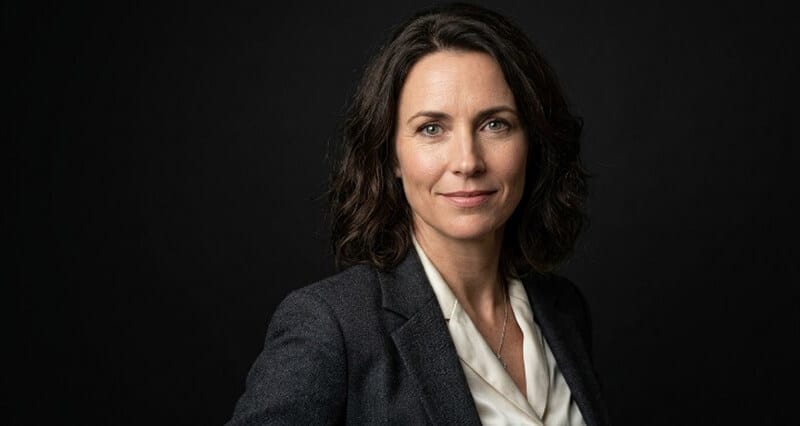
15 Female Corporate Portrait Poses That Read as "In Charge" (Not Stiff)
The small body adjustments that make a woman look like she runs the room, even when the photo is taken in ten minutes.
She booked the shoot to fix one photo. The LinkedIn one. The cropped wedding snap she'd been hiding behind for four years.
Twenty minutes in, she said the thing we hear constantly.
"I don't know what to do with my hands."
Here's the part nobody tells women before a corporate shoot: the pose is doing more work than the outfit, the background, or the lighting combined. A blazer can't fix a collapsed posture. A pretty background can't fix a chin that vanishes into the neck.
The pose is the message. Everything else is volume.
So let's talk about the fifteen that actually work for corporate portraits, why each one reads the way it does, and the tiny mechanical fixes that separate "approachable executive" from "deer in headlights."
First, what "corporate" actually asks of a pose
Most posing advice floating around was written for fashion or lifestyle shoots. Soft gazes over the shoulder. Hair flips. Hands in hair.
That look sells perfume. It does not sell competence.
A corporate portrait has a narrow job. In under a second, a stranger decides whether you look capable, trustworthy, and warm enough to work with. That is the whole game.
The best corporate poses signal two things at once: authority and approachability. Lose either one and the photo tips into "cold" or "junior."
Keep that tension in mind as you read. Every pose below is really a dial between those two.
1. The slight body angle (stop facing the camera square)
This is the one fix that changes everything, and almost everyone gets it wrong on the first try.
Do not point your shoulders straight at the lens. A square-on body looks flat, wider, and weirdly confrontational, like a mugshot with better lighting.
Instead, turn your shoulders roughly 30 to 45 degrees away from the camera. Then bring your eyes back to the lens.
Why it works: the angle creates depth, narrows the torso, and gives the photo a natural diagonal that the eye finds easy to read. You look dimensional instead of pasted on.
Small thing, huge difference.
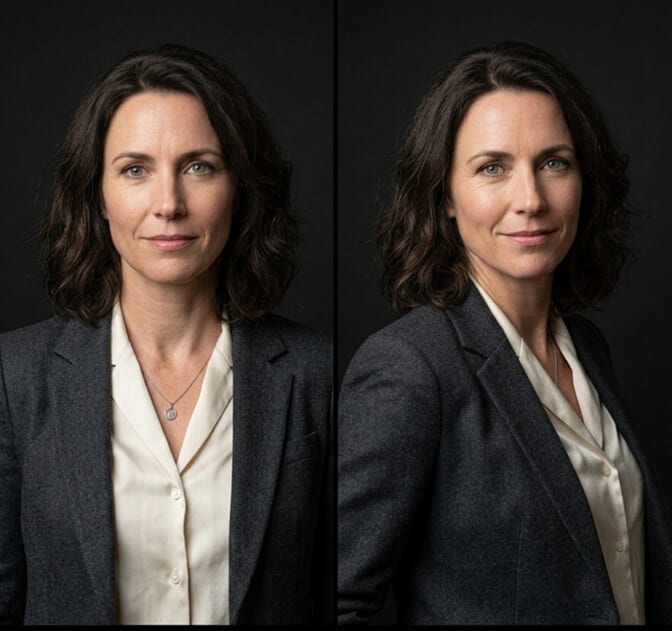
2. Chin forward and slightly down (the move that kills the double chin)
Cameras flatten faces and find chins that real life never does. The fix feels unnatural and looks fantastic.
Push your forehead slightly toward the camera, then drop your chin a touch. It feels like a slow, subtle turtle. On camera, it carves out a clean jawline and erases the soft area under the chin.
Stay with me here, because this is the one people fight. It feels wrong in the moment. It photographs as poised and defined every single time.
If you only practice one thing in the mirror before a shoot, practice this.
3. Shoulders back, weight on your back foot
Posture is read as confidence before a single word is spoken. A collapsed chest reads as uncertain, no matter how senior you are.
Roll your shoulders back and down. Lengthen the back of your neck. Then, if you are standing, shift your weight onto your back foot and let the front foot come slightly forward.
Why the foot thing matters: putting weight on the back leg straightens your spine, drops the front shoulder a fraction, and gives the body a relaxed, grounded line. You stop looking like you are bracing for a photo and start looking like you own the floor.
4. The arms crossed (done the confident way, not the defensive way)
Crossed arms get a bad reputation, and badly done, they deserve it. Done right, this is one of the strongest authority poses a woman can use in a corporate portrait.
The trick is the face. Cross your arms loosely, keep the shoulders down and open, and pair it with a genuine, warm expression. Relaxed arms plus a real smile reads as "I know my stuff and I'm easy to work with."
Tight arms plus a flat face reads as a wall. Same pose, opposite message.
This is where most people get it wrong. They tense up the second their arms cross. Keep the jaw soft and the eyes engaged, and the whole thing flips to commanding.
5. Hand on the hip, or a hand tucked into the blazer
You wanted something to do with your hands. Here it is.
A single hand resting on the hip opens the silhouette, adds a confident line, and quietly signals ease. One hand slipped lightly into a blazer pocket (thumb out, relaxed) does the same with a slightly more understated tone.
The rule for hands in any corporate pose: show the edge of the hand, never the flat back of it. A flat palm or the back of the hand toward the camera looks large and stiff. Turn the hand so the lens sees the slim side.
One hand engaged, one hand relaxed. That asymmetry is what makes it look natural.
6. The seated lean
If you have a desk, a chair, or any surface, use it. Seated poses are a gift for executive portraits because they read as settled and senior.
Sit, then lean very slightly forward toward the camera, forearms resting on the desk or one elbow on the chair arm. Leaning in says engaged and interested. Leaning back too far says checked out.
Keep your back off the chair. The moment your spine touches the backrest, your posture slumps and the photo loses energy.

7. The thoughtful hand-to-face
Used sparingly, a hand brought lightly to the chin or jaw signals thought, expertise, and consideration. It is the "I'm listening, and I have an opinion worth hearing" pose.
The danger is overdoing it. Do not prop your whole face up on your fist, and never let the hand squash your cheek out of shape. Light contact. Fingertips, not a full grip.
This one works beautifully for consultants, lawyers, advisors, and anyone who sells judgment for a living.
If you want to see how wardrobe choices change the read on poses like this across roles, our breakdown of female executive outfits for headshots pairs nicely with this section.
8. The walking shot (motion reads as momentum)
Static is safe. Motion is memorable.
A photo that catches you mid-stride, looking toward or just past the camera, reads as energy and forward drive. It is a favorite for founders and leaders who want to look like they are going somewhere.
You do not need a real catwalk. A few slow steps, weight rolling naturally, chin up, repeated several times, gives plenty of frames to choose from.
Here's the weird part: the most natural-looking walking shots come from the most repetition. The first three steps look posed. By step ten, your body forgets the camera and you finally look like yourself.
9. The look-back over the shoulder
This is the angled pose taken one step further, and it is genuinely flattering when the corporate context allows for a touch of personality.
Turn your body almost fully away, then rotate your head back toward the lens over the near shoulder. It elongates the neck, defines the jaw, and creates a strong, elegant line.
A word of caution: keep it grounded. Too much tilt or a coy expression pushes it toward glamour and away from boardroom. Strong eyes, level head, confident mouth. That keeps it corporate.
10. The genuine laugh (your secret weapon for warmth)
Authority poses are easy. Warmth is the hard part, and it is the part that makes people actually want to work with you.
The fix is not "say cheese." A posed grin reads as fake because the eyes don't move. A real laugh does.
Get the photographer (or the AI, more on that in a second) to catch you a half-second after a genuine laugh, as it settles. The eyes crinkle, the smile softens, and the whole face relaxes into something people instinctively trust.
If every photo in your set is serious, you look capable but cold. One real laugh in the mix is what makes people pick you.
That single warm frame is often the one our customers end up using everywhere.
Quick honest aside before the next five. You can read all fifteen of these, practice in the mirror, book a studio, sit through an awkward hour, and still walk away with two usable shots if the lighting or the photographer's eye is off. That is the old way, and it is expensive and slow.
The reason we built Headshot Photo was simple. You upload a handful of selfies, and you get back dozens of polished corporate portraits across different poses, angles, and backgrounds, with the jaw, posture, and lighting already handled. You pick the angled one, the seated one, and the warm laughing one, instead of betting everything on a single afternoon. If you want to see what that looks like for a whole team, our company headshots page shows the consistent-set approach.
Now, five more poses, then the details that make any of them land.
11. The clean classic (relaxed arms, three-quarter stand)
Sometimes the strongest pose is the simplest. Body angled, weight on the back foot, arms relaxed at your sides, shoulders down. No props, no crossing, no hand on hip.
Why it works: stillness itself reads as secure. You do not need to do anything clever with your hands to look confident.
The trick: keep the hands soft, fingers slightly curled, and let the arms hang a touch away from the body so the silhouette doesn't flatten against you. This is the safe default that almost never fails.
12. The executive clasp (hands loosely held in front)
If relaxed arms feel like too much exposure, clasp your hands lightly in front, around waist height. It is controlled, composed, and quietly senior.
Loose is the key word. Gripped, white-knuckle hands read as nervous. Lightly resting fingers read as poised.
Keep your elbows slightly out from the body so your arms don't pin flat. This one suits formal directories and finance or legal contexts where understated authority is the whole brief.
13. The lean (against a wall, desk, or railing)
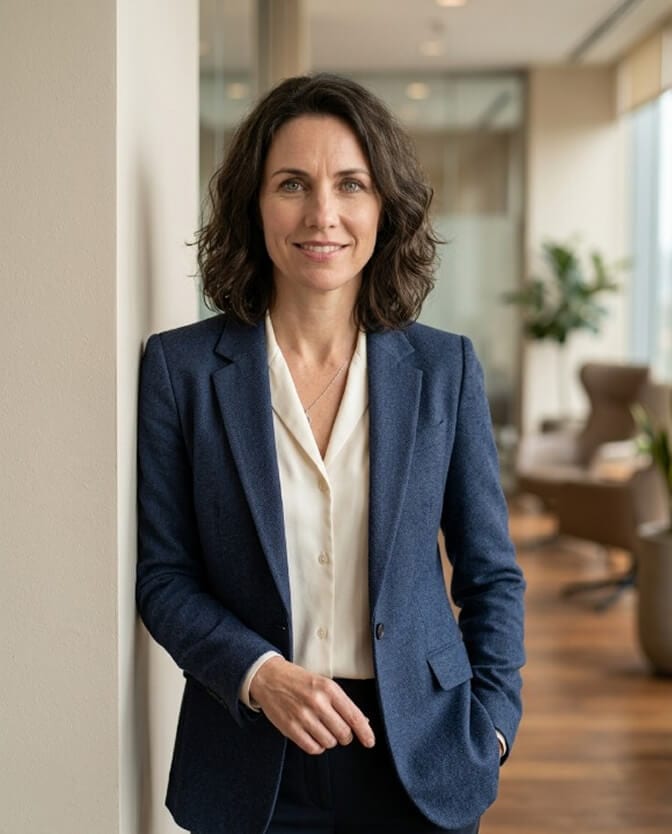
Leaning is the fastest way to look relaxed without looking casual. Rest a shoulder against a wall, or plant a hip against a desk, angle the body, and bring your eyes to the lens.
Why it works: the lean breaks the rigid vertical line and signals that you are comfortable, that the room is yours.
Keep it subtle. A heavy slouch reads as disengaged. Light contact reads as easy confidence. This one shines in environmental shots with an office or architectural background.
14. The purposeful prop (glasses, folder, tablet)
Hands with a job look natural. Hold your glasses, rest a hand on a closed laptop, carry a slim folder. The prop gives your hands a reason to exist and adds a quiet layer of story about what you do.
The rule: the prop supports you, it does not star. Keep it small and relevant.
Anything you would actually hold in your real workday works. Anything staged purely for the camera does not. Glasses held lightly in one hand is a reliable, expertise-signaling choice.
15. The power close-up (tight crop, direct eye contact)
Every set needs one frame that is all face. Tight crop, shoulders just in the frame, chin forward, eyes locked on the lens.
Why it works: at small sizes, only the eyes and expression survive. A strong close-up reads clearly even at thumbnail scale, where a full-body pose turns to mush.
Make the eyes do the work: a slight lower-lid tension, a relaxed brow, a hint of a smile. This is the photo that lands on your profile thumbnail, your conference badge, and the panel slide, so it is worth getting right.
If you only walk away with two photos, make one a warm laughing frame and one a strong close-up. Those two cover most places your portrait will ever appear.
The three details that quietly ruin good poses
Your eyes are the whole photo. Slightly tighten your lower eyelids, just a hair, like you are about to smile with your eyes only. It removes the wide, startled look and replaces it with calm confidence. Soft, relaxed eyes beat wide-open eyes every time.
Mind the negative space. Leave a little room above your head and don't crop too tight. A portrait that crowds the top of the frame feels claustrophobic. A touch of breathing room reads as composed and intentional.
Pick colors that don't fight your face. Solid, muted tones keep the focus on you. Busy patterns and harsh neon pull the eye away from your expression. If you want the full rundown, our guide on the best color to wear for a headshot saves a lot of trial and error.
The mindset that beats any single pose
Here is what I wish more women knew walking into this.
You are not trying to look like a model. You are trying to look like the most composed, capable version of yourself on a good day. That is a much easier target, and a far more useful one.
The poses are scaffolding. The angle slims, the chin defines, the posture grounds, the laugh warms. But the photo people remember is the one where you look like you, just dialed up to your best ten percent.
Pick three or four poses from this list. A strong angled one. A seated or arms-crossed authority one. A warm laughing one. That trio covers nearly every place you'll ever need a corporate portrait, from your profile to the company about page. For more options beyond the corporate set, browse our guide to the best professional headshot poses.
If you're tired of scheduling studios and praying for two decent frames, you can get your full set of corporate poses done in one to three hours, depending on the plan. Upload a few photos, and try Headshot Photo to see the angled, seated, and laughing versions side by side before you commit to one.
Your portrait is the first handshake. Make it the one that says capable, warm, and clearly in charge.
Frequently Asked Questions
What are the best female corporate portrait poses for LinkedIn and an about page?
The safest, most flattering set is a slight body angle with eyes to camera, a relaxed arms-crossed or hand-on-hip authority pose, and one genuine laughing shot for warmth. Together they cover both signals a corporate portrait needs: competence and approachability. Avoid square-on, flat-expression photos, which read as stiff.
How do corporate portrait poses for women compare to casual or lifestyle poses?
Casual and lifestyle poses lean into softness, movement, and personality, like hair flips or dreamy over-the-shoulder gazes. Corporate poses keep the head level, the eyes engaged, and the expression confident, because the goal is credibility rather than mood. The same angled body works for both, but the expression and chin position are what shift the read toward professional.
How do I pose to avoid a double chin in a corporate headshot?
Push your forehead slightly toward the camera and drop your chin a touch, which feels unnatural but carves out a defined jawline. Pair it with a body angled 30 to 45 degrees away from the lens and a back-foot weight shift for posture. This single adjustment fixes the most common complaint women have about their photos.
Are AI corporate portraits worth it compared to a studio session?
For most professionals, yes, because you get many poses, angles, and backgrounds for a fraction of a studio's cost and without booking around a photographer's calendar. A studio gives you one set of conditions in one window of time, while an AI set lets you choose the angled, seated, and warm versions separately. It also removes the pressure of nailing every pose live.
Is it safe and professional to use AI generated headshots for corporate use?
Used well, AI corporate portraits look like real, polished studio work and are widely accepted for professional profiles, team pages, and company directories. The key is choosing a tool that produces natural skin, sharp eyes, and realistic posing rather than obviously synthetic results. Keep the retouching light and the expression genuine, and the photo reads as authentically you.