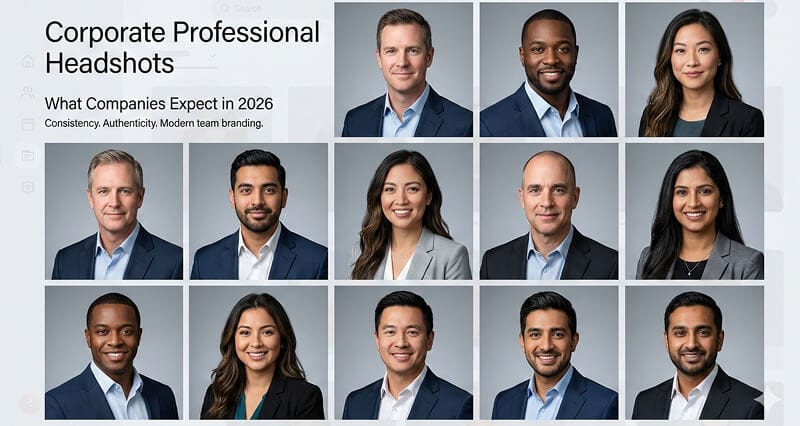
The standard has shifted. The stiff pose is dead. But the consistency problem is bigger than ever. Here's what's changed and how companies are solving it.
Last fall, a marketing director at a 200-person SaaS company sent me a screenshot of their "Meet the Team" page.
Twelve photos. Twelve completely different styles. One person had a studio shot with a gray background. Another had what was clearly a selfie taken in their kitchen. A third looked like it was captured mid-sneeze at a conference. One executive's photo was so heavily filtered it looked like a painting. Two people had no photo at all, just gray silhouettes.
"We've asked people three times to submit headshots," she told me. "This is what we got."
This is the reality for most companies in 2026. The standard for corporate headshots has evolved significantly. The problem of actually getting them done has not.
The expectation is clear: professional, consistent, authentic. The execution is a mess. And the gap between what companies want and what they end up with on their website is where trust goes to die.
Let me show you what's actually expected now, what's changed from even three years ago, and the most practical ways to close the gap.
The Standard Has Shifted (and It's Better)
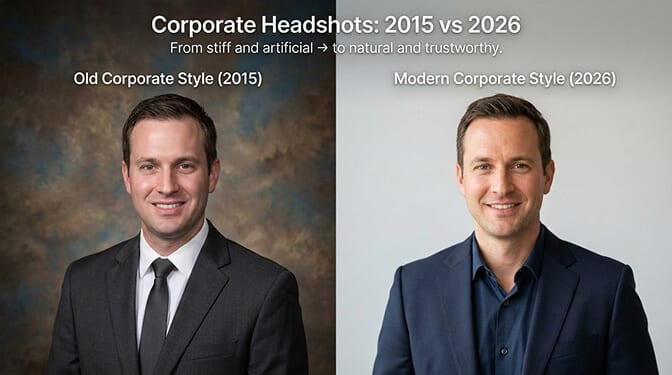
If you picture a corporate headshot and imagine a stiff person in a dark suit against a gray background with a forced smile, you're picturing 2015.
Corporate headshots in 2026 look different. The formal rigidity is gone. The heavy retouching is gone. The one-size-fits-all formula is gone.
What replaced it is something that looks, at first glance, simpler. But it's actually harder to execute well.
The modern corporate headshot is: polished but natural. Confident but approachable. Professional but human.
The shift in one sentence: companies stopped wanting headshots that look "corporate" and started wanting headshots that look "trustworthy."
The practical translation:
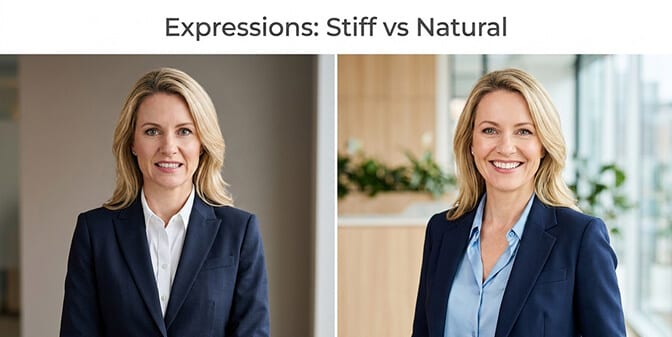
Expressions are warmer. The tight-lipped power pose has been replaced by relaxed, genuine expressions. A natural smile or warm neutral. Direct eye contact. Relaxed shoulders. The goal is someone you'd want to work with, not someone posing for a passport.
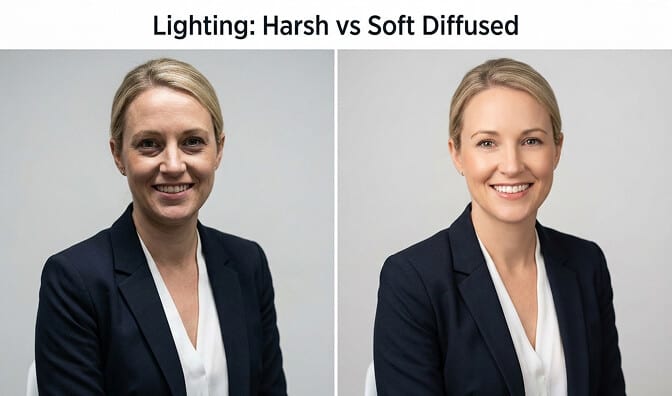
Lighting is softer. Harsh shadows under the chin and eyes are out. Soft, diffused lighting that flatters without looking obviously "studio lit" is the standard. Think: looks like it could have been taken near a window, but suspiciously well-lit.
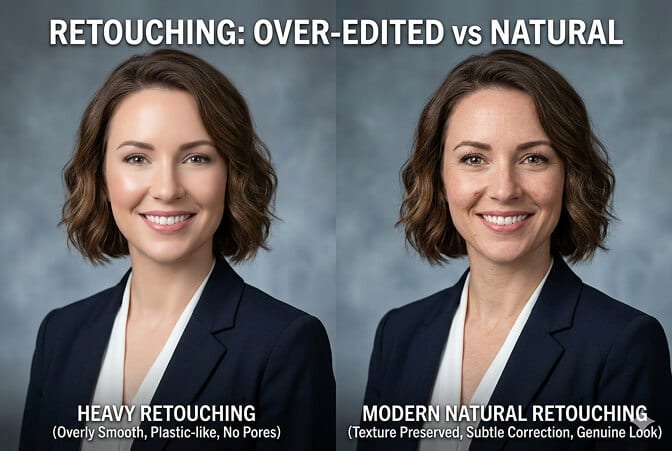
Retouching is minimal. The over-smoothed, plastic-skin look actively hurts credibility in 2026. Companies want employees to look like themselves, not airbrushed versions of themselves. Light skin evening, blemish removal, and subtle under-eye correction are standard. Anything beyond that reads as insecure or inauthentic.
Backgrounds are cleaner. Solid neutrals (white, light gray, soft blue, charcoal) remain dominant. Dark backgrounds are growing for executive-level headshots. The mottled, textured "portrait studio" backgrounds of the 2000s are decisively dead.
What Each Industry Actually Expects
This is where most guides get lazy and say "dress professionally." That advice is useless because "professional" means completely different things depending on your industry.
Finance and Law: Still the most formal. Structured suits (navy, charcoal, black), ties optional but common for senior partners. Dark, clean backgrounds. Composed expressions, slight smile or confident neutral. Research consistently shows darker clothing receives higher trust ratings in financial contexts. If you're in finance, the standard hasn't moved much. It's just less stiff.

Technology: The biggest shift. Full suits look out of place at most tech companies below the C-suite. The current standard is polished business casual: fitted button-downs, clean crew necks, optional blazer. Lighter backgrounds (white, soft gray). More open, genuine smiles. The vibe is "I'm smart and approachable" not "I'm important and serious."

Healthcare: White coats or clean scrubs remain standard depending on specialty. Warm expressions are critical because these headshots directly influence patient trust and selection. Neutral backgrounds. Our doctor professional headshot guide goes deeper on specialty-specific guidance.

Real Estate: The most personality-forward category. Agents need headshots that convey trustworthiness and warmth because they're marketing themselves directly to consumers. Bright, well-lit photos. Genuine smiles. Professional but accessible clothing. Some environmental shots work here (clean outdoor settings with natural light).

Creative Industries: The most freedom. Agencies, design studios, and marketing firms allow bold colors, textured clothing, and expressive backgrounds. But the fundamentals remain: good lighting, clean framing, genuine expression.
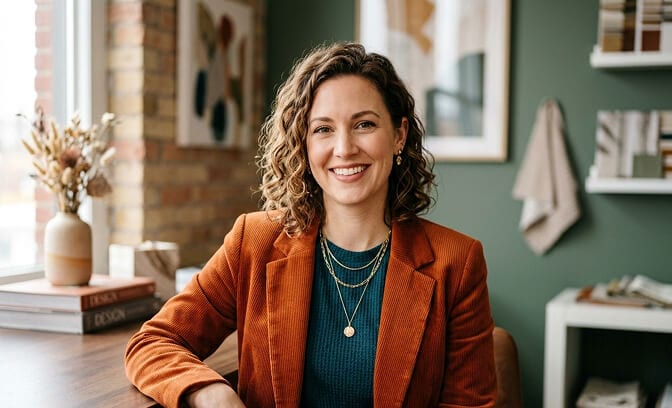
For specific clothing guidance across all industries, our guide to corporate headshot ideas covers the full breakdown.
The Consistency Problem (The Part Nobody Talks About)
Here's the thing about corporate headshots that individual guides completely miss.
The single biggest factor that makes a company's "Meet Our Team" page look professional isn't the quality of each individual headshot. It's whether they all match.
A page where every headshot has the same background color, similar lighting quality, consistent framing, and comparable retouching style communicates: this is an organized, professional, detail-oriented company.
A page where each photo is a different style, quality, and background communicates: this company can't coordinate a photo.
Patients, clients, investors, and job candidates all notice this. Research on brand consistency shows that uniform visual presentation across platforms can increase revenue by 10-20%. Your team page is one of those platforms.
But consistency is brutally hard to achieve. Here's why:
Employees join at different times throughout the year. You can't wait for photo day when someone starts in March and the next photo day isn't until September.
Remote and hybrid teams are spread across cities and time zones. Getting everyone in the same studio on the same day is logistically impossible for most companies.
People leave. People join. Headshots go stale. The average employee changes their appearance enough to warrant a new headshot every 2-3 years. At a 200-person company with normal turnover, you need 5-10 new headshots per month just to stay current.
The old model (book a photographer, schedule a photo day, herd everyone through) was designed for a world where everyone worked in the same building. That model is broken for how companies actually operate in 2026.
How Companies Are Actually Solving This
There are four realistic approaches. Each has clear tradeoffs.
1. Annual Photo Day (Traditional)
A photographer comes to the office (or employees go to a studio) for a dedicated session. Everyone rotates through. Results are consistent because one photographer controls lighting, background, and style.
Works when: Everyone is in the same location, you can block half a day, and you do it consistently every year.
Breaks when: You have remote employees, distributed offices, constant hiring, or busy schedules that make scheduling impossible. New hires between photo days are stuck without matching headshots for months.
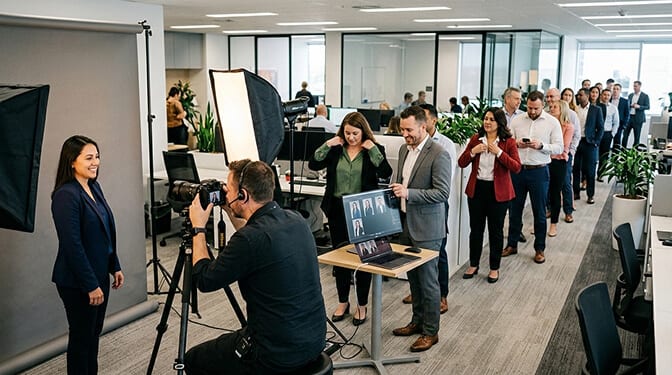
Cost: $150-400 per person, depending on the photographer and location.
2. Virtual Photography Sessions
Employees connect with a photographer via video call. The photographer directs the session remotely, the employee takes the photo on their phone, and the photographer handles retouching and background replacement.
Works when: You have distributed teams and need real photographs with professional direction.
Breaks when: Employee phone cameras and home lighting produce inconsistent quality. The retouching and background replacement can only do so much with a poorly lit source image.
Cost: $45-100 per person at scale.
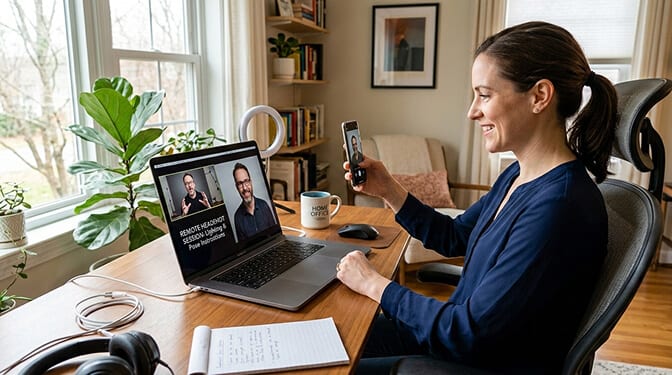
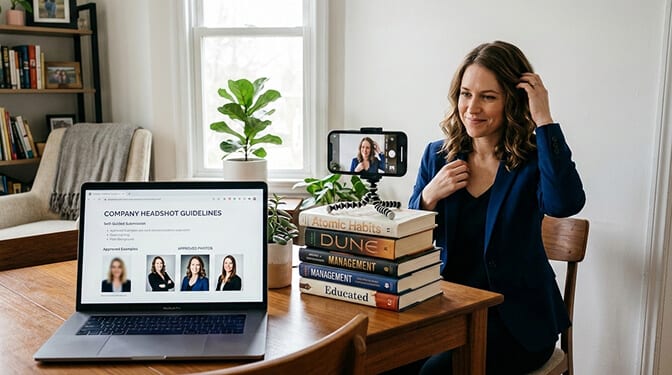
3. Self-Guided Photo Submission
Employees take their own photos following brand guidelines. Photos are submitted to a centralized team for approval, background replacement, and retouching.
Works when: Employees are motivated and follow instructions carefully. Works best with very clear visual guidelines and examples.
Breaks when: Most employees don't follow photo guidelines carefully (or at all). Rejection rates can be high, frustrating employees who have to re-submit multiple times.
Cost: $25-60 per approved headshot.
4. AI Headshot Generators
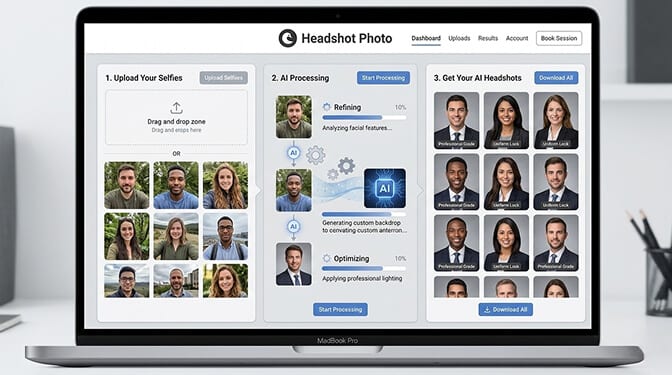
Employees upload casual selfies. AI generates studio-quality headshots with consistent backgrounds, professional lighting simulation, and natural retouching.
Works when: You need matching headshots for a distributed team without coordinating schedules, you need results fast, and you want consistent output regardless of each person's photography setup at home.
Breaks when: Highly regulated industries prohibit AI-generated images, or you need environmental/editorial photography that requires a real setting.
Cost: $20-40 per person.
This is exactly what Headshot Photo was built for. Each employee uploads their own photos on their own time. The AI generates consistent, matching headshots with the same background style, lighting quality, and professional polish across the entire team. No scheduling, no photo day logistics, no rejection cycles. Results in minutes.
The Cost Math for Companies
Let me lay out the real numbers for a 50-person team.
| Method | Per Person | Total (50 people) | Time to Complete | Consistency |
|---|---|---|---|---|
| Traditional photo day | $200 avg | $10,000 | 4-6 weeks (booking + session + editing) | High (if everyone shows up) |
| Virtual photographer | $75 avg | $3,750 | 2-3 weeks (scheduling + delivery) | Medium-High |
| Self-guided submission | $40 avg | $2,000 | 3-6 weeks (submissions + rejections + resubmissions) | Medium (varies by employee) |
| [AI headshot generator](/ai-headshot-generator) | $30 avg | $1,500 | 1-2 days (employees can do it anytime) | Very High (AI controls consistency) |
The math becomes even more obvious at scale. For a 200-person company, the difference between a traditional photo day ($40,000+) and an AI solution ($6,000) is significant. And the AI approach eliminates the scheduling coordination that is, for most HR and marketing teams, the actual painful part.
What HR and Marketing Should Specify
If you're the person responsible for getting this done at your company, here's a quick specification sheet you can share with your team or vendor:
Background: Specify one color. Solid white, light gray, or soft blue are the safest. Charcoal or navy for a more executive feel.
Framing: Head and shoulders. Eyes in the upper third of the frame. Consistent crop ratio across all employees.
Attire guidance by level: Provide examples. "Executives: blazer required. Managers: collared shirt or blouse. Everyone else: clean, professional, no logos or busy patterns."
Expression: Warm, approachable, genuine. Show examples of what you mean. Most people default to either "frozen smile" or "serious" if you don't show them what "natural and professional" actually looks like.
Retouching standard: Natural. Blemish removal and light skin evening, yes. Smoothing out all texture, no. People should look like themselves, not like magazine covers.
Update frequency: Every 2 years, or whenever an employee's appearance changes significantly. Build this into your onboarding process for new hires.
For more on which background colors photograph best across different contexts, our best headshot background colors guide covers the full range.
The Real Standard in 2026
Here's what actually changed versus what people think changed.
What changed: The style. It's less stiff, more human, warmer lighting, more genuine expressions, lighter retouching. The aesthetics evolved and they evolved in a good direction.
What really changed: The logistics. Companies now expect headshots to be a scalable, maintainable system rather than a one-time event. The "team page" isn't a static thing you update once a year. It's a living asset that needs to be current, consistent, and automatically updated as people join, leave, and change.
What hasn't changed: Consistency still wins. A mediocre headshot that matches the rest of the team beats a spectacular headshot that looks completely different from everyone else's.
At Headshot Photo, companies can get consistent, matching headshots for their entire team without scheduling a single photographer or coordinating a photo day. Each employee uploads their own selfies and gets studio-quality results with matching backgrounds and professional polish. Fast, uniform, and built for how companies actually work in 2026.
One Last Thing
That marketing director with the mismatched team page? She eventually ran the whole company through an AI headshot generator. Sent a link to all 200 employees with instructions: "Upload 5-10 photos. Select this background. Submit your best one."
Three weeks later, their team page had 200 matching, professional, current headshots. Same background. Same framing. Same polish. Everyone looked like themselves, just the best, most professional version of themselves.
"Nobody complained about looking fake," she told me. "Nobody missed a photo day. Nobody had to reschedule three times. It just got done."
For most companies in 2026, that's the standard. Not perfection. Just: get it done. Get it done well. Get it done consistently. And stop overthinking it.
Frequently Asked Questions
1. What are corporate professional headshots and why do companies need them?
Corporate professional headshots are standardized, polished portrait photographs of employees used across company websites, LinkedIn profiles, email signatures, internal directories, and marketing materials. Companies need them because these images directly affect brand credibility and client trust. Research shows consistent brand presentation across platforms can increase revenue by 10-20%, and mismatched team photos signal organizational disorganization to clients and candidates.
2. How do AI corporate headshots compare to traditional photographer sessions?
For standard head-and-shoulders corporate headshots, AI-generated photos produce results comparable to studio photography at a fraction of the cost and time. The main advantage of AI for companies is consistency: every employee gets matching backgrounds, lighting, and retouching regardless of when or where they submit their photos. Traditional photographers still offer advantages for executive-level editorial portraits, environmental shots, and situations requiring creative direction.
3. How do I get consistent headshots for a distributed or remote team?
The most efficient method is an AI headshot generator like Headshot Photo where each employee uploads their own photos independently and selects from pre-set matching backgrounds. This eliminates scheduling coordination entirely and produces uniform results. Alternatively, virtual photography sessions with a live photographer can achieve consistency, though at higher cost and with scheduling requirements.
4. How much do corporate headshots cost per employee?
Corporate headshot costs range from $20-400+ per person in 2026 depending on method. Traditional in-studio photography runs $150-400 per person. Virtual photographer sessions cost $45-100 per person. Self-guided submission services charge $25-60 per approved photo. AI headshot generators cost $20-40 per person and offer the fastest turnaround with the highest consistency for teams.
5. Are AI-generated headshots professional enough for a corporate website?
Yes, for the vast majority of corporate uses. AI headshots in 2026 produce studio-quality results with proper lighting, clean backgrounds, and natural retouching that are indistinguishable from traditional photography for standard team page, LinkedIn, and email signature uses. The exception is highly regulated industries (some financial and healthcare contexts) where policies may specifically require real photographs. Check your company's brand guidelines before proceeding.