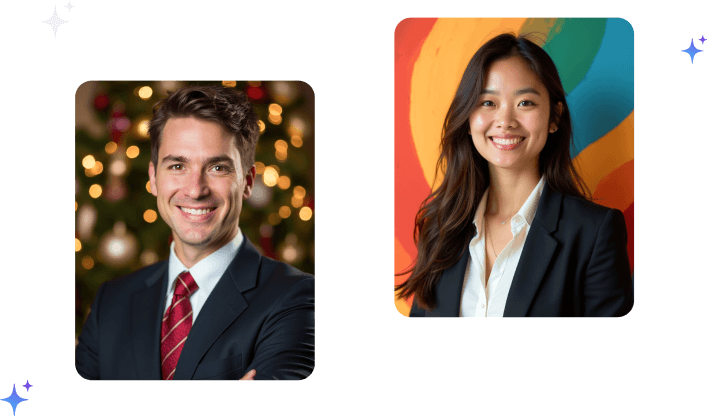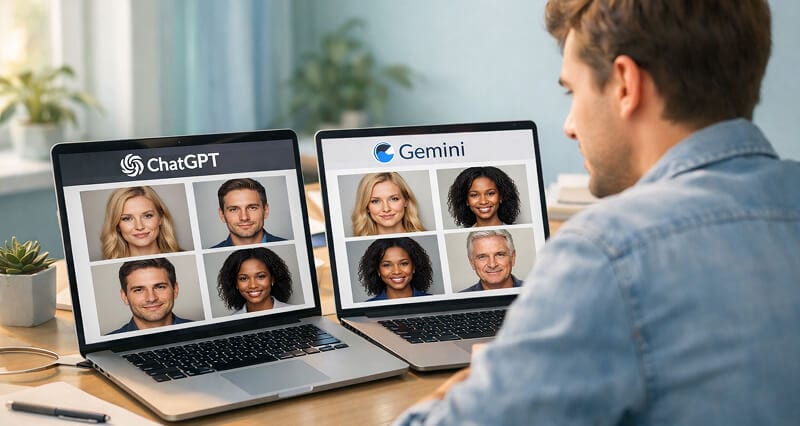
We tested both. One changed our hair color. The other gave us a completely different face. Here's what actually happened.
Last Tuesday, one of our users sent us a screenshot that made us laugh and wince at the same time.
She'd asked ChatGPT to turn her selfie into a professional headshot. The result? Her nose was different. Her jawline was sharper. Her brown eyes had turned hazel.
"Is this supposed to be me?" she wrote. "Because this is definitely not me."
We hear some version of this story every single week now. Ever since ChatGPT and Gemini started offering image generation, people have been flooding these tools with selfies, hoping to skip the photographer and walk away with a LinkedIn-ready headshot.
And honestly, we get it. The idea is irresistible. You already pay for ChatGPT Plus. Gemini is sitting right there in your Google account. Why not just ask them to make you look professional?
Here's the weird part.
Sometimes it works. Sort of. And that "sort of" is exactly where things get dangerous.
The Promise Sounds Too Good
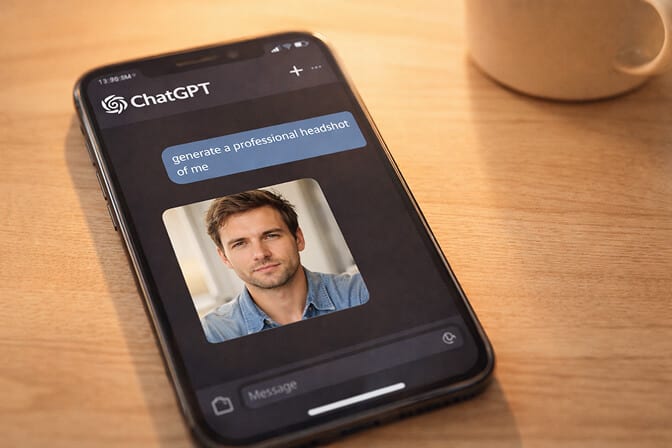
Free. Fast. Easy.
The problem is that "an image" and "your professional headshot" are two very different things.
A headshot isn't just a nice-looking picture of a person. It's a picture of you. Your exact face, your real skin texture, your actual proportions. The version of you that someone would recognize if they met you at a conference five minutes later.
And that's precisely where these general-purpose AI tools start falling apart.
What Actually Happens When You Try ChatGPT for Headshots
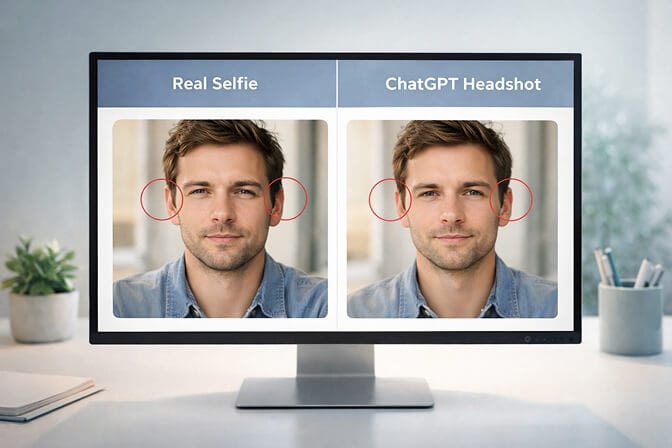
The output looked polished at first glance. Professional lighting. Clean background. Nice composition.
But then we zoomed in.
The face wasn't quite right. Subtle things. The distance between the eyes was slightly off. The skin had that telltale smoothness, almost like someone had airbrushed a mannequin. And the expression? It looked like the AI's idea of "confident" rather than the person's actual resting expression.
This isn't a knock on ChatGPT. It's genuinely impressive technology for generating creative images, writing stories, and brainstorming ideas. But generating a headshot that accurately preserves someone's identity is a fundamentally different problem than generating "a professional-looking person."
ChatGPT's image model doesn't train on your specific face. It receives your photo as a reference and tries to approximate your features while following the prompt. The result is often someone who looks similar to you rather than someone who is you.
For a social media meme? That's fine. For the photo that sits on your LinkedIn profile, your company's About page, or the resume you're sending to hiring managers? That's a real risk.
If you want to see what happens when ChatGPT is pushed to its limits for headshots specifically, we did a deeper dive in our post on how ChatGPT performs as a headshot generator.
And Then There's Gemini
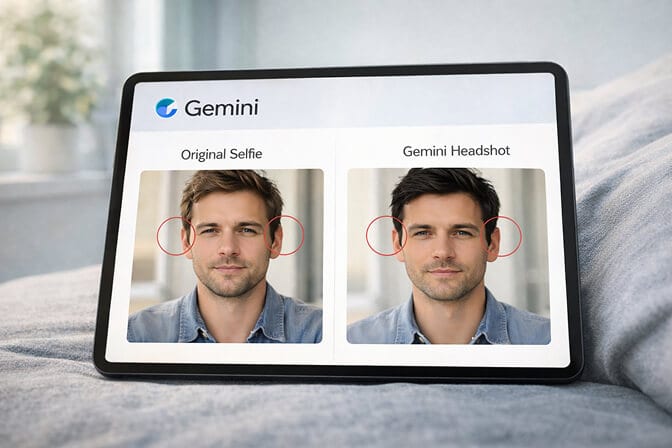
On the positive side, Gemini sometimes preserved the overall "vibe" of the person better than ChatGPT. The pose felt more natural. The hair texture had more detail.
But then it changed our tester's brown hair to jet black. The face looked noticeably heavier than the actual person. The skin tone shifted. And the expression felt generic, like a stock photo actor trying to look "approachable."
We've read glowing reviews from people who got great results with Gemini for personal branding photos. And some of those results genuinely look good. But there's a critical distinction between a creative AI-generated portrait and a professional headshot you'll use to represent yourself in real business contexts.
A headshot needs to be you. Not a better-looking version of you. Not a stylized interpretation of you. Literally, recognizably you.
Stay with me here. Because this is the part that most comparison articles skip over.
The Part Nobody Tells You About "Free"
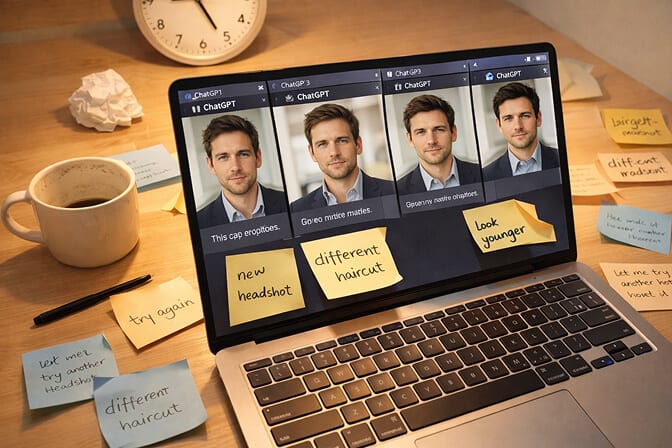
But the real cost of using ChatGPT or Gemini for your headshot isn't money. It's the time you spend prompting, re-prompting, adjusting, and then finally settling for something that's "close enough."
We've watched users go through 15, 20, sometimes 30+ iterations trying to get ChatGPT to produce a headshot that actually looks like them. Each time tweaking the prompt. "Make the nose slightly wider." "The eyes should be darker." "Less smooth skin."
That's not a 2-minute task. That's an afternoon project. And at the end of it, most people still aren't satisfied.
Here's why. These tools were not built for headshots. ChatGPT is a conversational AI with image generation bolted on. Gemini is a multimodal assistant that can generate images among dozens of other things. Neither was specifically trained or optimized for the precise task of creating realistic, identity-preserving professional portraits.
A dedicated AI headshot generator works differently. Tools built specifically for this purpose train a model on your uploaded selfies. The AI learns your exact facial features, your bone structure, your unique characteristics. Then it generates headshots that are genuinely, unmistakably you.
That's a fundamentally different approach from "here's a reference photo, now generate something similar."
To see how dramatic the difference can be between a casual selfie and a proper AI headshot from a dedicated tool, check out our collection of AI headshot before and after transformations.
When Free Tools Work (And When They Don't)

Probably fine for: a quick social media avatar, a placeholder image while you're waiting for a real headshot, internal Slack profiles that nobody takes too seriously, or casual personal branding experiments.
Probably not fine for: LinkedIn profiles that hiring managers and recruiters will see, company team pages that represent your brand, resumes and job applications, speaking event bios, or any context where someone might meet you in person afterwards and expect you to look like your photo.
The gap between "looks like a professional photo" and "looks like me in a professional photo" might sound small. But it's the gap between building trust and creating confusion.
Think about it from the recruiter's perspective. They see your LinkedIn photo. They schedule a video call. You show up looking noticeably different. That's an awkward way to start a relationship. We explored this exact question in detail in our post on whether employers can tell if your headshot is AI.
This Is Where Most People Get It Wrong
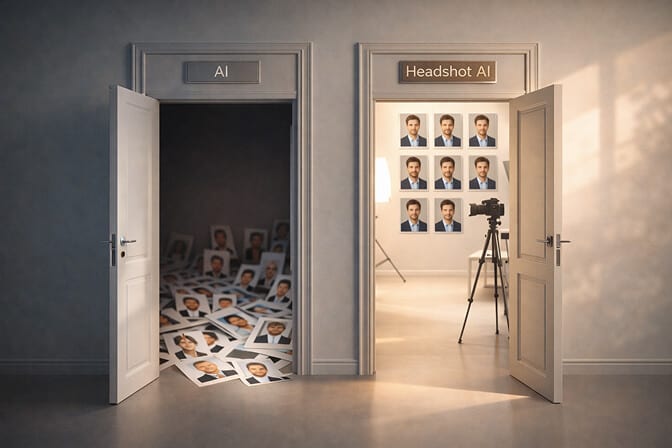
General-purpose tools like ChatGPT and Gemini use large image models that have been trained on billions of images across every category imaginable. Animals, food, architecture, and yes, people. They're incredibly versatile but not specialized.
Dedicated AI headshot generators use those same foundational models but then fine-tune them specifically on your photos. It's the difference between a general practitioner and a specialist. Both are doctors. But when you need heart surgery, you want the cardiologist.
At Headshot Photo, this is exactly how we built our tool. You upload 8 selfies. The AI learns your specific face. Then it generates over 100 professional headshots in different styles, backgrounds, and outfits. The whole process takes about 1 hour, and the output is designed to look indistinguishable from real studio photography.
No prompt engineering required. No 30 iterations. No ending up with someone else's face.
If you're curious about how this stacks up against hiring an actual photographer, we broke it all down in our comparison of headshot photographers vs AI headshots.
The Honest Comparison Nobody Wants to Write
Fair point. So let's look at this from the other direction.
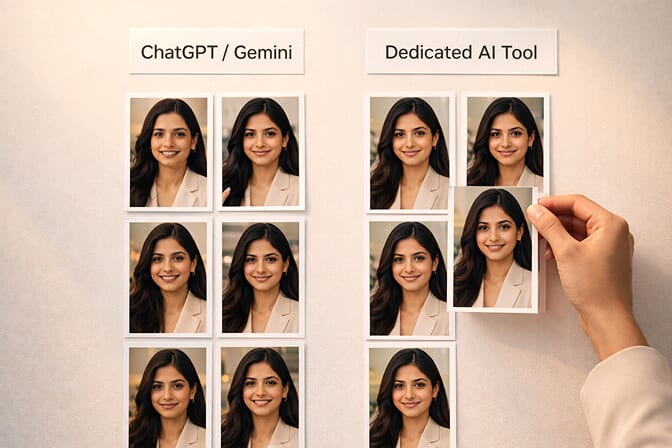
What ChatGPT and Gemini do better: They're more flexible. You can ask for creative, artistic, editorial-style images that a headshot-specific tool wouldn't generate. If you want a "cinematic portrait in the style of Annie Leibovitz with dramatic side lighting and a moody forest background," ChatGPT will give you something interesting. That's not what a headshot tool does.
What dedicated headshot tools do better: Accuracy. Identity preservation. Consistency. Speed. And output that you can confidently put on a professional profile without worrying whether someone will think you used a stock photo of a different person.
Different tools for different jobs. Neither is "wrong." But using ChatGPT for your LinkedIn headshot is a bit like using a Swiss Army knife to slice bread. It technically has a blade. But a bread knife does it better and faster with cleaner results.
For a broader look at where AI headshot tools stand in 2026, including both free and paid options, check out our roundup of the best AI headshot generators tested side by side.
So, Do Free AI Tools Actually Work for Headshots?

They don't work for generating accurate, identity-preserving headshots that you'd trust with your career.
And that distinction matters more than most people realize.
Your headshot is often the first thing a potential employer, client, or collaborator sees. Before they read your experience. Before they see your portfolio. Before they hear you speak. They see your face.
A professional headshot isn't about vanity. It's about trust. And trust starts with authenticity.
If you're tired of playing prompt engineer and want a headshot that actually looks like you, done in 1 hour instead of an afternoon, give Headshot Photo a try. Upload a few selfies and see the difference a purpose-built tool makes.
Frequently Asked Questions
1. Can ChatGPT generate professional headshots?
ChatGPT can generate images that look like professional headshots, but it doesn't accurately preserve your facial identity. The output often changes subtle features like nose shape, skin texture, and proportions, making the result look like a similar person rather than you. For professional use, a dedicated headshot tool produces significantly more reliable results.
2. How does Gemini compare to ChatGPT for AI headshots?
Gemini's Nano Banana models sometimes preserve overall appearance better than ChatGPT, but it still struggles with accuracy. In our testing, Gemini changed hair color, altered face proportions, and shifted skin tone. Both tools produce creative portraits, but neither consistently generates headshots you'd confidently use on LinkedIn or a company website.
3. How do I create a professional headshot with AI?
The most reliable method is using a dedicated AI headshot generator like Headshot Photo. Upload 8 clear selfies taken in good lighting, select your preferred styles and backgrounds, and receive over 100 professional headshots in about 1 hour. Unlike general AI tools, dedicated generators train a model on your specific features for accuracy.
4. Is it worth paying for an AI headshot generator instead of using free tools?
For casual or personal use, free tools may be sufficient. But for LinkedIn profiles, resumes, job applications, or corporate team pages, paid tools consistently produce more realistic, identity-accurate results. Most dedicated generators cost a fraction of a traditional photo shoot while delivering studio-quality output that actually looks like you.
5. Are AI-generated headshots good enough for LinkedIn?
Yes, when created with the right tool. Headshots from dedicated AI generators like Headshot Photo are designed to meet professional standards and look indistinguishable from real photography. Headshots from general tools like ChatGPT or Gemini often have subtle AI artifacts or identity inconsistencies that can undermine your professional credibility.