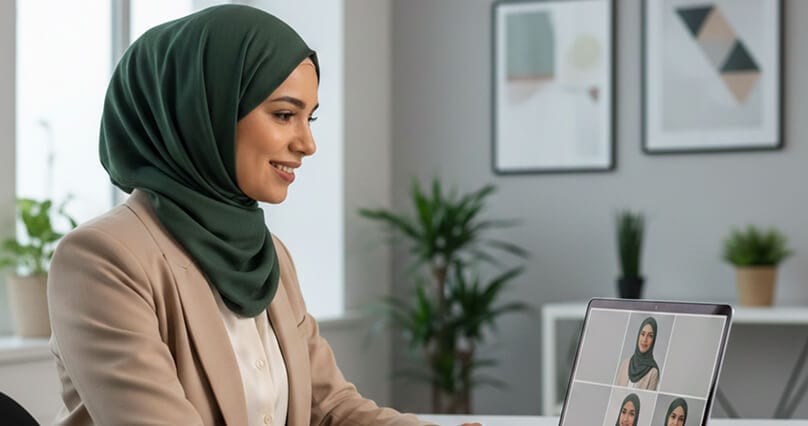
Professional Headshot With Hijab: The Complete Styling Guide Nobody Gave You
The styling secrets that make the difference between a forgettable photo and one that commands respect
The photographer adjusted the lighting for the third time.
"Something's just... off," she said, tilting her head like I was a puzzle she couldn't quite solve.
I knew exactly what was off. She didn't.
My hijab a beautiful seafoam chiffon I'd carefully chosen was catching the light in all the wrong places. The draping I'd perfected for everyday wear was creating shadows under my chin that aged me ten years. And the way I'd tucked the fabric behind my ears? It was making my face look rounder than a dinner plate.
I'd spent twenty years styling my hijab. But I'd never styled it for this.
That photoshoot taught me something important: What works in real life doesn't always work on camera. And most photographers wonderful as they are simply don't know how to guide hijabi women through the specific adjustments that make professional photos actually work.
So I learned. Through trial, error, and way too much money spent on headshots that made me cringe.
Here's everything I wish someone had told me.
The Fabric Truth Nobody Talks About
Let's start with what actually matters most: what your hijab is made of.
That silk scarf you love? Disaster under studio lights. The satin finish creates hot spots those blown-out white patches that make it look like your head is radiating light.
The fabrics that photograph beautifully:
Cotton jersey absorbs light instead of bouncing it back. It drapes smoothly without creating harsh lines. And it stays crucial when you're holding poses for extended periods.
Matte chiffon (not shiny) gives you elegant draping without the reflective nightmare. Layer it over a matching undercap for the most polished look.
Modal and viscose blends hit the sweet spot between structure and softness. They hold their shape but don't look stiff.
What to avoid:
Satin and silk (too reflective), pure polyester (can look cheap on camera and creates weird texture), and anything with metallic threads or sparkle (they read as distracting artifacts in professional photos).
The rule of thumb: If it catches your eye in direct sunlight, it'll catch the camera in ways you don't want.
Face Shape Meets Hijab Style (The Real Guide)
Here's where most styling advice gets vague. "Wear what flatters you," they say.
Not helpful.
Let me be specific.
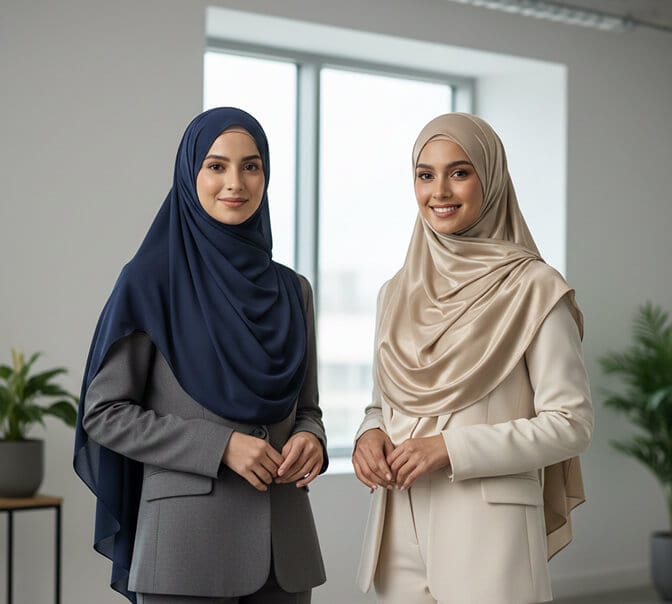
Round face? You need vertical lines and volume above your forehead, not beside it. Try the Turkish-style wrap that creates height at the crown. Pull the fabric slightly forward to elongate your face, and avoid wrapping tightly around your cheeks it emphasizes roundness.
Oval face? You've got the most flexibility. But for headshots specifically, slightly looser framing around the face photographs better than tight pulls. Too tight and you look severe. Softness reads as approachable on camera.
Square or angular face? This is actually an advantage for professional photos strong features photograph powerfully. A simple, clean wrap that doesn't add bulk at the jawline lets your natural structure shine. Avoid excessive fabric layers near your chin.
Long face? Add width with side draping. A wrap that sits lower on your forehead and has more horizontal movement balances proportions. Avoid styles that add height at the crown.
Heart-shaped face? You want to balance a narrower chin. Let some fabric drape loosely below the jawline it creates visual weight where you need it.
The key insight here: professional headshots crop tight. Everything from mid-chest up gets magnified. Those small adjustments matter more than they would in a full-length mirror.
The Undercap Strategy Most Women Miss
Your undercap isn't just about keeping things in place.
It's the foundation of how your entire headshot looks.
A high-quality cotton undercap in a color close to your skin tone creates a seamless transition from your face to your hijab. It prevents that harsh "line" where hijab meets forehead that can look jarring in close-up photography.
The color matching trick: Match your undercap to your hijab, not your skin. When the undercap peeks through (and it will, at least slightly), you want it to look intentional like a coordinated layer rather than an accident.
For lighter hijab colors, a nude undercap works beautifully.
For darker hijabs, match the hijab shade or go slightly lighter.
Never: Use a stark white undercap under a dark hijab unless you want to look like you're wearing a bathing cap.
The Lighting Challenge (And How to Work With It)
Here's what photographers don't realize: traditional headshot lighting was designed for uncovered hair.
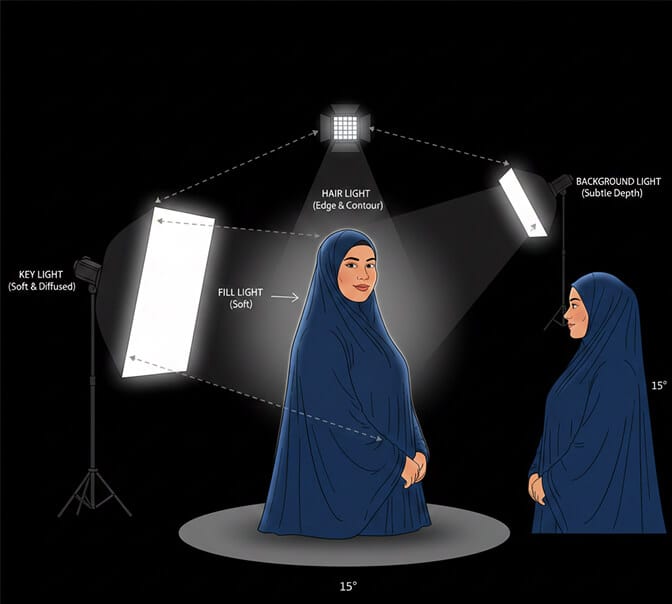
Standard three-point lighting can create unflattering shadows with hijab especially where the fabric folds near your neck and chin.
What to ask your photographer:
"Can we bring the fill light slightly higher?" This reduces under-chin shadows created by hijab draping.
"Can we try a slightly lower key light?" This reduces harsh shadows across the hijab fabric itself.
If you're taking photos at home or using an AI headshot generator, the same principles apply. Face a window for natural light. Avoid overhead lighting at all costs it's the enemy of anyone wearing a headscarf.
The angle that always works: Turn your head about 15 degrees from straight-on. This creates dimension in your face while giving the hijab natural shadowing that looks intentional rather than accidental.
Color Psychology for Professional Impact
Color matters more than you think. And the "rules" for professional headshots shift when you're wearing hijab.
Why? Because your hijab becomes a significant part of the visual composition. It frames your face. It's the first thing people notice. So the color needs to work hard.
The power colors:
Navy blue reads as competent and trustworthy. It's the safest choice for corporate environments and photographs beautifully.
Burgundy and deep plum convey sophistication without being boring. Great for creative industries.
Forest green is underrated it's professional without being predictable.
Soft neutrals (taupe, warm gray, camel) let your face be the focus. Perfect if you're in an industry where you want personality to come through more than wardrobe.
Colors to approach carefully:
White can work but only if your photographer knows how to expose for it properly. Otherwise it blows out and becomes distracting.
Black can create a "floating head" effect if your background is light. It works well against darker backgrounds.
Bright colors (coral, teal, mustard) can be stunning but require careful consideration of your industry and personal brand. A creative director? Go for it. An investment banker? Maybe not.
The "Looking Natural" Problem
Here's the paradox: professional headshots need to look effortless. But achieving that effortlessness requires... effort.
Specifically, your hijab needs to look like you just happened to put it on perfectly. Not like you've been adjusting it nervously for twenty minutes (even if you have).
The trick: Style your hijab exactly how you want it, then move.
Shake your head gently. Turn side to side. Let the fabric settle naturally.
The slightly imperfect drape looks more authentic than the mathematically precise one. Humans are drawn to faces that look alive, not mannequin-perfect.
One exception: under the chin should stay neat. That's where eyes go in headshots. The rest can breathe.
Common Mistakes I See Constantly
Wearing a hijab style you don't normally wear. Your discomfort shows. If you usually wear a simple wrap, don't suddenly try an elaborate Turkish style because you think it looks "more professional." Wear what feels like you, just optimized for camera.
Too much pattern. Solid colors photograph better. Patterns can compete with your face and look busy in tight crops. Save the printed hijabs for your personal life.
Matching hijab to outfit. This sounds counterintuitive, but perfect matching can look costumey. Choose complementary colors instead. Navy hijab with a gray blazer. Burgundy hijab with a black top. The slight contrast adds visual interest.
Forgetting your ears. Decide: are they showing or not? Asymmetry here looks accidental rather than intentional. Commit to one or the other.
Ignoring the neckline. Where your hijab meets your clothing matters. V-necks generally photograph better than crew necks because they create visual length. Avoid turtlenecks unless you want your face to look like it's sitting directly on your shoulders.
The Part Where I Get Real With You
Getting professional headshots as a hijabi woman comes with emotional weight that non-hijabi women don't have to carry.
You might be wondering: Will I be judged? Will this hurt my career? Should I choose the most "neutral" look possible?
Here's what I believe: Your hijab is part of your professional identity. Full stop.
The goal isn't to make it invisible or apologetic. The goal is to make it look intentional, confident, and polished the same goal any professional has for their headshots.
The most powerful headshots I've seen are from women who wore their hijab like it was an extension of their expertise. Not something to work around. Something that's simply part of their presence.
That confidence shows. Every time.
Ready to Skip the Trial and Error?
If the thought of coordinating photographers, lighting, and endless reshoots exhausts you, I get it.
That's exactly why we built HeadshotPhoto.io to handle professional AI headshots that respect how you actually look hijab and all. No explaining to photographers what you need. No hoping they "get it." Just upload your photos and let our AI create headshots that you'd actually want to use.
Try it free and see for yourself.
Quick Reference: Your Headshot Prep Checklist
- Choose matte fabrics (cotton jersey, modal, matte chiffon)
- Select a color that complements your skin tone AND your industry
- Match undercap to hijab shade
- Practice your exact wrap style until it's automatic
- Ask photographer about adjusted lighting angles
- Commit to ears showing or covered no in-between
- Wear a neckline that creates vertical length
- Move and resettle before final shots
You've got this.
Frequently Asked Questions
What is the best hijab color for a professional headshot?
Navy blue, burgundy, forest green, and neutral tones like taupe photograph beautifully and convey professionalism across industries. Avoid very bright colors unless your personal brand supports them, and be cautious with white or black without proper lighting considerations.
Can I use AI headshot generators if I wear hijab?
Yes, AI headshot tools like HeadshotPhoto.io work well with hijab-wearing users. The key is uploading input photos with consistent hijab styling and various expressions. Quality AI generators will preserve your hijab in the generated headshots while creating professional backgrounds and lighting.
How do I prevent my hijab from looking shiny in photos?
Choose matte fabrics like cotton jersey, modal, or matte chiffon. Avoid silk, satin, and polyester with sheen. If your hijab has slight shine, ask your photographer to reduce direct lighting intensity and use diffused light sources.
Should I wear my hijab differently for a LinkedIn photo versus everyday wear?
Your LinkedIn headshot should look like an elevated version of your normal style not a completely different look. The goal is recognition when people meet you in person. Make small adjustments for camera (neater draping, solid colors, good undercap) but maintain your signature style.
How can I make my face look slimmer in a professional headshot with hijab?
Create vertical lines and height at the crown with Turkish-style wrapping. Pull the fabric slightly forward to elongate the face shape. Avoid tight wrapping around the cheeks, and choose darker hijab colors which photograph more slimming than lighter shades.