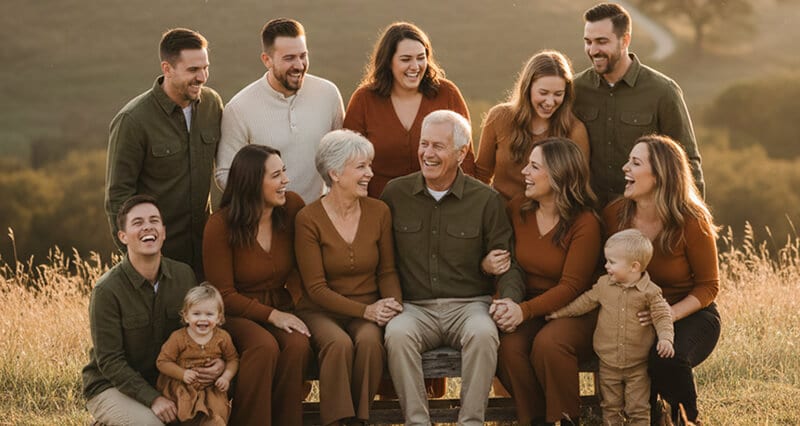
Quick answer: the best colors for large group family photos
Muted, mid-tone shades built around one neutral. Cream, camel, olive, rust, navy, sage and dusty blue photograph well in almost any light. Pick one palette of three to five colors, give each household one accent color, and keep bright neon, pure white and busy logos out of the frame.
- Fall
- Rust, olive, cream, chocolate brown
- Winter
- Burgundy, forest green, cream, charcoal
- Spring
- Sage, lavender, blush, cream
- Summer or beach
- Dusty blue, sand, white linen, soft coral
Jump to: The 12 palettes · By season · By location · Who wears what · Extended family and reunions · Coordinating 15+ people · Patterns and skin tones · Colors to avoid · FAQ
How to get 15 or more people looking effortlessly polished, even when Uncle Larry insists on wearing jeans.
Last Thanksgiving, my cousin sent a group text that made my stomach drop.
"Family portrait on Saturday! Everyone wear blue!"
You can probably guess what happened. Grandma showed up in navy. My brother wore electric teal. The kids had on powder blue. And my uncle? Royal blue polo with khaki pants the exact combo you'd wear to sell insurance in 1997.
The photo looked like a Crayola explosion had a fight with a Best Buy uniform policy.
Here's the thing. Most families approach large group photos completely wrong. They either go full matching which looks like a cult initiation or they wing it entirely and end up with visual chaos.
But there's a third option. One that makes everyone look intentional, coordinated, and like themselves.
It starts with choosing the right color scheme. And more importantly, knowing how to actually execute it across 10, 15, or 20+ people without losing your mind.
Why Color Schemes Beat "Just Wear Whatever"
When I first started researching best colors for family photos, I assumed the advice would be simple. Pick a nice color. Tell everyone to wear it. Done.
Not even close.
The difference between a forgettable family portrait and one you'll frame for 30 years often comes down to color coordination. And with large groups, the stakes get higher.
Here's why a proper color scheme matters:
It creates visual cohesion without uniformity. You want people to look together without looking like they're about to break into synchronized choreography.
It photographs better. Certain color combinations create depth and dimension. Others like everyone in stark white flatten into a blob under camera flash.
It helps define family units naturally. In extended family photos, subtle shade variations can help viewers understand who belongs to whom without anyone wearing name tags.
And honestly? It reduces stress. Giving family members a clear palette with options is infinitely easier than fielding 47 texts asking "is this okay?"
The goal isn't matching. It's harmony.
The 12 Best Large Group Family Photo Color Schemes
Each palette below comes with hex codes you can screenshot and send to the group chat. I've tested them across dozens of family sessions. They work for three-generation gatherings, reunion weekends, holiday cards, and everything in between.
Each one includes the exact colors to use, who should wear what, and how to handle the family member who inevitably goes rogue.
1. Earth Tones + Cream (The Failsafe)
Colors: Terracotta, olive, camel, ivory, rust, sage, warm brown
Swatch
Best for: Outdoor shoots, fall sessions, relaxed family vibes
This is my go-to recommendation for first-time large group portraits. It's warm. It's forgiving. And it works with almost every skin tone and location.
The secret? Earth tones have natural variation built in. One person can wear rust while another wears camel, and they'll still look cohesive because the colors share the same warm undertone.
How to distribute:
- Older generations: Cream, ivory, or soft sage (lighter colors read as approachable)
- Parents: Terracotta, olive, or camel (grounding colors anchor the composition)
- Kids: Rust, warm brown, or mix of textures (they'll pop without overwhelming)
Texture tip: This palette sings with natural fabrics. Think linen shirts, cotton dresses, knit sweaters. Avoid shiny synthetics they catch light weird in photos.
2. Jewel Tones + Navy (The Statement Maker)
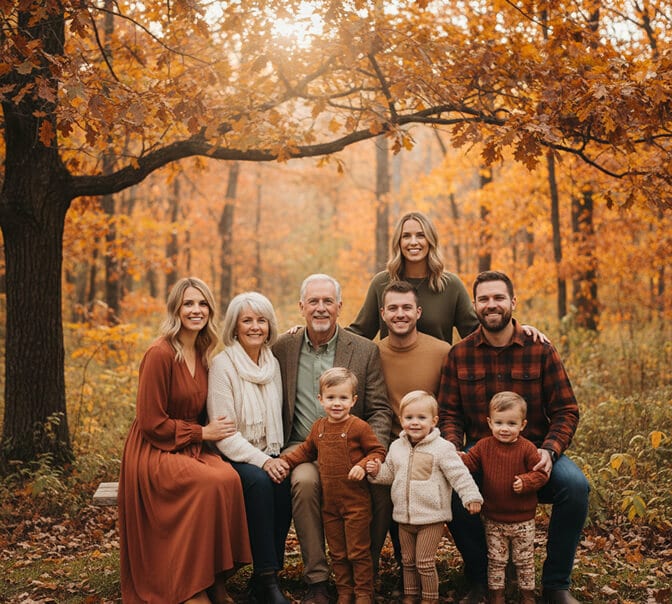
Colors: Emerald, burgundy, navy, mustard, deep plum, forest green
Swatch
Best for: Winter shoots, studio sessions, holiday cards, formal events
If your family isn't afraid of bold color, this palette creates stunning, editorial-style portraits. Jewel tones have depth and richness that photograph beautifully especially in controlled lighting or against snowy backdrops.
The key is balance. Too much of any single jewel tone gets heavy fast.
How to distribute:
- Limit each bold color to one or two people max
- Use navy as your neutral anchor (works like a dark denim effect)
- Add mustard as an accent on kids or accessories
- Keep the ratio roughly 60% neutrals/navy, 40% jewel tones
The Uncle Larry workaround: If someone insists on jeans, embrace it. Navy denim fits right into this palette. Pair it with a burgundy sweater and you've turned resistance into coordination.
3. Soft Neutrals + One Pop of Color (The Minimalist)
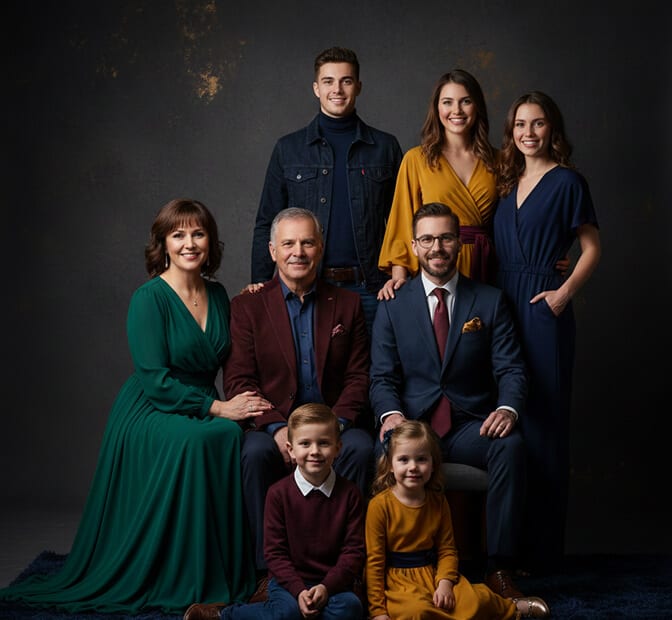
Colors: Cream, beige, light gray, tan + ONE accent (dusty rose, sage, or soft blue)
Swatch
Best for: Beach photos, modern aesthetics, families who want understated elegance
This is the family photo color scheme for people who cringe at bold colors. It's clean, timeless, and incredibly versatile across locations.
Here's the trick: you need that single pop of color. Otherwise, everyone blends together like a sea of oatmeal.
How to distribute:
- Choose ONE accent color (I love dusty rose or sage)
- Put it on Mom or the person who'll be most central in compositions
- Everyone else stays in cream, beige, or light gray
- Vary the textures to add visual interest without adding color
Warning: Avoid pure white. It blows out in photos and creates harsh contrast. Cream and ivory are your friends.
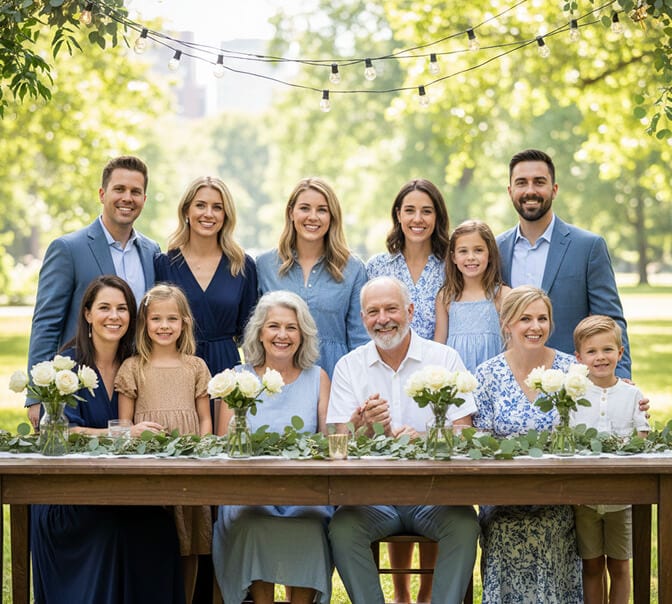
4. Blues + Warm Neutrals (The Crowd Pleaser)
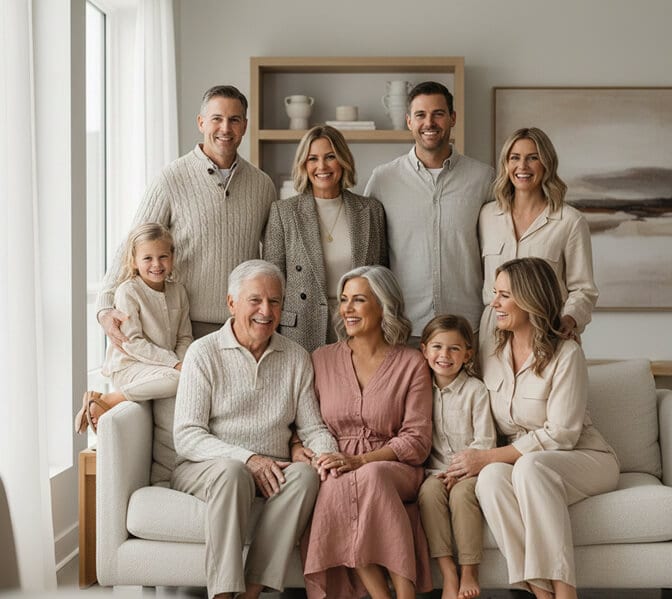
Colors: Navy, dusty blue, light blue, cream, tan, warm gray
Swatch
Best for: Any season, beach or park settings, families with mostly male members
Blue is probably the most universally flattering color that exists. It works on virtually every skin tone and gender, which makes it ideal for large groups where you're coordinating across generations.
The magic happens when you mix blue tones with warm neutrals. The contrast creates visual interest without chaos.
How to distribute:
- Vary the blue shades across the group (navy on some, dusty blue on others, light blue on kids)
- Use cream and tan to break up the blues
- Add warm gray for older family members who aren't blue fans
- Allow one person in chambray or denim for texture variety
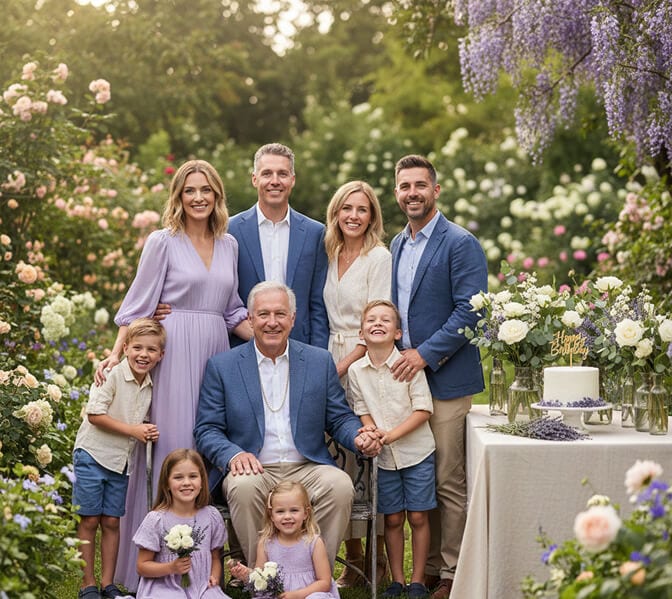
5. Lavender + Slate Blue + Cream (The Romantic)
Colors: Soft lavender, slate blue, cream, dusty mauve, silver gray
Swatch
Best for: Spring shoots, garden settings, families who want something different
This one's a sleeper hit. Most families default to earth tones or blues, but this palette creates absolutely dreamy portraits—especially in soft natural light.
It feels romantic and editorial without being over-the-top.
How to distribute:
- Lavender works beautifully on women and girls
- Slate blue flatters men and boys
- Use cream as the connector between both
- Add dusty mauve as an accent on accessories or one statement piece
Why it works: These colors sit next to each other on the color wheel (analogous), which creates natural harmony without effort.
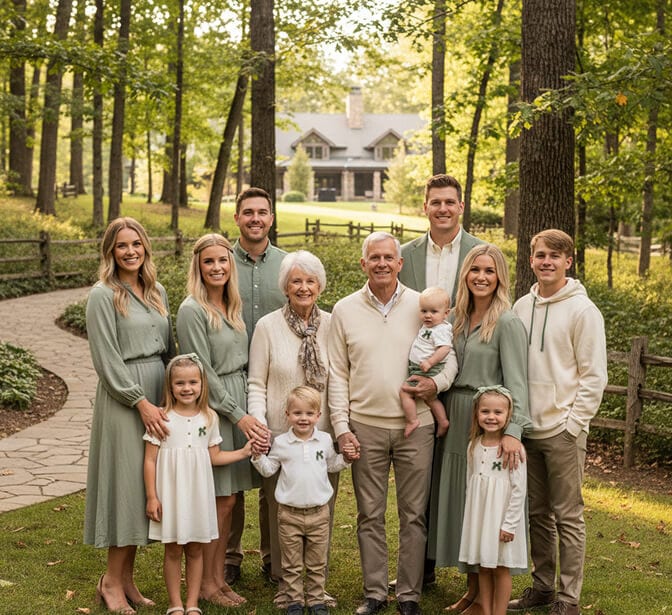
6. Sage Green + Taupe + Cream (The Organic)
Colors: Sage, eucalyptus green, taupe, cream, warm white, olive
Swatch
Best for: Outdoor shoots, wooded settings, eco-conscious aesthetics
Green palettes have exploded in popularity, and for good reason. They connect families to natural settings without competing with the environment.
This scheme photographs especially well in parks, forests, or anywhere with natural greenery as a backdrop.
How to distribute:
- Adults: Sage or eucalyptus (one statement piece per person)
- Kids: Cream or warm white with sage accents
- Grandparents: Taupe or cream (softer colors near faces)
- Use olive sparingly it can read dark in photos
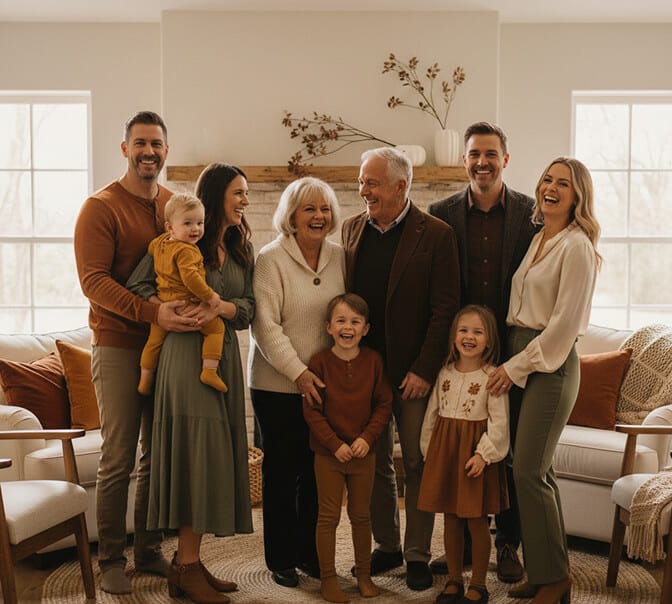
7. Burnt Orange + Olive + Cream (The Fall Classic)
Colors: Burnt orange, rust, olive, cream, deep brown, mustard
Swatch
Best for: Fall family photos, rustic settings, holiday portraits
This palette was designed for autumn. The warm tones mirror changing leaves while the neutrals keep things from looking like a pumpkin spice ad.
It's bold but earthy. Vibrant but grounded.
How to distribute:
- Burnt orange is your statement color use it on ONE key person (usually Mom or the photo's visual anchor)
- Distribute olive and cream across most of the group
- Add rust or mustard on kids for energy
- Deep brown works for shoes, belts, or dad's pants
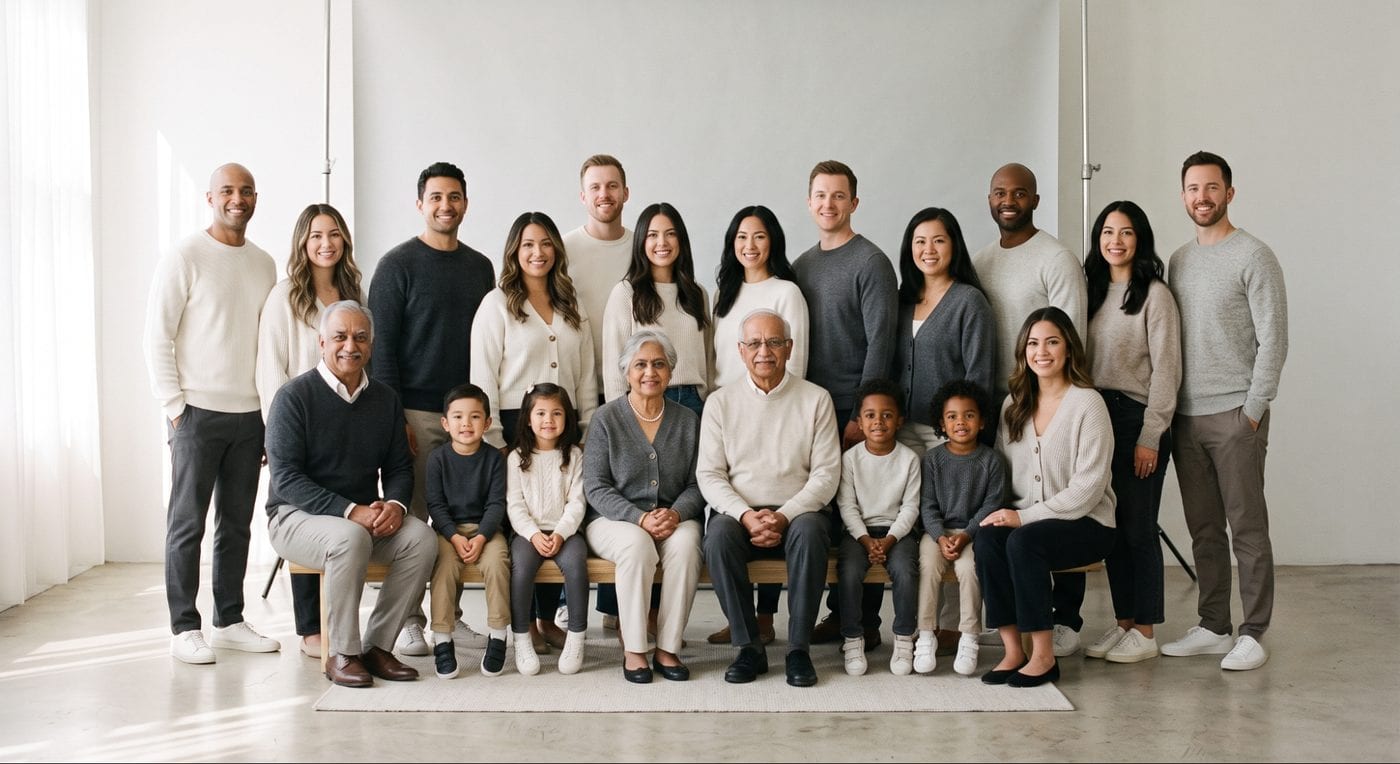
8. Cloud Dancer + Charcoal (The 2026 Classic)
Colors: Cloud Dancer off white, charcoal, warm grey, oatmeal
Swatch
Pantone picked Cloud Dancer, a soft off white, as its 2026 Color of the Year. It's warmer than pure white, so it doesn't blow out in sunlight the way stark white does. Pair it with charcoal on the adults and warm grey or oatmeal on the kids. It looks clean in a studio and just as good against bare winter trees.
Best for: studio sessions, winter, and any photo you might convert to black and white later
How to distribute:
- Grandparents: charcoal
- Adults: a mix of Cloud Dancer and warm grey
- Kids: oatmeal knits
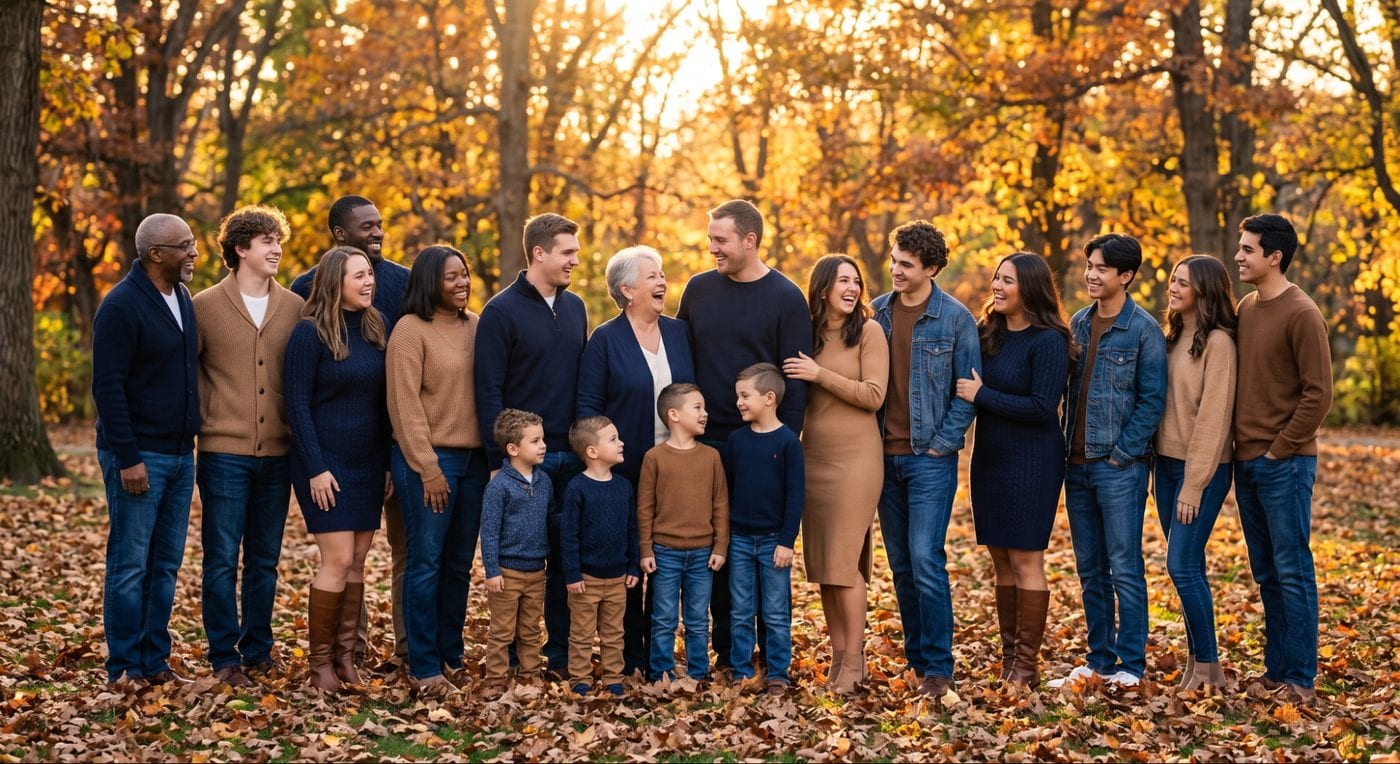
9. Chocolate Brown + Navy (The Rich Contrast)
Colors: Chocolate brown, navy, camel, cream
Swatch
Brown and blue is one of the big fashion pairings this year, and it works even better across a group than it does on one person. The dark tones ground the photo while camel and cream keep it from going heavy. It's also the easiest palette on this page to shop for, because most people already own jeans and a brown sweater.
Best for: fall parks, urban backdrops, indoor holiday photos
How to distribute:
- Dads and grandfathers: navy
- Mothers: chocolate or camel
- Kids: cream with one navy piece
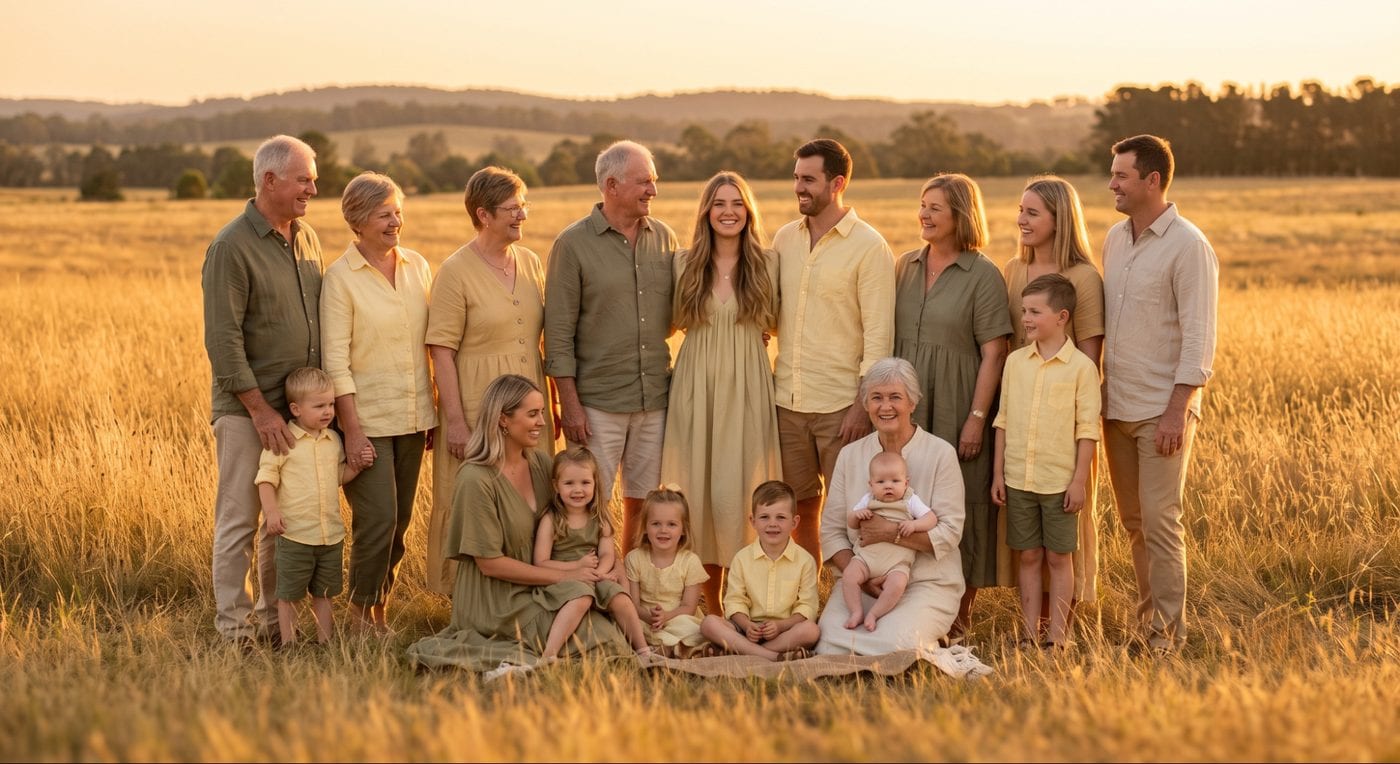
10. Olive + Butter Yellow + Cream (The Sunny One)
Colors: Olive, butter yellow, cream, tan
Swatch
Butter yellow is the soft yellow that turned up everywhere in 2026. It's gentle enough that it doesn't wash anyone out, and olive gives it the depth it needs. This one looks best in open grass in late summer and early fall.
Best for: late summer, early fall, open fields, farm settings
Tip: limit butter yellow to three or four people, mostly kids, so it reads as an accent rather than a theme.
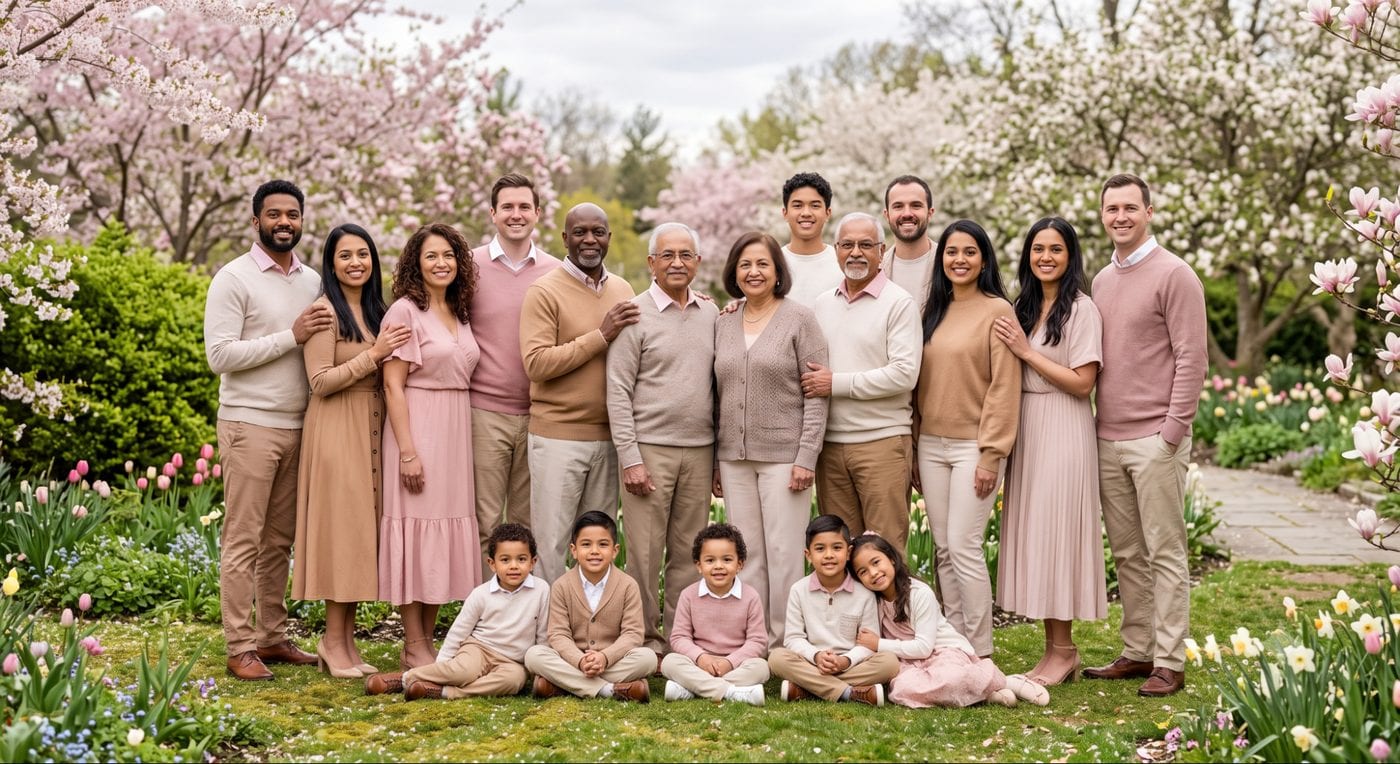
11. Dusty Pink + Camel (The Soft Warm)
Colors: Dusty pink, camel, ivory, taupe
Swatch
Dusty pink has a grey undertone, which is why it reads soft rather than sugary. Camel keeps it warm and grown up, and it's the reason the men in the family will actually agree to it. Best in spring and in gardens.
Best for: spring, gardens, golden hour
How to distribute:
- Men: camel and taupe
- Women and girls: dusty pink or ivory
- Toddlers: ivory
12. Burgundy + Caramel + Cream (The Rich Autumn)
Colors: Burgundy, caramel, forest green, cream
Swatch
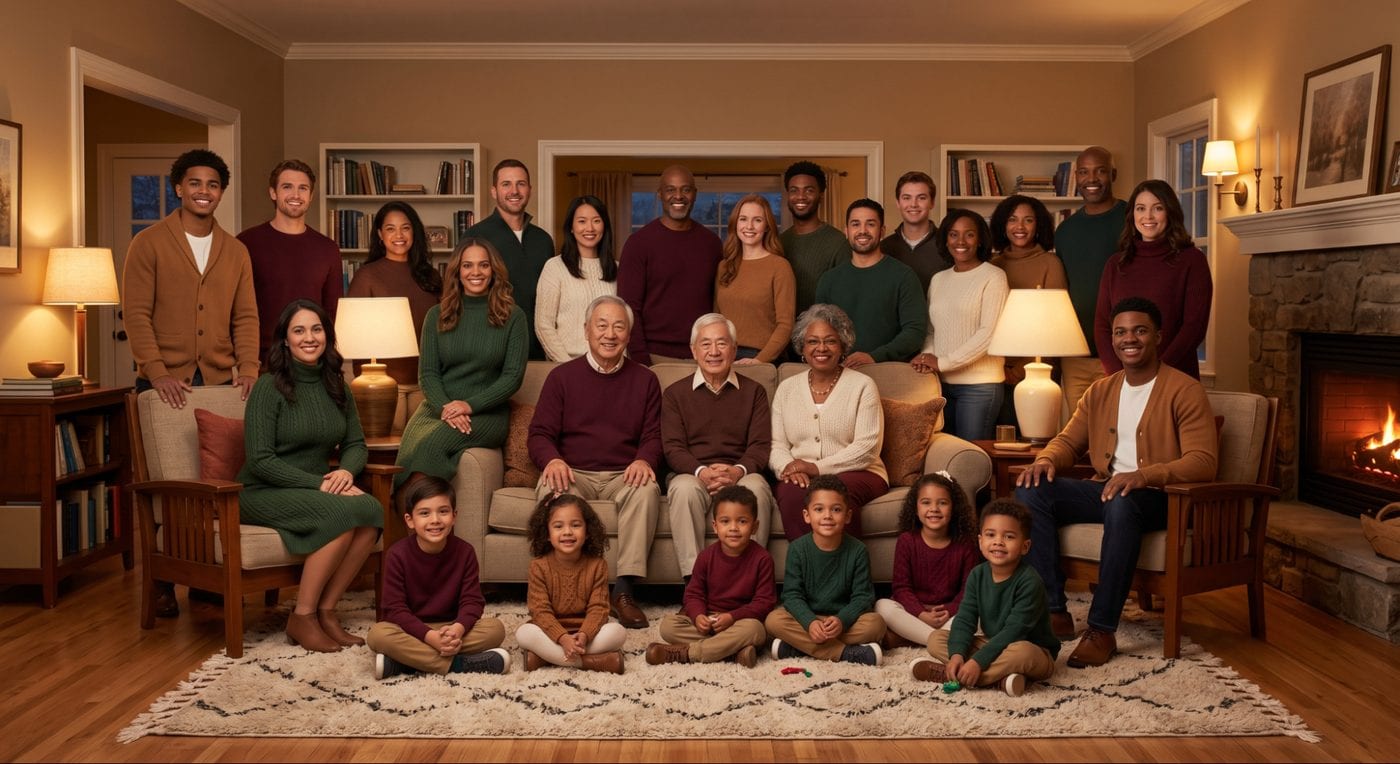
This is the palette for late fall and the holidays. Burgundy and caramel feel warm and cosy, and a little forest green makes it holiday ready without tipping into full Christmas card. It works indoors by a fireplace and outdoors in fallen leaves.
Best for: late October through December, Thanksgiving, holiday cards
Tip: keep burgundy to about a third of the group. Much more than that and it reads dark on camera.
Color Schemes by Season: Fall, Winter, Spring and Summer
Fall is the busiest season for large family photos by a wide margin, but the palette that works in October falls apart in July. Here's the short version for each.
Fall (September to November)
Warm, earthy tones that match the leaves and the low golden light.
- Classic fall: burnt orange, olive, cream, denim
- Rich autumn: burgundy, caramel, forest green, cream
- Soft fall: sage, taupe, cream, with a rust accent
- Avoid: bright orange on everybody. One or two rust pieces go a long way.
Winter and Holiday (December to February)
- Holiday classic: deep red, forest green, cream, and one plaid piece at most
- Snowy and soft: Cloud Dancer, charcoal, silver grey, navy
- Formal: black and white with a single metallic or velvet accent
Spring (March to May)
- Garden: sage, lavender, blush, cream
- Fresh: dusty blue, white linen, soft yellow, tan
Summer (June to August)
- Beach: dusty blue, sand, white linen, soft coral
- Field: olive, butter yellow, cream, tan
- Tip: light, breathable fabrics. A sweating grandfather in a navy wool sweater is not the look you're after.
Seasonal palettes at a glance
Four starting points with the hex codes. Screenshot the one that matches your date and send it to the group chat.
Fall
September to November
Winter
December to February
Spring
March to May
Summer
June to August
Color Schemes by Location: Field, Beach, Studio and Home
Look at your background before you look at anyone's closet. The palette needs to contrast with the setting, not blend into it.
| Location | Best palettes | Avoid |
|---|---|---|
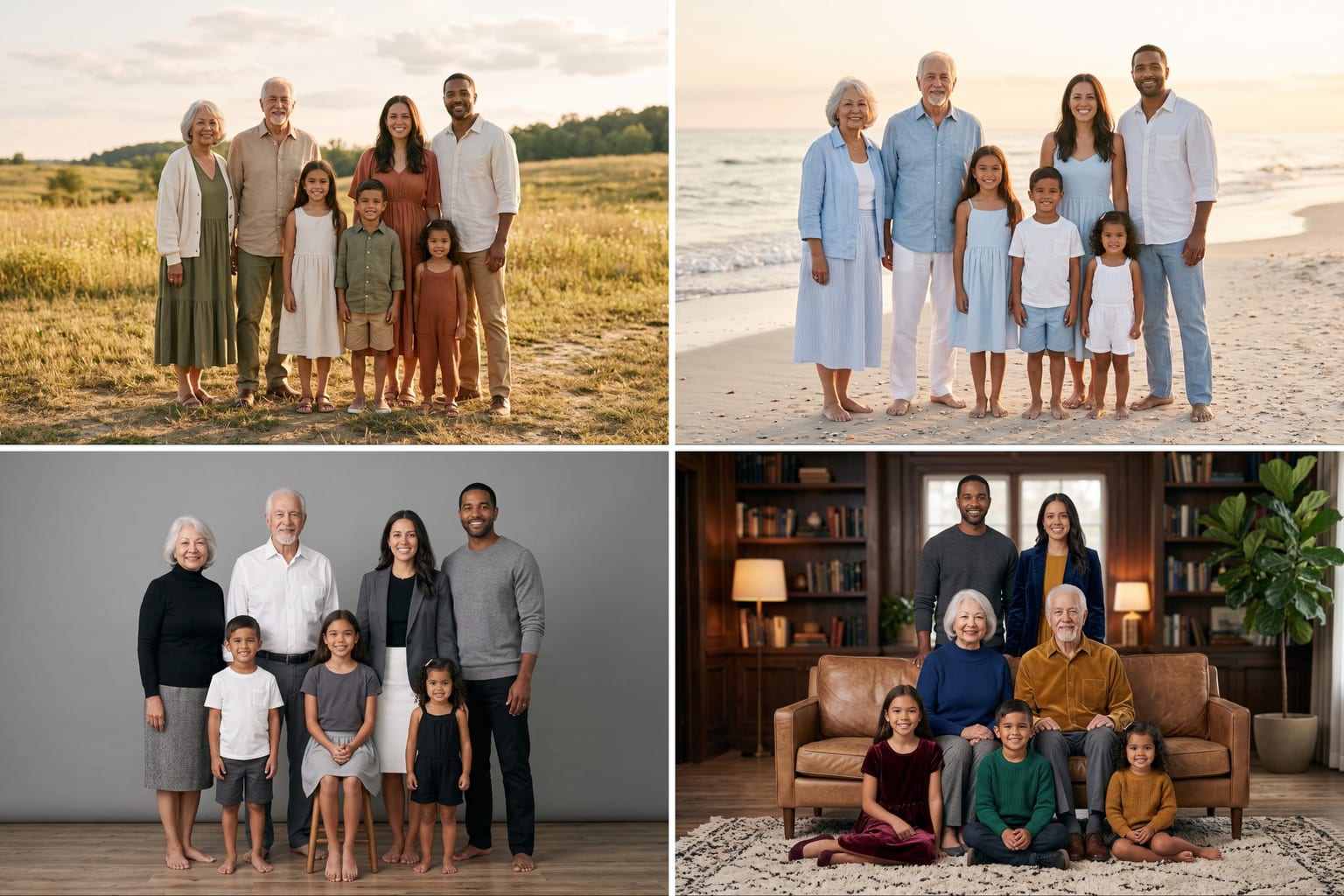
| Open field or park | Earth tones, olive + butter yellow, sage + taupe | Bright green, which blends into the grass |
| Beach | Dusty blue + sand, white linen + coral | Dark heavy colors, black |
| Studio, white or grey backdrop | Cloud Dancer + charcoal, jewel tones + navy | All white against a white backdrop |
| Home or indoors | Burgundy + caramel, chocolate + navy | Anything that clashes with your walls |
| Urban or city | Chocolate + navy, black + camel | Too many patterns against busy brickwork |
Who Wears What: Color Plans for 15, 25 and 40 People
The trick with a big group is to stop thinking person by person. Assign colors by household and let the grandparents anchor the whole thing.
Rule of thumb:
- Grandparents wear the anchor neutral, the color that ties everything together
- Each household gets one accent color from the palette
- Kids wear the lightest shades, because they stand at the front
- Three to five colors total, no matter how big the group gets
Example plans, using the Earth Tones palette
15 people, 3 households
| Who | Wears |
|---|---|
| Grandparents | Cream + tan |
| Household 1 | Olive |
| Household 2 | Rust |
| Household 3 | Denim |
| All the kids | Cream, light tan |
25 people, 5 households
| Who | Wears |
|---|---|
| Grandparents | Cream + tan |
| Household 1 | Olive |
| Household 2 | Rust |
| Household 3 | Denim |
| Households 4 - 5 | Tan |
| All the kids | Cream, light tan |
40 people, 8 households
| Who | Wears |
|---|---|
| Grandparents | Cream + tan |
| Household 1 | Olive |
| Household 2 | Rust |
| Household 3 | Denim |
| Households 4 - 8 | Tan and cream, one accent each |
| All the kids | Cream, light tan, one pop of color |
For 40 or more: split the group into two color zones. Warmer shades (rust, tan) on the left half, cooler ones (olive, denim) on the right, with cream spread across both. Your photographer can then balance the rows without rearranging forty people.
The household colour plan
Worked through on the Earth Tones palette. Grandparents anchor the group, each household takes one accent, and the children stay lightest so they read at the front.
Grandparents · the anchor
Cream + tan
the neutral every other colour is chosen against
Household 1
Olive
one accent colour
Household 2
Rust
one accent colour
Household 3
Denim
one accent colour
Household 4+
Tan
repeat or soften
All the children, whichever household
Cream, light tan
lightest shades, because they stand at the front
Same color rules, different photo. The palette tricks that make a family photo work do the same job for your professional photos. If you need a polished LinkedIn or work headshot without booking another shoot, get your professional headshot with Headshot Photo.
See Headshot Photo pricing →Extended Family and Reunion Photos
Reunion photos are harder than ordinary large family photos, because people are flying in, packing light, and nobody is going to buy new clothes for a photo they found out about last week.
What actually works:
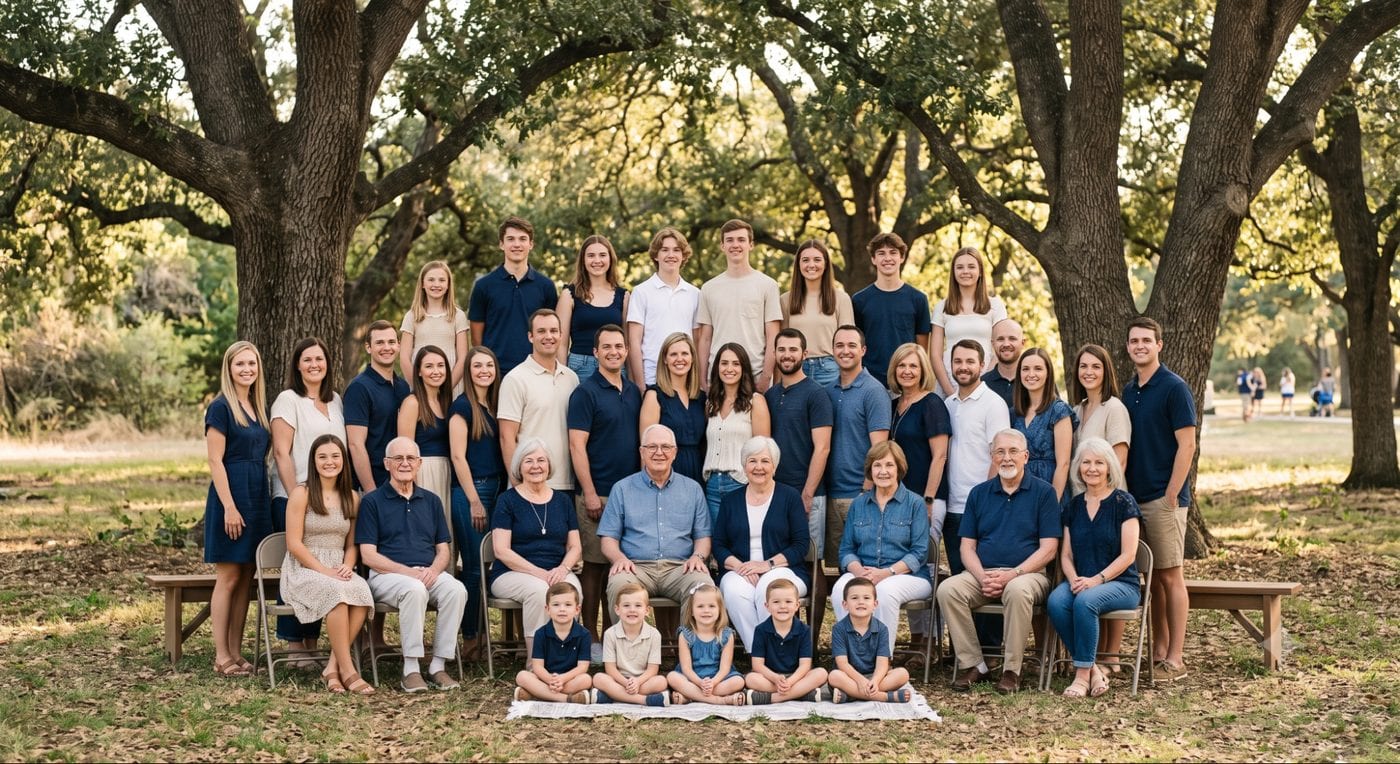
- Pick a palette people already own. Denim, cream, navy and tan are in almost every closet in the country.
- Send the palette four weeks early, not two, so people can pack or order.
- Give a fallback that always passes: "If you can't find anything, wear jeans and a cream or white top."
- Bring two or three spare neutral tops to the shoot for whoever turns up in the wrong thing.
The best color for a family reunion photo is navy, cream and denim. It works outdoors and indoors, in summer and in fall, and nobody has to shop for it.
How to Actually Coordinate 15+ People (Without Losing Friends)
Here's where most family photo planning falls apart.
You've picked the perfect color scheme. You've sent out the palette. And then... someone shows up in bright red because "it's basically burgundy, right?"
Coordinating outfits for family photos requires more than inspiration it requires a system.
Step 1: Assign by family unit.
Break your extended group into households or family units. Each unit gets a "primary" and "secondary" color from your palette.
For example, with earth tones:
- Your household: Terracotta + cream
- Your brother's family: Olive + cream
- Grandparents: Cream + sage
This creates subtle visual groupings that help viewers understand family structure.
Step 2: Start with one outfit.
Pick the boldest or most central outfit first usually Mom in the host family. Build everyone else's outfits around that anchor piece.
Step 3: Do a virtual dress rehearsal.
Have everyone send photos of their planned outfits in good lighting. Lay them out digitally (a simple phone collage works) to see how they interact. You'll catch clashes before photo day.
Step 4: Embrace imperfection.
Someone will forget. Someone will improvise. That's okay. Color schemes provide structure, not prison sentences. A grandmother in a slightly off shade won't ruin anything it adds character.
The Copy-Paste Group Text
Save yourself forty messages. Send this:
Hi everyone! Family photos are on date at location.
Our colors are color 1, color 2, color 3, and cream or denim is always fine.
Your household color is color.
Please avoid logos, neon, pure white and big busy patterns.
Not sure? Send me a photo before the day and I'll tell you yes or no.
Thanks, this is going to look great.
Patterns, Skin Tones and the Cream vs White Question
Patterns. One small pattern per five or six people, maximum. Florals and small plaids work. Stripes and logos don't, because fine stripes create a shimmer on camera and a logo pulls the eye straight off the faces.
Skin tones. Warm undertones look best in rust, olive, camel and cream. Cool undertones come alive in navy, dusty blue, lavender and charcoal. For a mixed group, which is most groups, choose a palette that contains at least one warm and one cool color so everybody has a flattering option inside it.
Cream or white? Go cream. Pure white reflects light and loses its detail, especially in direct sun. Cream, ivory, oatmeal and Cloud Dancer give you the same fresh look while holding onto the texture in the fabric.
Black. Fine for a formal studio portrait. Outdoors it swallows light and hides every fold and detail, so swap it for charcoal or navy.
What Colors to Avoid in Large Group Photos
Not every color photographs well. And some choices create problems you won't notice until you see the final images.
Avoid these:
- Pure black: Absorbs light and loses all detail. Use charcoal or deep gray instead.
- Pure white: Blows out under flash and creates harsh contrast. Stick to cream or ivory.
- Neon anything: Reflects color onto faces. No one wants a green glow on their chin.
- Large logos or graphics: Super distracting. Solid colors or subtle patterns only.
- Extremely shiny fabrics: Create hot spots and glare in photos.
Use with caution:
- All-denim: Can work, but needs intentional variation in washes
- Very dark navy: Functions like black if not balanced with lighter tones
- Bright red: Pulls focus dramatically use only as a small accent
Before You Go: A Quick Sanity Check
If you're planning extended family photos soon, here's your action list:
- Pick one palette from the seven above based on your season, location, and family vibe
- Assign color ranges to each family unit
- Send the palette early minimum two weeks before the shoot
- Request outfit photos in advance to spot issues
- Pack a backup neutral a cream cardigan or navy button-up can save disasters
Getting everyone looking cohesive doesn't require matching. It requires intention.
And when you nail it? Those portraits become the ones that hang in living rooms for generations.
Same color rules, different photo. The palette tricks that make a family photo work do the same job for your professional photos. If you need a polished LinkedIn or work headshot without booking another shoot, get your professional headshot with Headshot Photo.
See Headshot Photo pricing →Frequently Asked Questions
What is the best color scheme for a large family photo?
Earth tones paired with cream (terracotta, olive, camel, ivory, sage) work best for most large family photos. This palette is universally flattering across skin tones and ages, photographs beautifully outdoors, and allows enough variation that 15+ people can coordinate without looking identical.
How do I coordinate colors for extended family photos?
Assign each household a primary and secondary color from your chosen palette. For example, one family wears olive + cream while another wears terracotta + cream. Have everyone submit outfit photos in advance, and build all outfits around one anchor piece (usually Mom's). This creates cohesion while maintaining individual family identities.
Should everyone wear the same color in family photos?
No matching exactly looks forced and dated. Instead, choose a coordinated color palette with 5-7 complementary colors. Distribute these across the group, varying shades and textures so everyone looks intentionally coordinated rather than uniformed. The goal is harmony, not matching.
What colors photograph poorly in family pictures?
Avoid pure white (blows out), pure black (loses detail), neon colors (reflects onto skin), large logos or graphics (distracting), and shiny fabrics (creates glare). Stick to cream instead of white, charcoal instead of black, and matte natural fabrics for best results.
What should you not wear for family photos outside?
Skip solid black or white, busy patterns that compete with each other, mismatched neon shoes, and anything with prominent branding. Also avoid overly casual athletic wear unless it fits your family's aesthetic. Outdoor photos benefit from natural colors that complement the environment earth tones, blues, and soft greens work particularly well.
What colors should a large family wear for pictures?
Muted, mid-tone colors work best. Choose one palette of three to five shades, such as cream, olive, rust and denim, and give each household one accent color from it. Avoid neon, pure white and anything with a large logo.
How many colors should a large group family photo have?
Three to five in total, including one neutral. More than that starts to look random once you have twenty or more people in the frame.
What are the best colors for fall family pictures?
Rust, olive, cream, camel, burgundy and chocolate brown. They match autumn leaves and golden hour light. Use bright orange sparingly, on one or two people at most.
Can you wear black in family photos?
Yes for formal or studio photos. For outdoor photos, charcoal or navy is the better choice, because black loses its detail in natural light.
What is the best color for a family reunion photo?
Navy, cream and denim. Most people already own all three, they photograph well in any setting, and nobody needs to go shopping.
Is cream or white better for family photos?
Cream. Pure white reflects too much light and can blow out in sunshine, while cream and off white hold their detail and look warmer on camera.