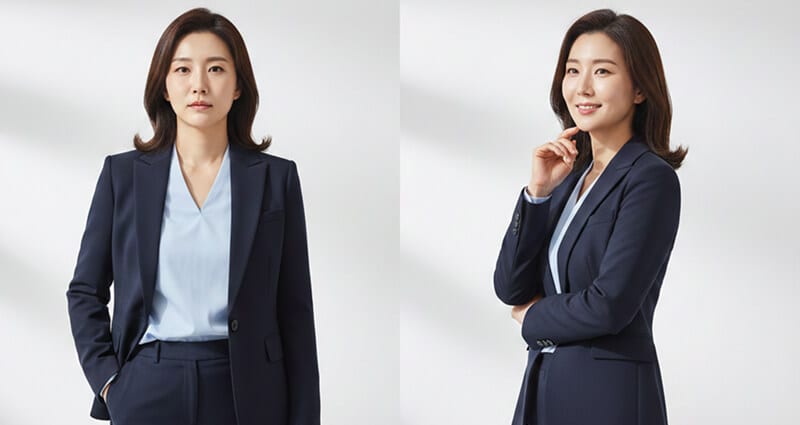
The soft lighting. The flawless skin. That effortless "I definitely didn't try this hard" glow. Here's how to finally get it.
I was doom-scrolling LinkedIn at 11 PM when it happened.
A connection request from someone I'd met at a conference. I clicked her profile. And there it was.
Her headshot looked like she'd stepped out of a K-drama casting call. Soft. Luminous. Professional, but somehow warm. The kind of photo that makes you lean in instead of scroll past.
Meanwhile, my profile picture looked like a hostage situation at a Sears Portrait Studio circa 2003.
How does she look like that?
I messaged her. Turns out she'd spent $1,800 at a studio in Gangnam during a trip to Seoul. The session included professional hair and makeup, a 1:1 consultation with the photographer, and retouching so subtle you'd never know it happened.
Here's the weird part.
She told me she'd tried recreating the look with three different photographers back home. None of them got it right. "They kept making me look like a corporate lawyer," she said. "Not a human being."
That's when I started obsessing over Korean professional headshots. What makes them different? Why do they feel different? And most importantly: could AI replicate that look without the $2,000 plane ticket?
Spoiler: it can. But first, you need to understand what you're actually trying to recreate.
The 5 Things That Make Korean Headshots Look Different
Korean headshot studios aren't just taking pictures. They're engineering a specific emotional response.
After analyzing hundreds of K-style portraits and interviewing photographers who specialize in this aesthetic, I identified five distinct elements that separate Korean professional headshots from their Western counterparts.
1. Butterfly lighting, not Rembrandt lighting
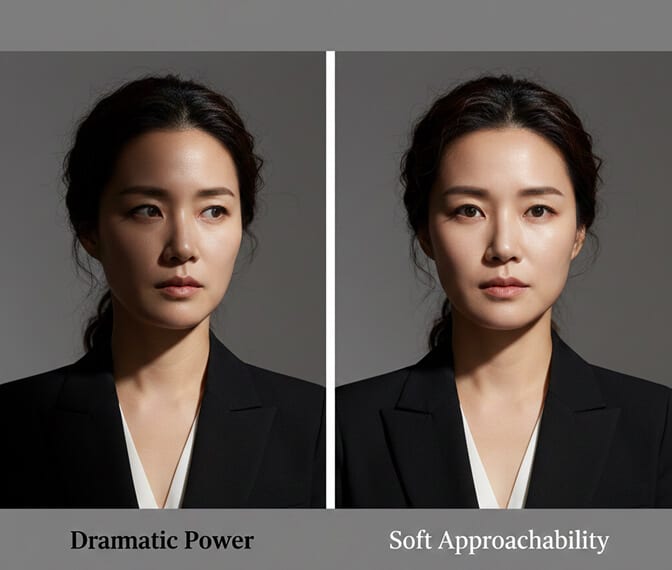
Western corporate photography loves dramatic shadows. The classic "Rembrandt" setup creates a triangle of light under one eye. It's meant to look powerful. Authoritative.
Korean headshots flip this entirely.
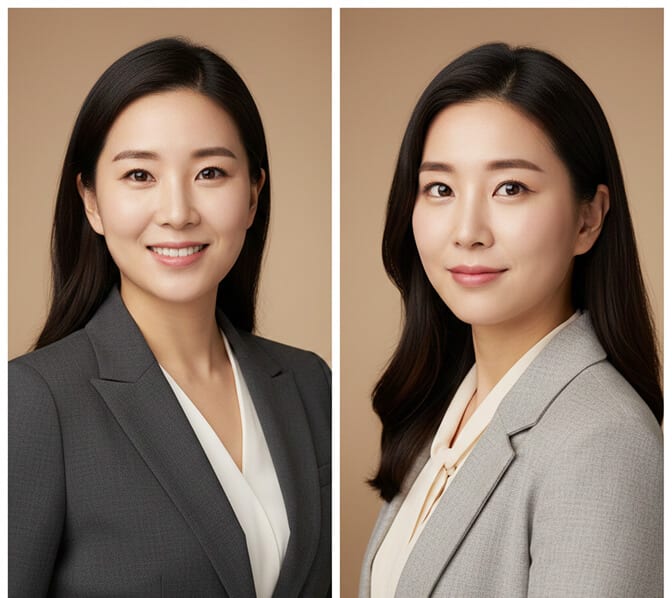
They use what's called butterfly lighting: a soft, diffused light source positioned directly in front and slightly above the subject. The result? Almost no shadows on the face. Your features appear smooth, symmetrical, and approachable.
This isn't accidental. Korean beauty standards prioritize a "glass skin" appearance, and harsh shadows work against that. The lighting literally softens how you're perceived.
2. Neutral backgrounds with subtle warmth
Notice how Korean headshots rarely use pure white backgrounds?
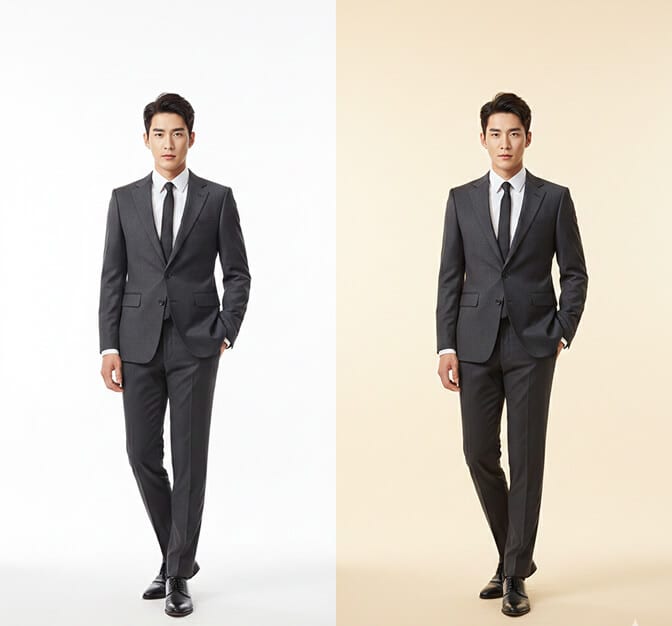
Most use a soft gray or warm cream. Sometimes there's a barely-perceptible gradient. This creates depth without distraction and prevents that "floating head" look you get with stark white.
3. The "adjective card" philosophy
Here's something Western photographers almost never do.
Studios like Sihyunhada in Seoul have clients choose "adjective cards" before their session. Words like "charismatic," "warm," "sophisticated," or "approachable." The entire shoot, from lighting to pose guidance to retouching, is designed around that single word.
"Instead of asking 'what do you want to look like,' we ask 'how do you want people to feel when they see you.'"
This shifts the entire philosophy from appearance to impression. It's why Korean headshots often feel more intentional than traditional corporate photos.
4. Retouching that enhances without erasing
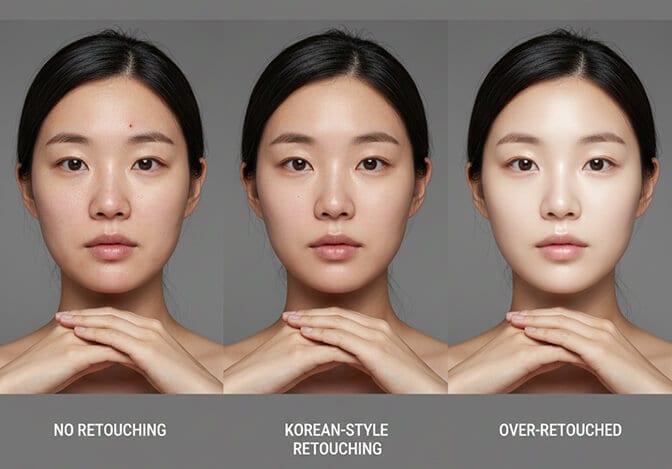
Western retouching tends to go one of two ways: either nothing (the "authentic" approach that leaves every pore visible) or everything (the plastic-looking Instagram filter effect).
Korean retouching walks a tightrope between them.
Skin is smoothed, but texture remains. Blemishes disappear, but freckles stay. Dark circles are lightened, but eye bags aren't completely removed. The goal is to look like yourself on your absolute best day, not like a different person.
This philosophy extends to skin tone. Korean retouching often adds a subtle warmth or brightness to the complexion without making it look artificially enhanced. It's the photographic equivalent of getting eight hours of sleep and drinking enough water.
5. Poses that suggest, not declare
The standard American corporate headshot pose is essentially: face camera, tilt head 15 degrees, smile with teeth.
Korean headshots are more subtle.
Slight angle to the body. Chin slightly down. Eyes looking directly at camera but with softness, not intensity. The expression is often described as "just before a smile" rather than a full grin.
This creates what photographers call "approachable authority." You look professional without looking like you're trying to intimidate someone in a boardroom.
Why This Matters for Your Career
This isn't just aesthetic snobbery.
Research consistently shows that profile photos affect how people perceive your competence, trustworthiness, and likability. A PhotoFeeler study found that professional headshots can increase perceived competence by up to 76%.
But here's what's interesting.
The type of professional headshot matters too. Photos with warmer tones and softer lighting consistently outperform harsh corporate portraits on "likability" and "approachability" metrics.
Korean professional headshots essentially optimize for both. They look polished enough to signal competence while remaining warm enough to signal "I'm a human you'd actually enjoy working with."
For industries like real estate, consulting, coaching, or any client-facing role, this combination is basically the holy grail.
The Old Way: Flying to Seoul (Or Settling for Less)
For years, there were only two options if you wanted a Korean-style headshot.
Option 1: Book a trip to Seoul. Visit a studio like Sihyunhada, StudioPeople, or Studio Bukchon. Spend $150-400 on the session itself, plus flights, hotels, and the time investment.
For a headshot.
Option 2: Find a local photographer and try to explain what you want. Show them Pinterest boards. Hope they understand words like "butterfly lighting" and "K-beauty aesthetic retouching."
Most don't.
I tried Option 2 with three different photographers. The first one gave me what I can only describe as "prom photo with a suit." The second understood the lighting but made my skin look like a smoothie commercial. The third got close but charged $800 for the privilege.
There had to be a better way.
The New Way: AI That Actually Gets It
This is where things get interesting.
AI headshot generators have exploded in the past two years. Most of them are... fine. They'll give you a generic corporate headshot that looks vaguely professional.
But very few understand the specific aesthetics of Korean-style photography.
At HeadshotPhoto.io, we spent months training our AI on the distinct elements that make K-style portraits work. The soft butterfly lighting. The warm neutral backgrounds. The subtle-but-present retouching philosophy. The "just before a smile" expression calibration.
The result is something that would have cost me $2,000 and a week in Seoul two years ago.
Now it costs $34 and takes about 1 hour.
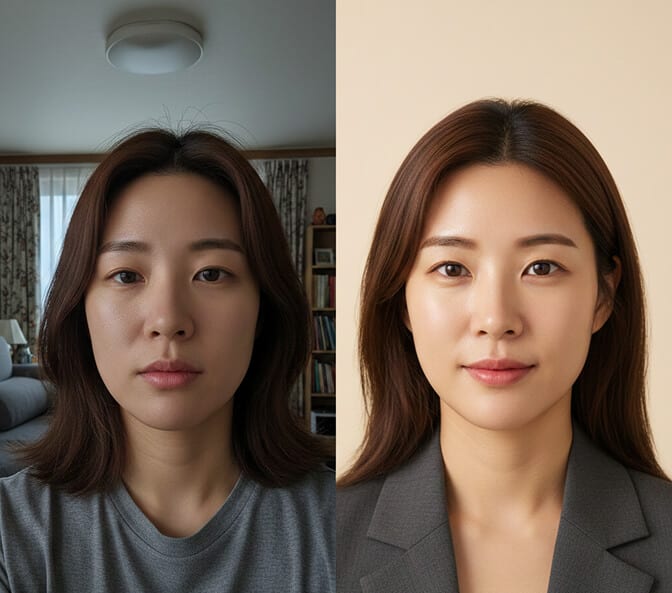
Here's what actually happens when you upload your photos:
- Our AI analyzes your facial structure and skin tone
- It applies K-style butterfly lighting simulation
- Background is generated or replaced with that signature warm neutral tone
- Retouching follows the "enhance, don't erase" Korean philosophy
- Expression and pose are subtly adjusted for approachable authority
The whole process generates 40-100 variations depending on your package. You pick the ones that resonate.
No scheduling. No awkward small talk with a photographer. No trying to hold a smile for 45 minutes while someone adjusts umbrella lights.
Real Results: What K-Style AI Headshots Look Like
I tested this myself before writing a single word of this article.
I uploaded six casual photos: a few selfies, one from a family dinner, one from a hiking trip. Nothing professional. Just regular phone photos with regular phone lighting.
Within three hours, I had 80 AI-generated headshots.
Here's what stood out:
The lighting looked professionally done. Not in a "clearly photoshopped" way. In a "someone set up really good equipment" way. The soft shadows under my cheekbones matched what I'd seen in authentic Korean studio portraits.
My skin looked like my skin. Just... better. Texture was still visible. But the uneven tone and minor blemishes that show up in harsh lighting? Gone. It looked like I'd had a really good skincare week.
The backgrounds felt intentional. Not generic gray cubicle vibes. Warm, subtly graduated tones that made the portrait feel complete.
My expression landed differently. In my original photos, I'm either grinning too hard or looking vaguely uncomfortable. The AI-generated versions captured something in between. Professional but not stiff. Confident but not intimidating.
I updated my LinkedIn the same day. Within a week, I'd received three comments about my "new headshot" and two connection requests mentioning how approachable I looked.
For $34. From my couch.
How to Get Your Own Korean Professional Headshots
If you're ready to ditch the hostage-photo corporate headshot, here's exactly how to do it.
Step 1: Gather 6-12 casual photos of yourself
You don't need professional shots. Phone selfies work perfectly. The AI needs to learn your facial structure, so variety helps: different angles, different lighting conditions, different expressions.
Avoid: heavy filters, sunglasses, group photos where your face is tiny, photos older than 2-3 years.
Step 2: Choose your style intention
Remember those adjective cards from Korean studios? Think about what you want your headshot to communicate. Warm and approachable? Confident and sophisticated? Friendly and energetic?
This will help you select from the generated options.
Step 3: Upload and generate
Head to HeadshotPhoto.io and upload your photos. The AI processes everything and generates your options within 1 to 3 hours depending on your package.
Step 4: Select your favorites
You'll get 40-100 variations. Some will immediately feel right. Others won't. Trust your gut. The ones that make you think "that actually looks like me on a really good day" are the ones to keep.
Step 5: Use everywhere
LinkedIn. Email signature. Company website. Bylines. Speaking bios. Conference badges. Once you have a headshot you actually like, you'll be amazed how many places you've been avoiding because you didn't want to use your old photo.
The Korean Headshot Aesthetic Isn't Going Anywhere
K-beauty and K-style photography have been trending globally for years, and there's no sign of that slowing down.
But here's the real insight.
It's not just about looking "Korean." It's about the philosophy behind Korean professional photography: that a headshot should make people feel something positive about you before they've read a single word of your profile.
That's universal.
Whether you're a realtor in Texas, a consultant in London, or a startup founder in Singapore, you want your first impression to be warm, competent, and human.
Korean professional headshots deliver that. And now, AI can too.
No plane ticket required.
Frequently Asked Questions
What makes Korean professional headshots different from regular corporate headshots?
Korean professional headshots use butterfly lighting (soft, front-facing light with minimal shadows), warm neutral backgrounds, and subtle retouching that enhances without erasing natural features. The aesthetic prioritizes approachability alongside professionalism, creating a "warmly competent" impression rather than the intimidating corporate look common in Western headshots.
Can AI really replicate Korean-style photography lighting?
Yes. Modern AI headshot generators trained specifically on K-style photography can simulate butterfly lighting effects, warm skin tone adjustments, and the characteristic soft shadow patterns of Korean studio portraits. The key is using an AI tool that was specifically trained on this aesthetic rather than generic corporate headshots.
How much does a Korean professional headshot cost?
Traditional Korean photo studios in Seoul charge $150-400 for professional sessions, not including travel costs. AI headshot generators like HeadshotPhoto.io can produce K-style results starting at $34 for 40 photos, making the aesthetic accessible to anyone regardless of location.
Are Korean-style headshots appropriate for LinkedIn and corporate use?
Absolutely. Korean professional headshots are designed for business and corporate contexts. They're widely used for LinkedIn profiles, company websites, resumes, and professional directories. The soft, polished look actually performs well in professional settings because it balances competence signals with approachability.
How do Korean headshots compare to traditional American corporate headshots?
American corporate headshots typically use Rembrandt or loop lighting with dramatic shadows, pure white backgrounds, and minimal retouching. Korean headshots use softer butterfly lighting, warm-toned backgrounds, and subtle enhancement retouching. The Korean style tends to score higher on "approachability" and "likability" metrics while maintaining professionalism.