
Most actors waste months chasing agents the wrong way. Here's how to actually get signed.
I still remember the email.
"Thank you for your submission, but we're not taking on new clients at this time."
Copy. Paste. Send to trash. Repeat.
For six months, that was my ritual. I'd send my headshot and resume to every agency in Los Angeles. Mass mailings. Generic cover letters. The whole "spray and pray" approach everyone told me to use.
Nothing worked.
Then one afternoon, a casting director friend said something that changed everything.
"You know agents spend about three seconds on your submission before deciding, right? And they spend two of those seconds on your headshot."
I looked at my headshot. It was fine. Professional enough. Taken by a friend who "knew lighting."
Fine was the problem.
Here's the thing nobody tells you about getting an acting agent: your headshot isn't just a photo. It's your first audition. And most actors are failing that audition before they even get in the room.
Let me show you how to actually get signed.
Why Most Actors Never Get Agent Callbacks
The math is brutal.
A mid-tier agency receives 200-400 submissions per week. They might call in 3-5 actors for meetings. That's a 1-2% response rate on a good week.
But here's where it gets interesting.
Agents don't read every cover letter. They don't watch every reel. They make snap judgments based on one thing first: your headshot.
"A headshot either makes me want to keep reading or move to the next submission. There's no middle ground." - Former William Morris agent
If your headshot looks amateur, outdated, or generic, your beautifully crafted cover letter never gets read. Your demo reel never gets watched.
You're invisible.
This is why I'm obsessed with helping actors nail their visual first impression. At HeadshotPhoto.io, we've seen actors go from zero callbacks to multiple agent meetings just by upgrading their headshots.
But a great headshot is just the beginning.
The 6-Step Process to Get Signed by a Talent Agent
Step 1: Get Your Headshot Right (Seriously)
I'm putting this first because everyone else buries it at step 4 or 5.
Your headshot needs to do three things:
Look expensive. If it looks like your roommate took it against a bedsheet, agents assume you don't take your career seriously.
Look like you. Not you on your best day with perfect lighting and heavy retouching. You walking into the audition room tomorrow.
Show your type. Are you the best friend? The villain? The romantic lead? Your headshot should whisper your castability without saying a word.
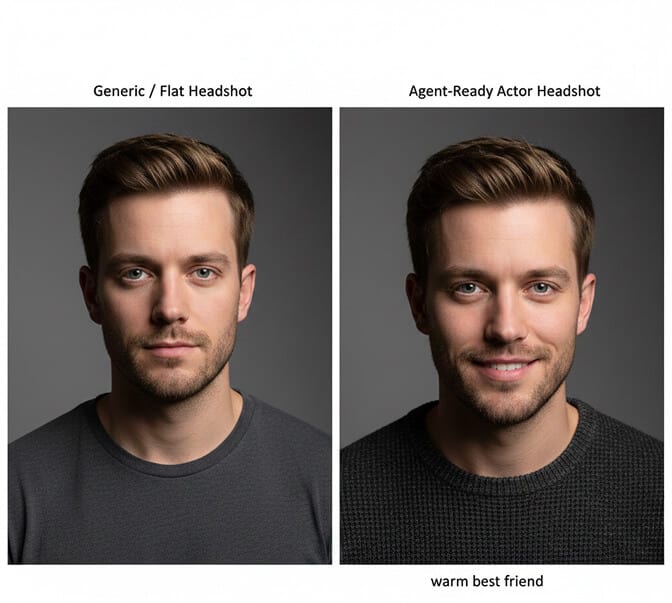
The traditional route costs $400-800 for a session with a decent photographer. But here's what most actors don't realize: AI-generated actor headshots can now produce agent-quality results for a fraction of the cost and time.
I've seen actors submit AI headshots and book meetings with legitimate agencies. The technology has gotten that good.
Whether you go traditional or AI, the point is this: invest in your headshot like your career depends on it.
Because it does.
Step 2: Build a Resume That Doesn't Embarrass You
Agents can smell padding from a mile away.
You don't need Broadway credits or a Netflix series to get representation. But you do need something that shows you're serious about the craft.
Acceptable experience includes:
- Student films (yes, even unpaid ones)
- Community theater productions
- Short films with IMDB credits
- Web series
- Improv or sketch shows
- Training from recognized institutions
If your resume is thin, that's okay. Focus on the training section. List your acting classes, workshops, and coaches. Agents understand that emerging actors won't have extensive credits.
What they won't forgive is an empty resume paired with no training. That signals someone who wants to be famous, not someone who wants to be an actor.

Step 3: Create a Demo Reel (Even If You Have No Footage)
Here's where most actors get stuck.
"I don't have any professional footage for a reel."
Neither did I when I started. Neither do most actors.
The solution? Self-tape scenes specifically for your reel. Find a scene partner, pick material that showcases your range, and record it with decent lighting and sound.
Your reel doesn't need to look like it was shot on a Hollywood set. It needs to show you can act.
Two minutes of compelling, emotionally authentic performance beats ten minutes of mediocre background work every time.

Step 4: Research Agents Like Your Career Depends on It
This is where the "spray and pray" approach dies.
Mass mailing 100 agents with the same generic submission is a waste of stamps and dignity. Instead, you need to build a targeted list of 15-20 agents who make sense for you specifically.
Check their roster. If they already represent three actors who look exactly like you, they don't need a fourth. Look for gaps you could fill.
Match their tier to your experience. CAA and WME aren't signing actors fresh out of community theater. Start with boutique agencies and smaller firms. Work your way up.
Verify they're legitimate. Contact SAG-AFTRA for a list of franchised agencies. If an agent asks for money upfront, run. That's always a scam.
Research individual agents, not just agencies. Read their bios. Check their social media. Find a genuine connection point for your cover letter.

Step 5: Submit Like a Professional
Your submission package needs four things:
- A personalized cover letter (more on this in a second)
- Your headshot
- Your resume
- A link to your demo reel
The cover letter is where most actors blow it.
Don't write a novel. Don't be desperate. Don't be generic.
Write three short paragraphs:
- Why you're reaching out to this specific agent
- One sentence about your type and what makes you castable
- A polite request for a meeting
That's it.
And for the love of all things holy, spell their name correctly.

Submit to about five agents per week. This pace lets you personalize each submission while tracking responses and adjusting your approach.
Step 6: Nail the Meeting
You got a callback. An agent wants to meet.
This is where preparation separates the signed from the forgotten.
Have three contrasting monologues ready. They'll probably ask you to perform. Don't fumble.
Dress like a working actor. Professional, clean, solid colors. Your look should match your headshot.
Prepare intelligent questions. Ask about their communication preferences. Ask how they see your type. Ask what you can do to make their job easier.
Don't lie about your experience. They will find out. IMDB exists.
If you want to see what kind of presence and energy reads well on camera (and in agent meetings), studying famous actor headshots can give you insight into how established actors present themselves.

The Part Nobody Talks About: What If You Have No Experience?
This is the catch-22 that drives new actors insane.
You need an agent to get auditions. You need auditions to get experience. You need experience to get an agent.
But there's a workaround.
If you're young (under 25), agents expect thin resumes. They're looking for potential, not credits. Your job is to show trainability and commitment.
If you're older with no credits, commercial agents are your entry point. They're always looking for new faces and are less concerned with your theatrical resume. Get signed commercially, book some spots, then leverage that relationship into legit representation.
Your headshot matters even more when you have no experience. It's literally all they have to judge you on. This is why getting your actor headshot posing right is so critical for emerging actors.
What Makes Agents Say No (Avoid These Mistakes)
I've talked to dozens of agents over the years. Here's what makes them instantly reject submissions:
Amateur headshots. We've covered this. It's the #1 killer.
Desperation in the cover letter. "I'll do anything for a chance" is not the vibe.
No clear type. If you can't articulate what roles you're right for, agents won't do that work for you.
Following up too aggressively. One follow-up after 5-7 days is fine. Daily emails are stalking.
Headshots that don't match reality. If your headshot looks nothing like you, the agent meeting will be awkward and short. Check out examples of bad actor headshots to make sure you're not making these mistakes.
The Truth About Getting an Acting Agent
Here's what I wish someone had told me years ago.
Getting an agent isn't about luck. It's not about knowing someone. It's not about being the most talented actor in the room.
It's about being easy to say yes to.
Professional headshot. Clean resume. Targeted submissions. Genuine personality in your cover letter. Prepared for the meeting.
Do those things consistently, and you will get representation.
Maybe not from your first choice agency. Maybe not this month. But you will get signed.
The actors who fail are the ones who treat agent hunting like buying a lottery ticket. Mass submissions, generic materials, hoping someone notices them.
That's not a strategy. That's wishful thinking.
If you're serious about getting signed and want actor headshots that actually get callbacks, try HeadshotPhoto.io. We've helped thousands of actors create professional headshots in minutes, not weeks.
Frequently Asked Questions
What does an acting agent actually do?
An acting agent submits you for auditions through industry databases like Breakdown Services, pitches you directly to casting directors, negotiates your contracts, and provides career guidance. They work on commission, typically taking 10% of whatever you earn from jobs they help you book. A good agent can generate multiple quality auditions per week during busy seasons.
How hard is it to get an acting agent with no experience?
It's challenging but absolutely possible. Younger actors (under 25) have an advantage since agents expect thinner resumes. For actors without credits, focusing on training credentials, starting with commercial agents, and investing in professional headshots can dramatically improve your chances. Many agents sign actors based on potential rather than extensive credits.
How much do acting agents charge?
Legitimate agents never charge upfront fees. They work on commission only, typically 10-15% of your earnings from jobs they secure for you. If an agent asks for payment before getting you work, that's a scam. Run away and report them to SAG-AFTRA.
What's the difference between an acting agent and a manager?
Agents are state-licensed to find employment and negotiate contracts. They typically handle 100-300 clients and focus on getting you auditions. Managers are unlicensed, work with fewer clients (20-30), and focus on career strategy and guidance. Agents take 10-15%, while managers often charge 15-20%. Many successful actors have both.
Do AI headshots work for talent agent submissions?
Yes, increasingly so. Modern AI headshot technology can produce agent-quality results that are virtually indistinguishable from traditional photography. The key is ensuring the AI headshot accurately represents how you look in person. Agents care about quality and authenticity, not whether a human pressed the shutter button.