What size should a CV photo be?
A CV photo should be 35x45mm (413x531 pixels at 300 DPI) for most European CVs, or 2x2 inches (600x600 pixels) where a square format is expected. Several countries differ: Germany and Austria commonly ask for a larger 4.5 x 6 cm, Japan, South Korea and Indonesia use 3 x 4 cm, and China uses a 25 x 35 mm "one inch" photo. Keep the file under 1MB, use a plain light background, and crop from the shoulders up with your head filling roughly 70% of the frame.
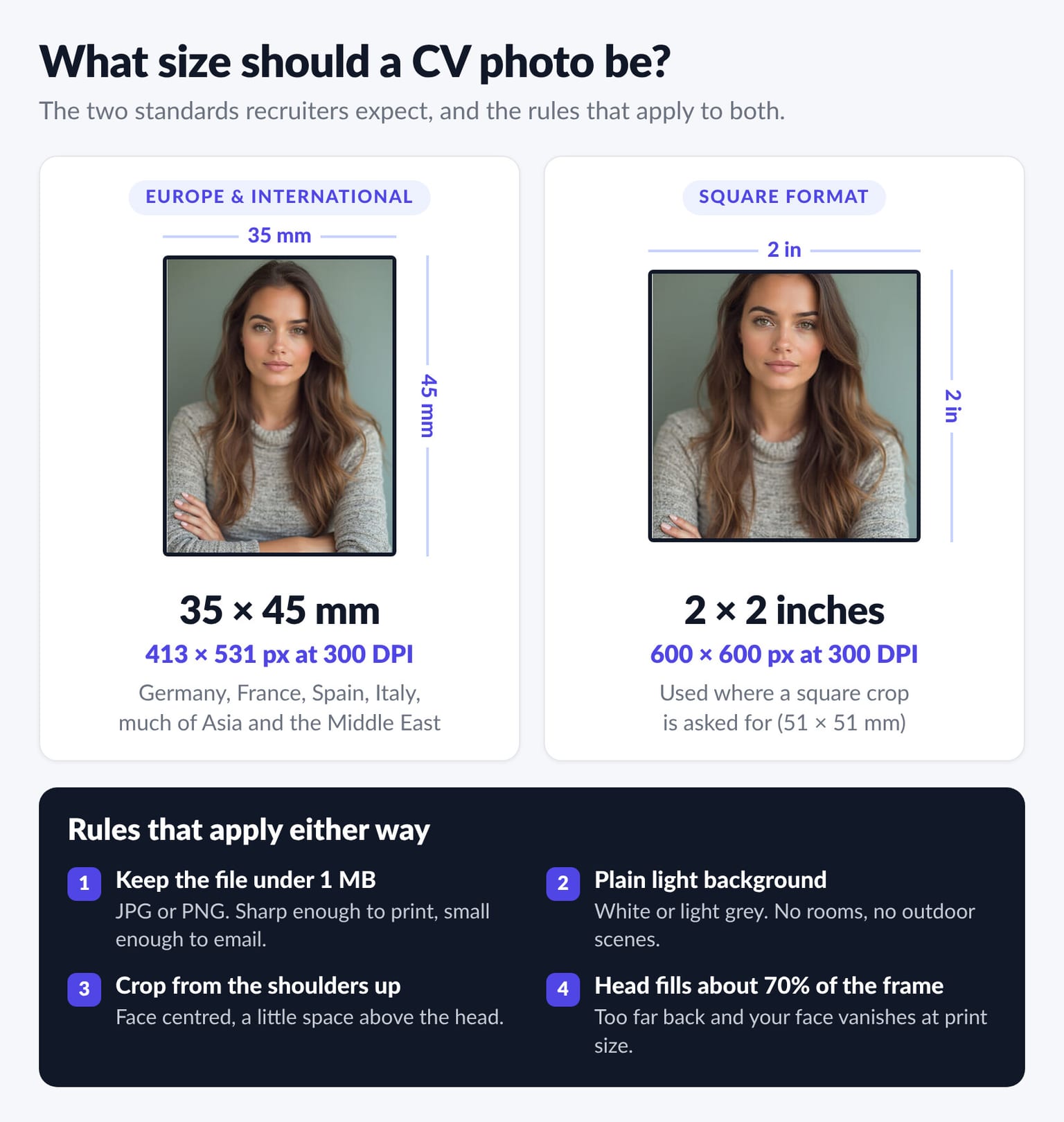
Already have a photo you like? Our free resume photo maker crops and resizes it to 413 x 531 px, 600 x 600 px or 531 x 709 px in the browser, free and without a signup. If you need the photo itself taken, skip to creating one from a selfie.
Should you put a photo on your CV at all? It depends on where you apply. In much of Europe, Asia, and the Middle East a photo is expected. In the US, UK, and Canada it is usually left off to avoid bias.
This guide covers the country rules, the correct size in pixels and millimetres, what to wear, numbered examples of CV photos and layouts that pass, how a resume photo differs from a CV photo, and a fast way to create one. A CV photo, also called a CV picture, is simply a small professional headshot placed on your CV, and the same rules apply whatever you call it.
Jump to: Should you include one? · Size in mm, inches and px · Size by country · What makes a good one · What to wear · Quick rules · Resume vs CV photo · 8 layout examples · Add it in Word, Docs or Canva · AI photos · Make one from a selfie · Checklist · FAQs
Should You Put a Photo on Your CV?
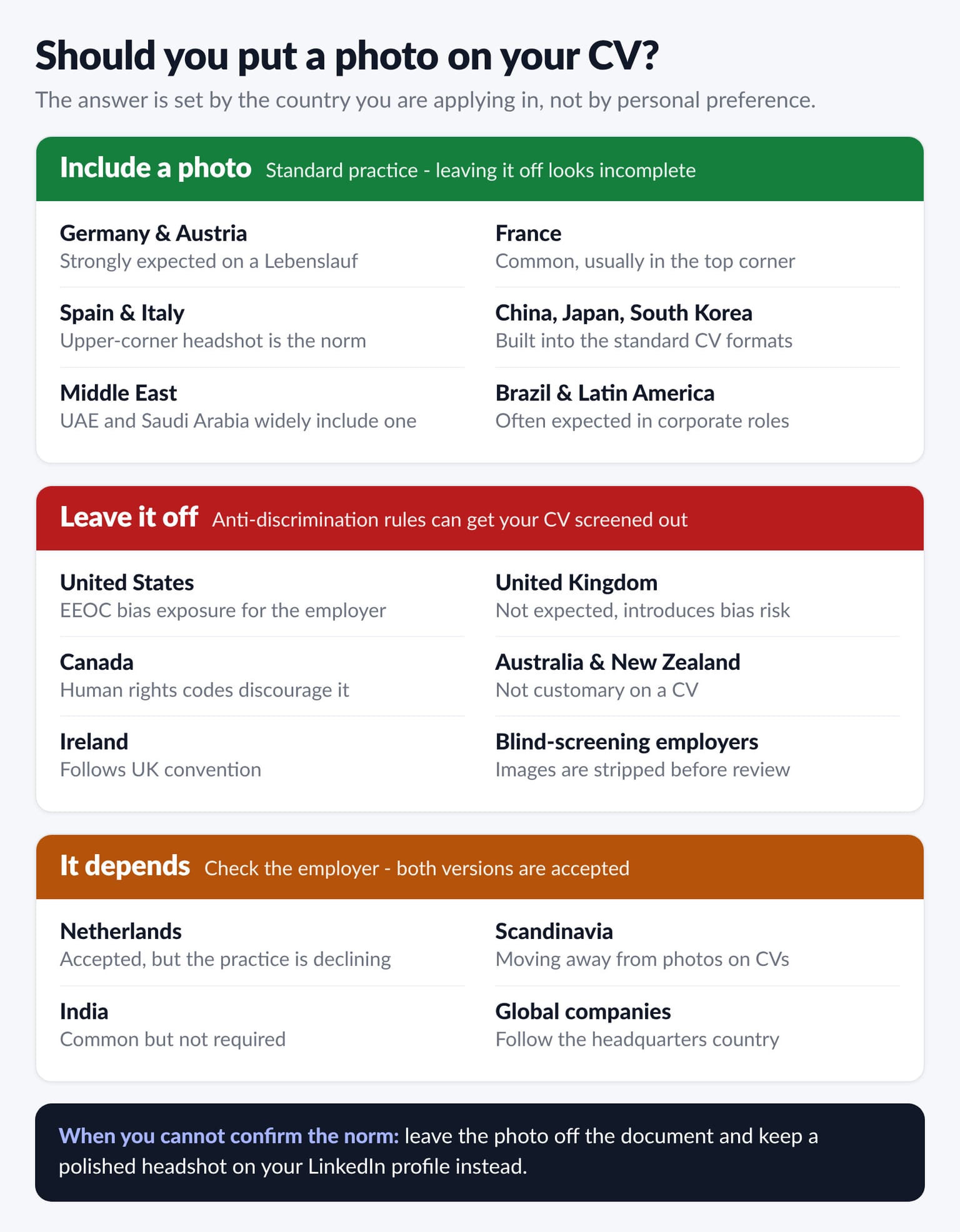
Yes in Germany, France, Spain, Italy, most of Asia, and the Middle East, where a headshot is standard practice and leaving it off looks incomplete. No in the UK, US, Canada, Australia, and Ireland, where anti-discrimination rules mean a photo can get your CV screened out before anyone reads it.
Whether to add a photo is a regional decision, not a personal preference. Recruiters in different countries expect different things, so match the local norm before you apply.
Where a photo on a CV is expected
Germany and Austria treat a headshot on the Lebenslauf as near-mandatory, and a CV without one reads as unfinished. France, Spain, and Italy commonly place a picture in the upper corner. China, Japan, and South Korea build the photo into their standard CV formats, so leaving it out breaks the format. Across the Middle East, the UAE and Saudi Arabia widely include one.
Where you should leave the photo off
In the US, UK, Canada, Australia, and Ireland, resumes and CVs typically carry no photograph, and this is a legal question more than a stylistic one.
US employers work under EEOC guidance that makes any protected characteristic visible on an application a discrimination risk. Many large recruiters will discard a CV with a photo on sight, not because they dislike it but because keeping it exposes them to a claim about age, race, or gender. Canada's provincial human rights codes push the same way. In the UK, Ireland, Australia, and New Zealand, equal-opportunity hiring guidance discourages anything that identifies a candidate before their experience is read, and some employers run blind screening that strips images entirely.
None of this means your face is a liability. It means the document is the wrong place to show it in those markets.
When you are unsure
If you are applying across regions or cannot confirm the norm, skip the photo and keep a polished headshot on your LinkedIn profile instead. That way your image is one click away without putting it on the document itself. For global employers, follow the convention of the headquarters country rather than the local office.
CV Photo Size in Pixels, Millimetres, and Inches
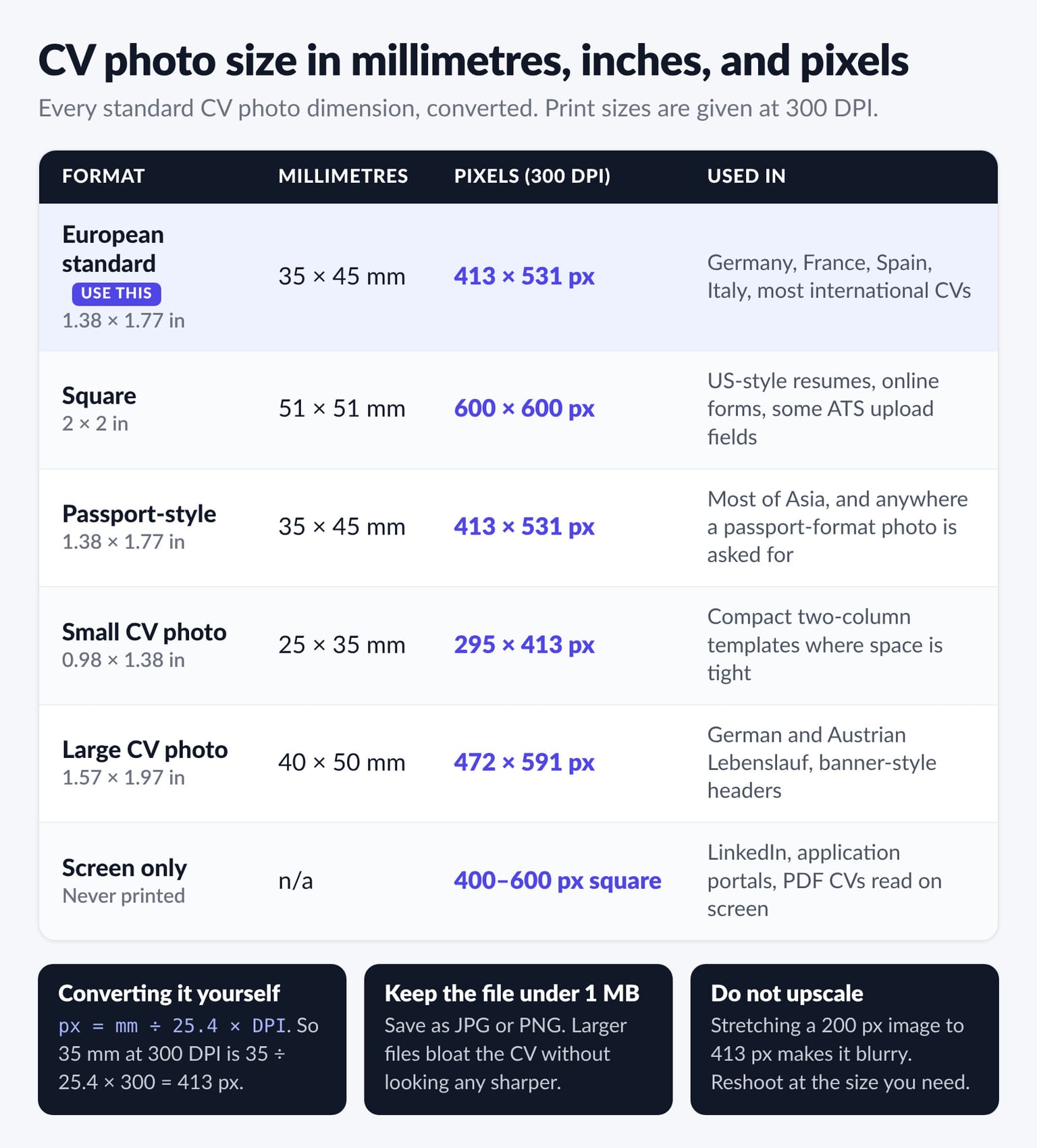
If you include a photo, size and quality matter as much as the shot itself. The standard CV photo size is 35 x 45 mm, which is 413 x 531 pixels at 300 DPI. Every other common CV picture size is below.
| Format | Millimetres | Inches | Pixels (300 DPI) | Used in |
|---|---|---|---|---|
| European standard | 35 x 45 mm | 1.38 x 1.77 in | 413 x 531 px | Germany, France, Spain, Italy, most international CVs |
| Square | 51 x 51 mm | 2 x 2 in | 600 x 600 px | US-style resumes, online forms, and some ATS upload fields |
| Passport-style | 35 x 45 mm | 1.38 x 1.77 in | 413 x 531 px | Most of Asia, and anywhere a passport-format photo is asked for |
| Small CV photo | 25 x 35 mm | 0.98 x 1.38 in | 295 x 413 px | Compact two-column templates where space is tight |
| Large CV photo | 40 x 50 mm | 1.57 x 1.97 in | 472 x 591 px | German and Austrian Lebenslauf, banner-style headers |
| Screen only | n/a | n/a | 400 x 400 to 600 x 600 px | LinkedIn, application portals, PDF CVs read on screen |
These are the international defaults, not the whole picture. Several of the countries that most expect a photo use their own format: a German Bewerbungsfoto is commonly 4.5 x 6 cm, a Japanese rirekisho photo is 3 x 4 cm, and a Philippine resume photo is 2 x 2 inches. The size by country table below has them all.
Converting it yourself: pixels = millimetres divided by 25.4, times DPI. So 35 mm at 300 DPI is 35 / 25.4 x 300 = 413 pixels.
File format and weight: save as JPG or PNG and keep the file under 1 MB so it stays sharp without bloating your document.
Do not upscale: stretching a 200 pixel image up to 413 pixels makes it blurry, and blur is more obvious at CV print size than at any other size you will use a headshot. Reshoot or regenerate at the dimensions you need.
Framing: head and shoulders, face centred, with a little space above your head and your head filling roughly 70% of the frame. Your face should read clearly even when the photo is small on the page. For more detail on crops and resolution, see our guide to professional photo dimensions.
CV Photo Size by Country
The 35 x 45 mm standard travels well, but it is not what every market asks for. Germany and Austria print a noticeably larger photo, East and Southeast Asia work in centimetres at 3 x 4 or 4 x 6, and the Philippines uses the 2 x 2 inch square. Applying with the wrong format is rarely fatal, but it reads as someone who did not check.
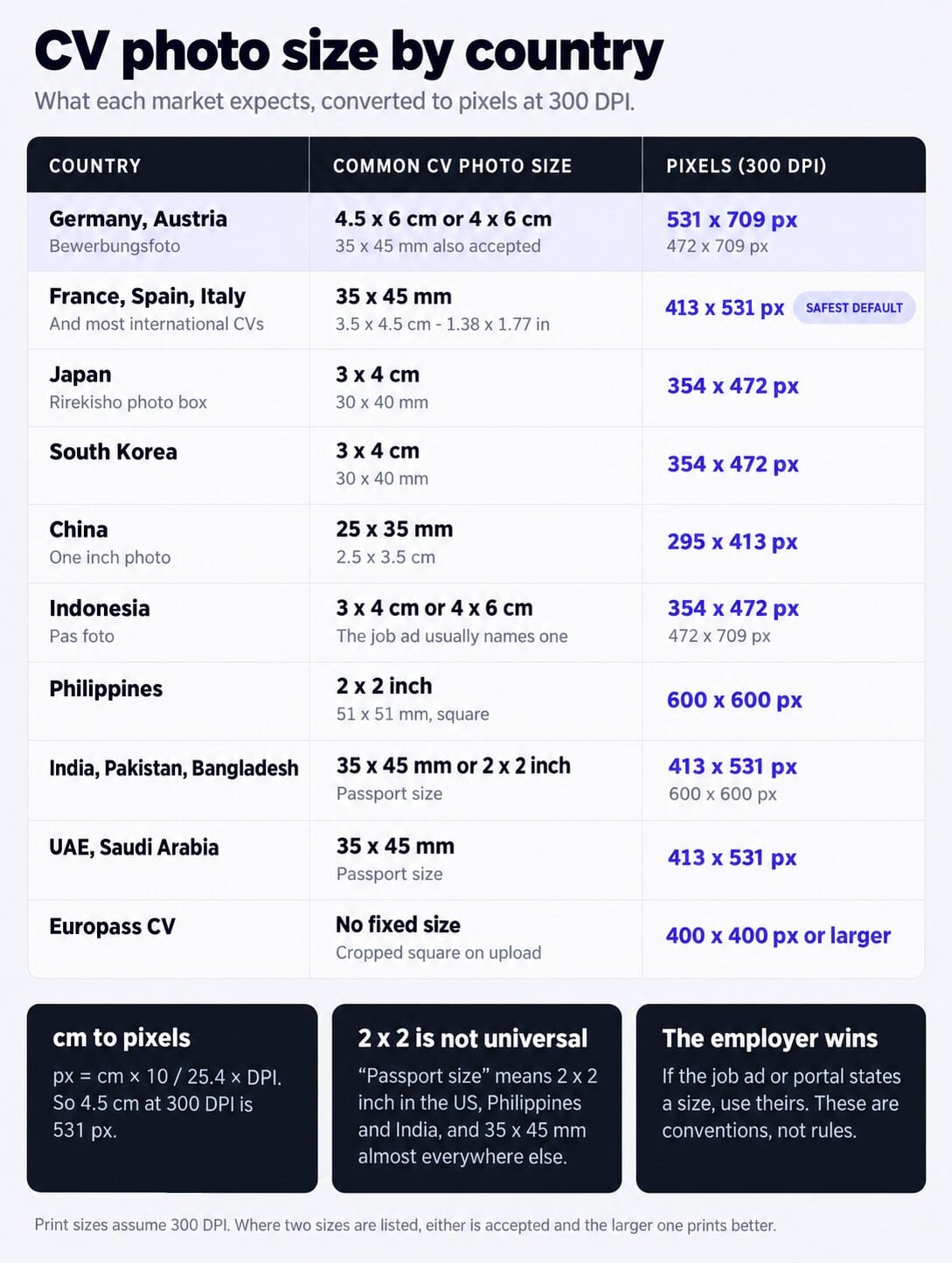
| Country | Common CV photo size | Pixels (300 DPI) |
|---|---|---|
| Germany, Austria | 4.5 x 6 cm or 4 x 6 cm (35 x 45 mm accepted) | 531 x 709 / 472 x 709 |
| France, Spain, Italy | 35 x 45 mm | 413 x 531 |
| Japan (rirekisho) | 3 x 4 cm | 354 x 472 |
| South Korea | 3 x 4 cm | 354 x 472 |
| China | "One inch" photo, 25 x 35 mm | 295 x 413 |
| Indonesia | 3 x 4 cm or 4 x 6 cm | 354 x 472 / 472 x 709 |
| Philippines | 2 x 2 inch | 600 x 600 |
| India, Pakistan, Bangladesh | Passport size, 35 x 45 mm or 2 x 2 inch | 413 x 531 / 600 x 600 |
| UAE, Saudi Arabia | Passport size, 35 x 45 mm | 413 x 531 |
| Europass CV | No fixed size, cropped on upload | 400 x 400 or larger |
Germany and Austria. The Bewerbungsfoto is the one to get right, because it is the market where the photo is least optional. Studios there shoot 4.5 x 6 cm as the default and many application templates are built around it, though 4 x 6 cm and the passport-format 35 x 45 mm both pass. Size it at 531 x 709 pixels and it will print cleanly at any of the three.
Japan and South Korea. The Japanese rirekisho has a photo box printed on the form itself, sized 3 x 4 cm, and the photo is expected to fill it. Korean resumes use the same 3 x 4 cm. Both markets expect a plain, formal shot: dark suit, white shirt, neutral expression, light grey or white background.
China. The "one inch" (yi cun) photo is 25 x 35 mm, not an actual inch, and it is the size Chinese application forms and portals assume. Where a "two inch" photo is asked for, that is usually 35 x 49 mm. White, light blue and red backgrounds are all common, so follow whatever the employer or portal specifies.
Indonesia and the Philippines. Indonesian job applications ask for a pas foto at 3 x 4 cm or 4 x 6 cm, and the job ad usually names which. The Philippines uses the 2 x 2 inch square, the same format as a Philippine passport photo, which is why a 2 x 2 photo is often already on hand.
If the employer states a size, use theirs. Every row above is a convention, not a rule, and a job ad or portal that names its own dimensions overrides it. When nothing is stated and you are applying internationally, 35 x 45 mm at 413 x 531 pixels is the safest default.
What Makes a Good CV Photo?
A good CV photo shares five traits:
Background: Neutral and uncluttered, such as white or light gray.
Lighting: Natural light or soft studio lighting, with no harsh shadows.
Outfit: Professional or business-casual, matched to your industry.
Posture and expression: Straight posture, a soft smile, and a confident but approachable look.
Framing: Head and shoulders visible, with a centered composition.
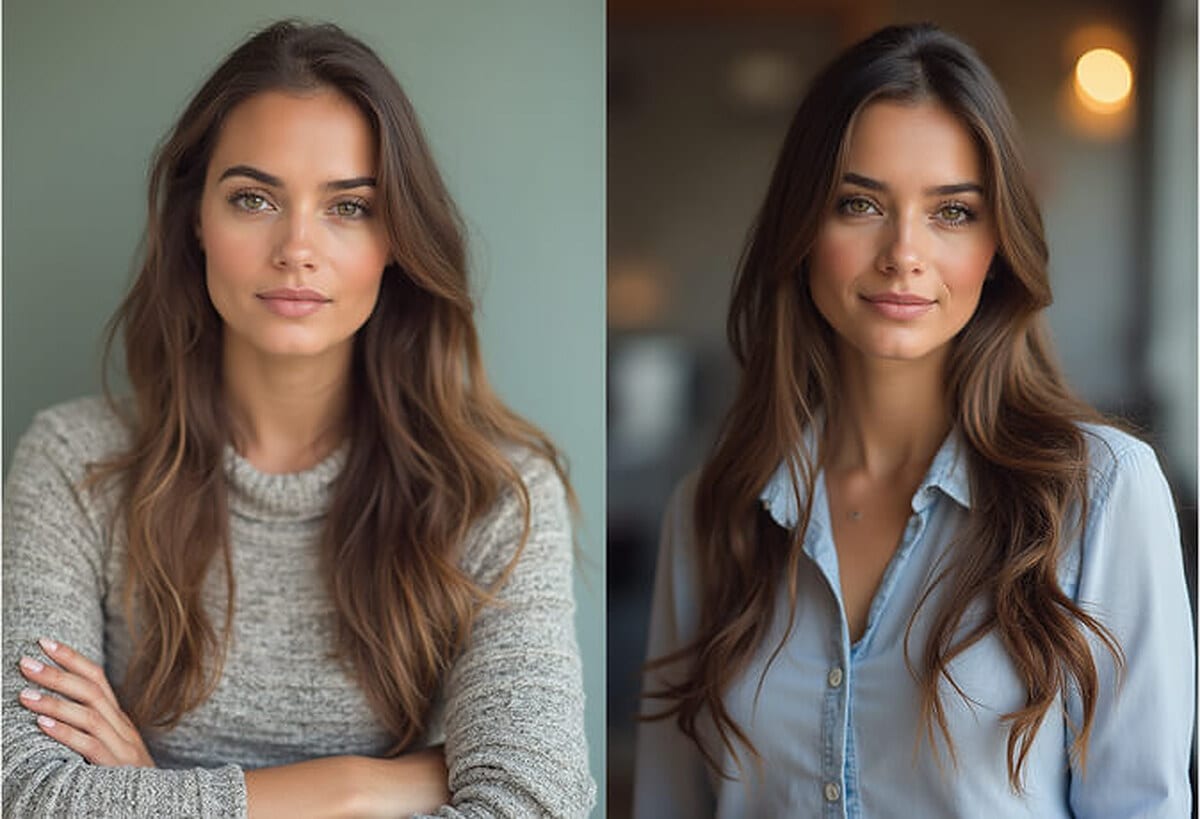
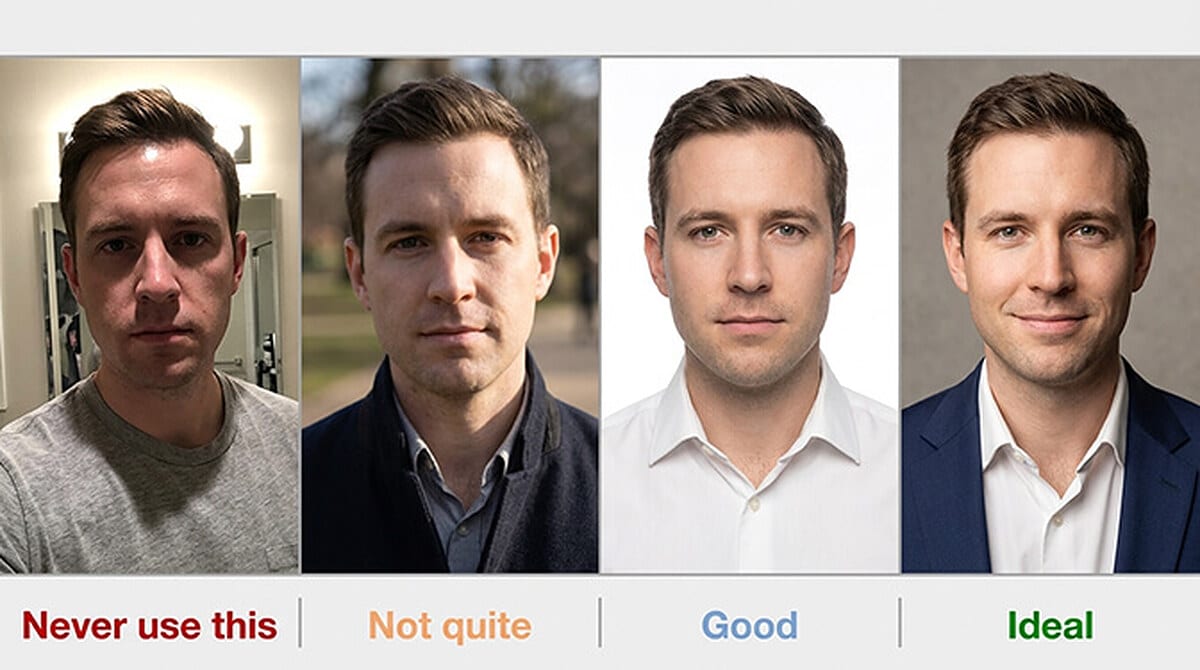
The difference between a passable CV photo and a strong one is usually small and entirely fixable. The four-step comparison below shows the same person at each stage, from a bathroom selfie through to a photo you would happily put on a Lebenslauf.
What to Wear in a CV Photo
Wear professional or smart-casual clothing that matches the standards of your target industry. Stick to clean, solid colours and avoid bold patterns or accessories that pull attention from your face. At 35 x 45 mm, a busy print turns into visual noise.
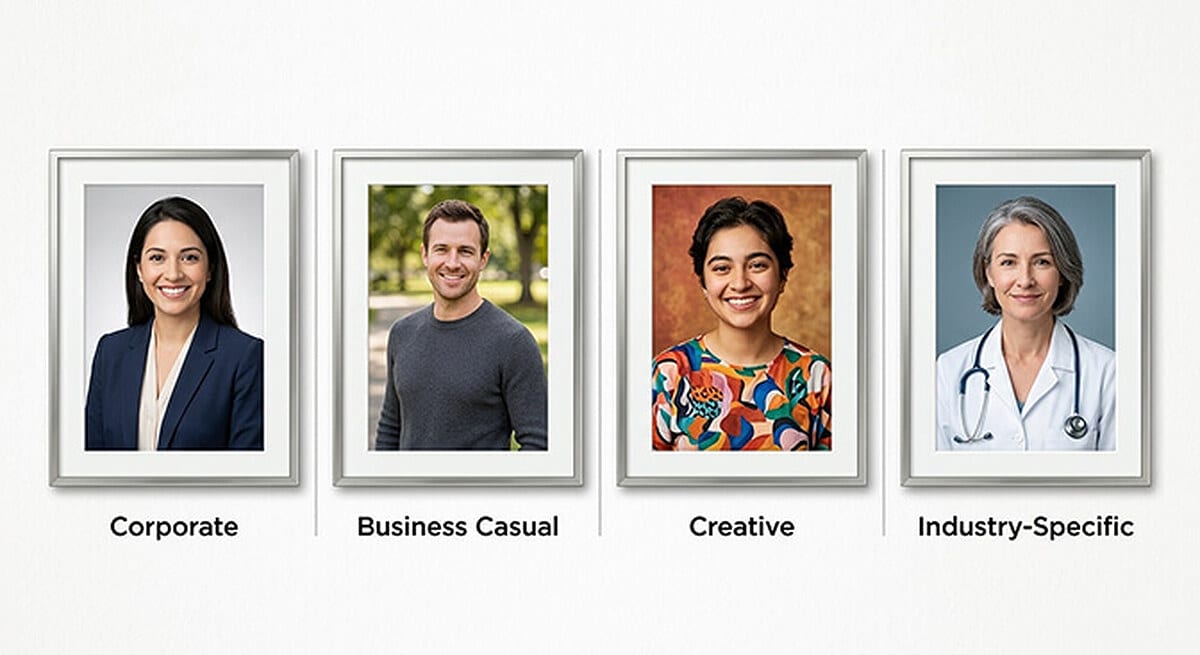
Corporate and finance: a blazer over a plain shirt or blouse, in navy, charcoal, or black.
Business casual: a collared shirt or a simple solid knit, no tie needed. Right for tech, consulting, and most mid-level roles.
Creative: you have room for colour and texture, as long as the face still wins the frame. See our guide to the best colour to wear for a headshot.
Industry-specific: wear the uniform your profession expects, such as a white coat with a stethoscope in medicine or scrubs in nursing.
Quick Rules: Smiling, Glasses, Black and White, and Students
The four questions that come up every time, answered in a line each.
Should you smile in a CV photo? A closed-mouth smile, or what photographers call a soft smile, is the safe answer almost everywhere. It reads as approachable without looking casual. Two exceptions: Japan and South Korea expect a neutral, unsmiling expression on a rirekisho photo, and a broad open-mouth grin looks out of place on any CV outside creative work.
Can you wear glasses? Yes, if you wear them every day. The photo should look like the person who walks into the interview. Turn the frames very slightly downward and keep the light off to one side so the lenses do not catch a reflection, and avoid tinted or photochromic lenses, which darken under studio light.
Colour or black and white? Colour. A black and white CV photo reads as a stylistic choice, and on a CV that choice is a distraction. It also loses the information a recruiter is unconsciously reading, such as whether your outfit suits the role. Keep black and white for actor headshots and author photos.
What about students and first jobs? The same rules apply, with one adjustment: dress one step above the job you are applying for, not three. A collared shirt or a simple solid top is right for a graduate role. A borrowed suit that does not fit reads worse than smart casual that does. Do not use a graduation photo with a cap and gown as a CV photo, and do not use your student ID picture.
Why a Bad CV Photo Hurts Your Application
Your hiring manager sees your photo before reading a single word, and recruiters spend only a few seconds scanning a CV. A weak image works against you before your experience gets a chance.
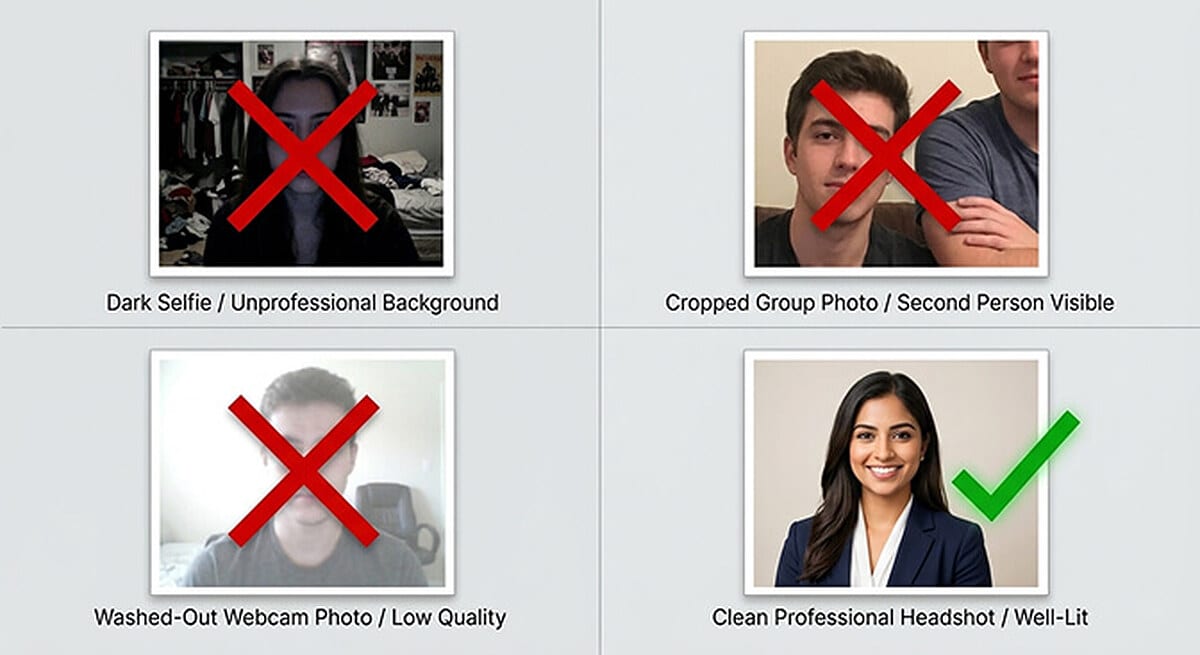
Common mistakes to avoid:
- Low-quality images that look pixelated or blurry
- Unprofessional or overly casual clothing
- Distracting backgrounds like cluttered rooms or outdoor scenes
- Cropped group photos where someone else's shoulder is still in frame
- Poor lighting that makes the image dull or shadowy
- Unfriendly or awkward expressions
- Selfies, vacation photos, or outdated pictures
Even with perfect qualifications, a bad photo can make you seem less polished or less serious about the role.
Resume Photo vs CV Photo: What's Different
A CV photo and a resume photo are the same kind of image, but they are governed by different conventions because a CV and a resume are read in different markets. A CV is the standard job document across Europe, Asia, and the Middle East, and it often runs to several pages. A resume is the one or two page document used in the US and Canada.
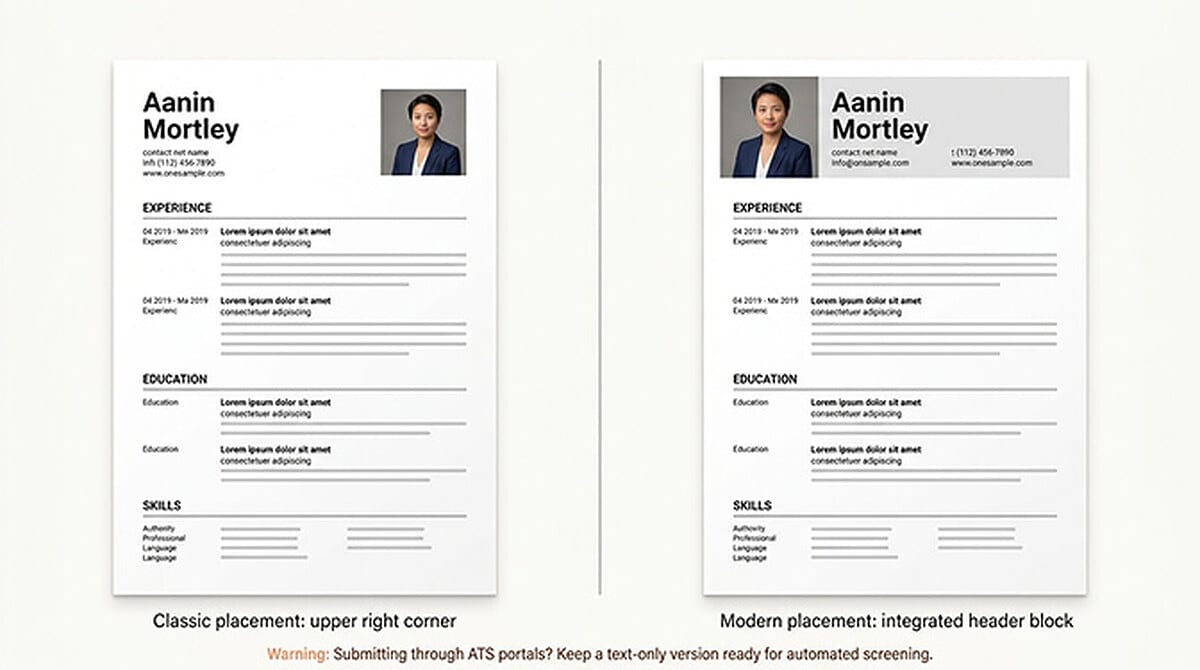
The practical differences:
Expectation. A CV photo is expected in most of Europe and Asia. A resume photo is not expected in the US or Canada, and most recruiters there would rather you left it off. If you are applying to an American employer, read should you put a picture on your resume before you add one.
Legal exposure. A resume picture creates bias risk for the employer under EEOC guidance, which is why a US resume photo is often removed by the recruiter before the hiring manager ever sees the file. A CV photo in Germany carries no such problem.
Size. A CV photo follows the 35 x 45 mm print standard. A professional photo for a resume is usually square, at 2 x 2 inches or 600 x 600 pixels, because US resume templates and application portals are built around a square crop.
Placement. CV templates put the picture in a sidebar or the upper corner. Resume templates keep it small and tight to the header so it never pushes content onto a second page. Our resume photo template guide covers the layouts in detail.
ATS. Both a CV photo and a resume picture can confuse applicant tracking systems that parse the document as text. Whichever you use, keep a plain text-only version to submit through portals. See picture on resume for how ATS parsing handles images.
If you have decided a resume photo is right for your market, our guide to the professional headshot for a resume covers the shot itself.
CV Photo Examples: 8 Layouts and Where the Photo Goes
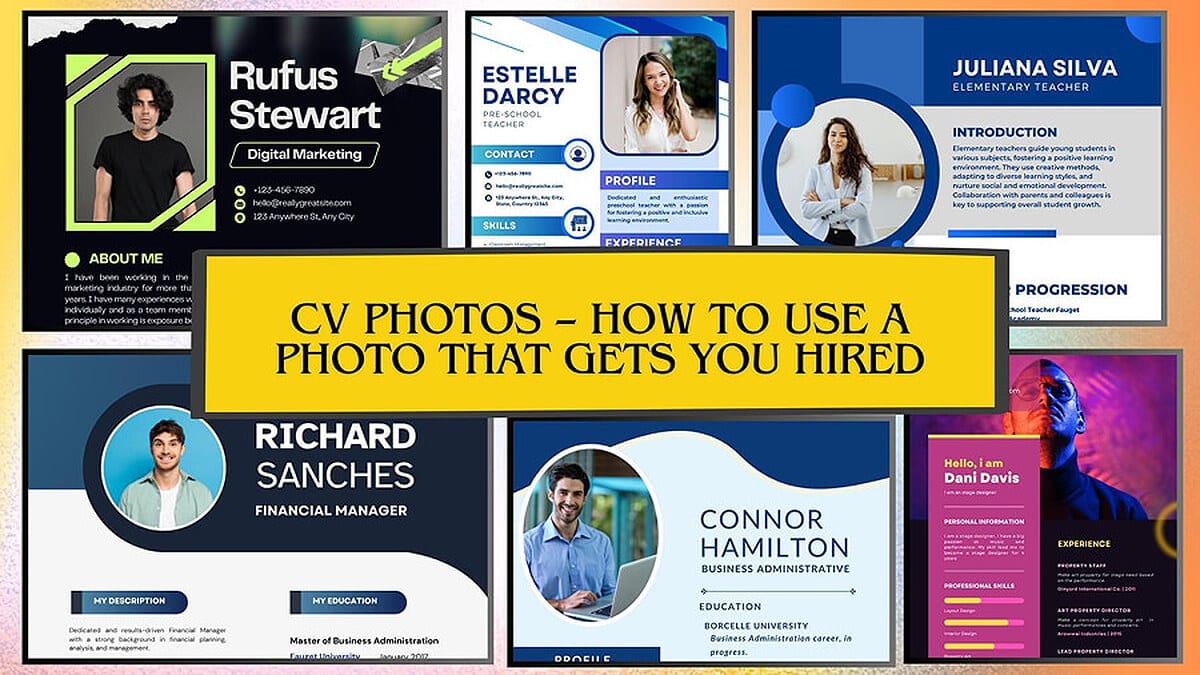
Placement is not just design. It shapes how recruiters read your profile at first glance. Here are eight CV photo examples, each with the layout it suits and what it signals.
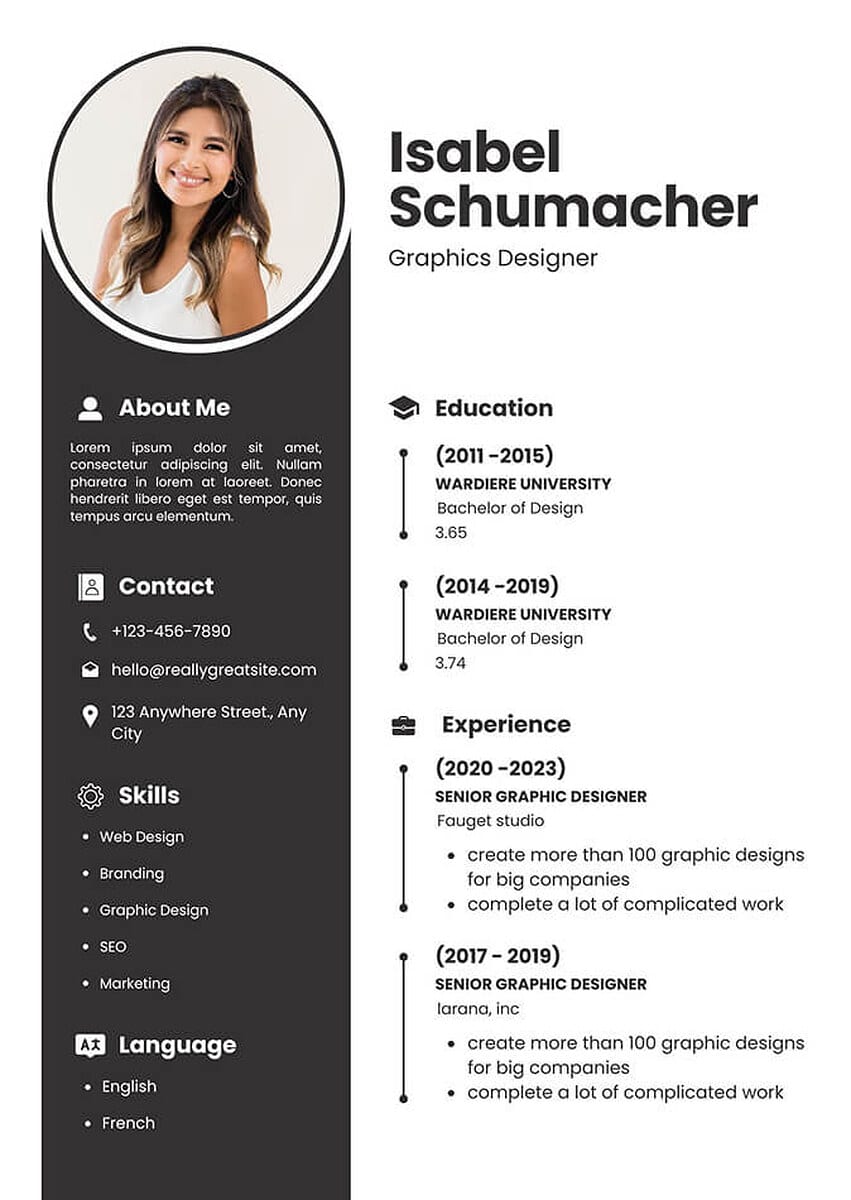
Example 1: Sidebar CV Photo in the Top-Left Column
The top-left corner is where most people start reading, so a photo here is seen immediately. It makes a quick, strong personal impression and suits traditional fields like law, finance, and administration.
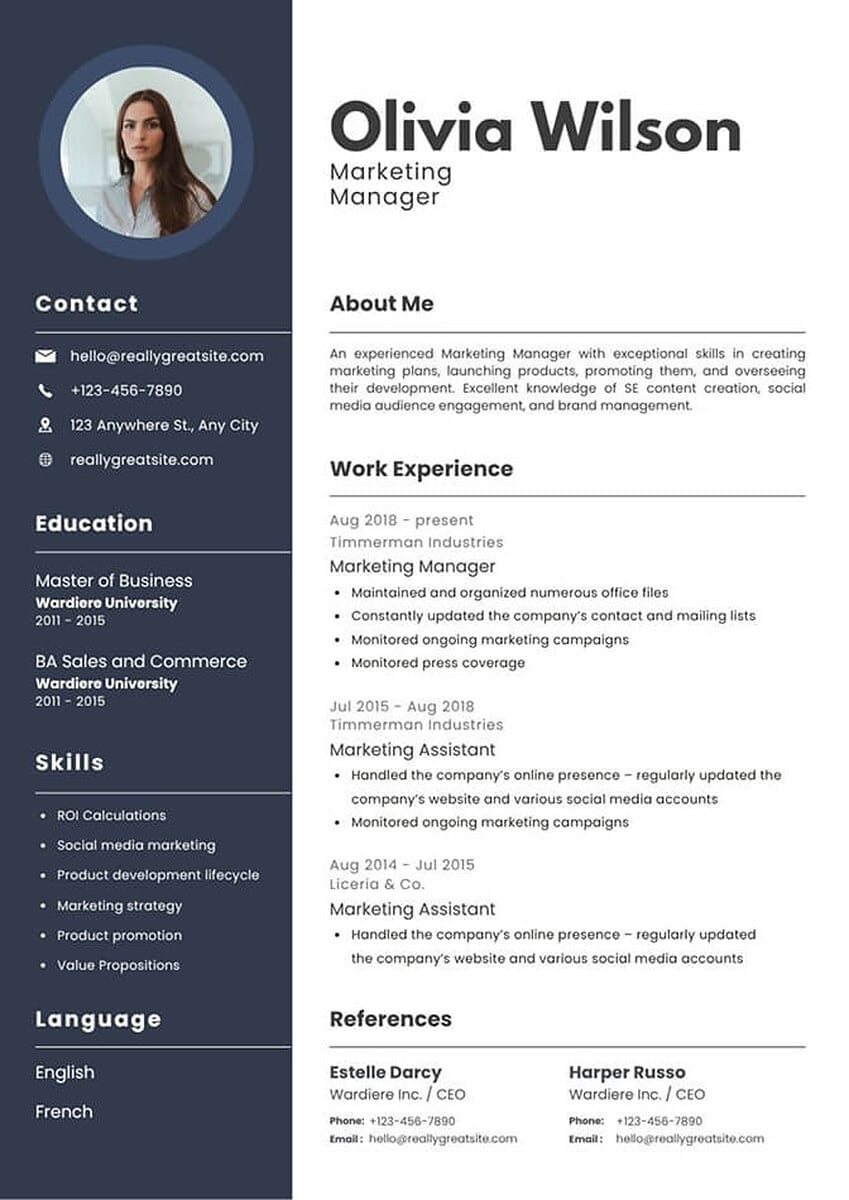
Example 2: ATS-Friendly CV Photo, Kept Discreet
A small, subtle top-left image keeps the CV scannable and text-focused for applicant tracking systems, which parse the document as plain text and ignore the image entirely.
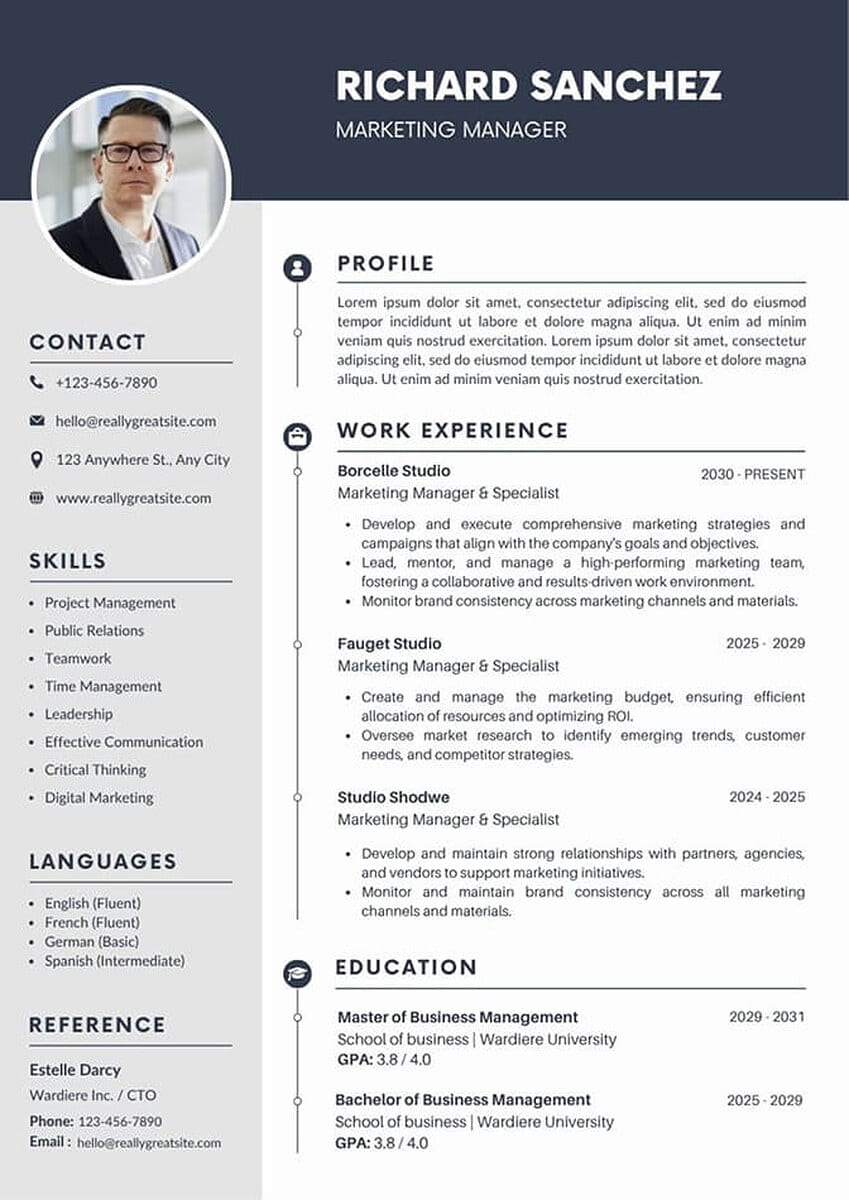
Example 3: Minimal CV Photo in the Top-Right Corner
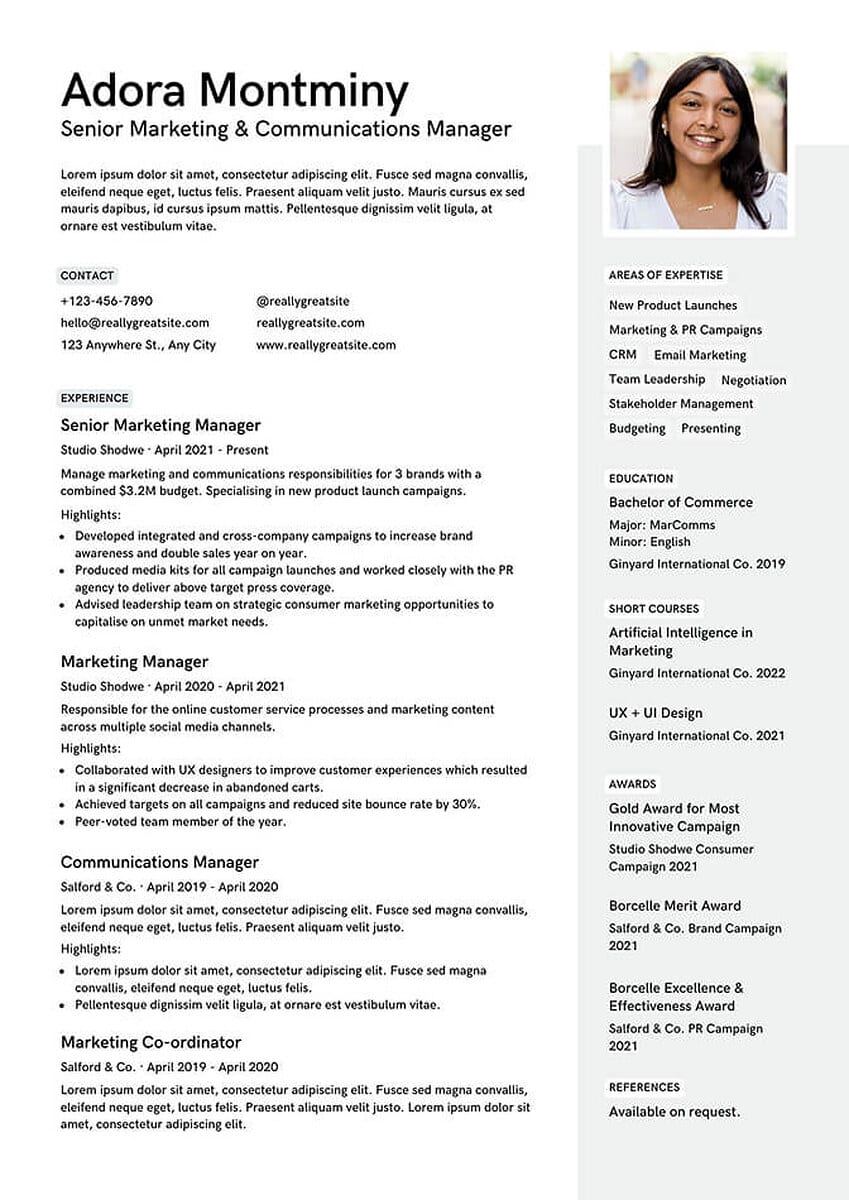
A top-right photo keeps the focus on your name and summary on the left while the image adds a softer, supportive visual. It works well for modern corporate CVs in consulting, marketing, and mid-level roles.
Example 4: Academic CV Photo, Small and Understated
A small photo adds personality without stealing attention from publications or research experience, which is what an academic reader is scanning for.
Example 5: Corporate CV Photo in a Profile Header
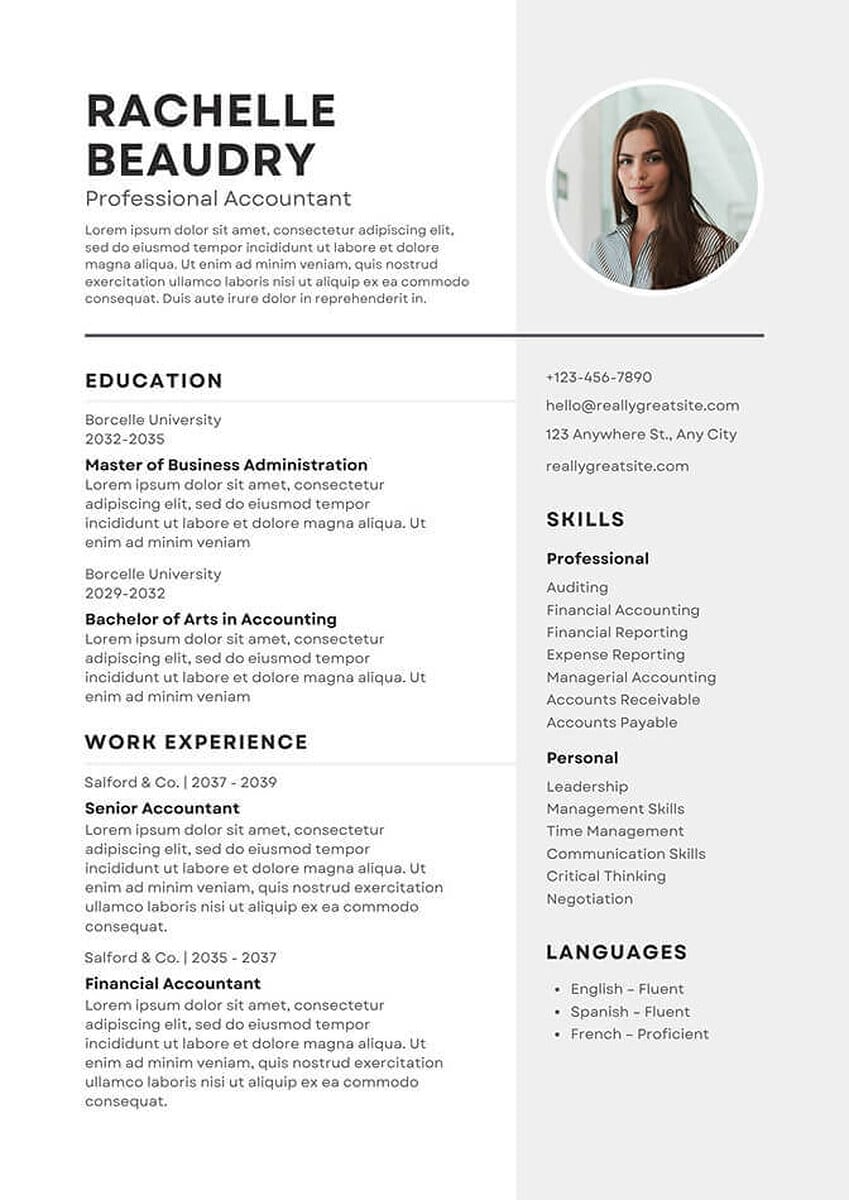
Your name, title, and headshot in a full-width header give a polished, profile-style feel that reads well for executive and leadership applications.
Example 6: Modern CV Photo in a Banner Layout
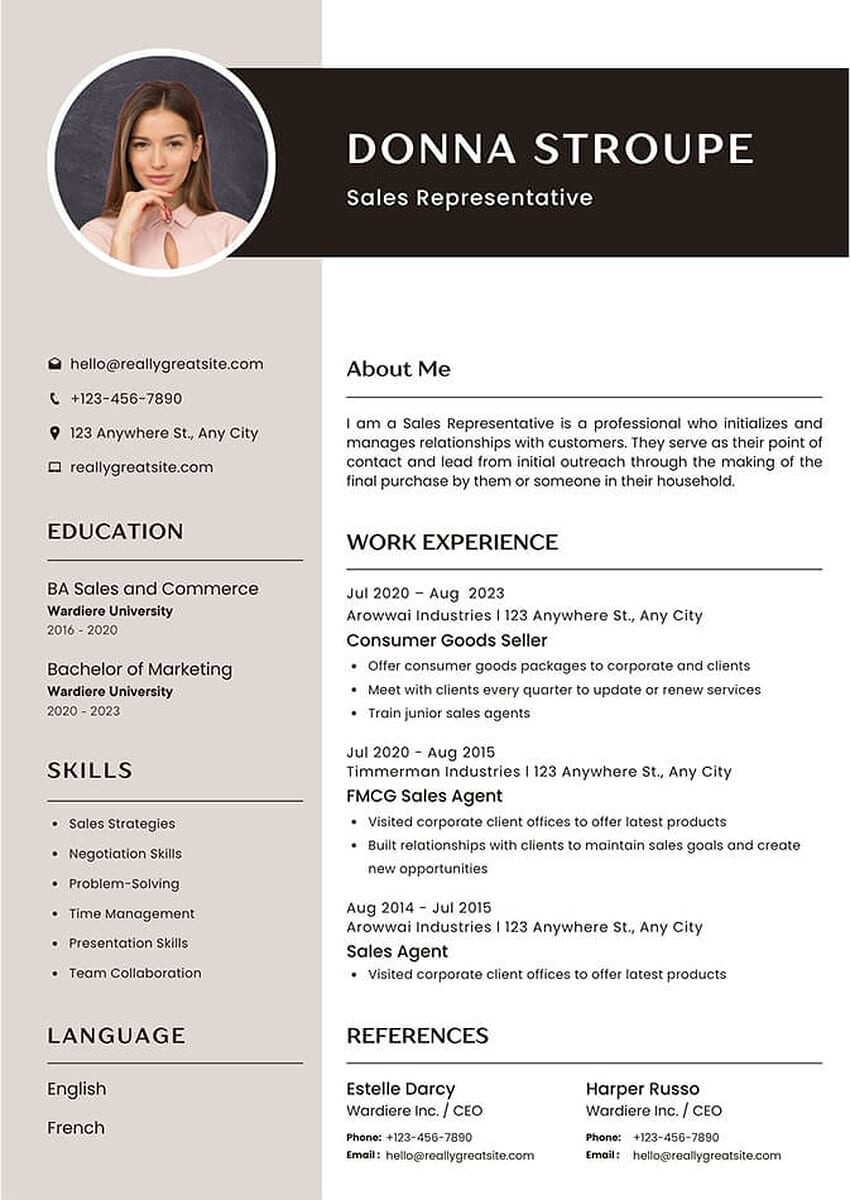
Placing the photo beside your name in a dark banner makes it impossible to miss. It signals confidence and modern personal branding, and suits PR, content, and client-facing roles.
Example 7: Multi-Column CV Photo in a Vertical Sidebar
A sidebar photo acts as a visual anchor, keeping the focus on your experience while giving quick access to your skills and your image. It is a contemporary, space-saving choice.
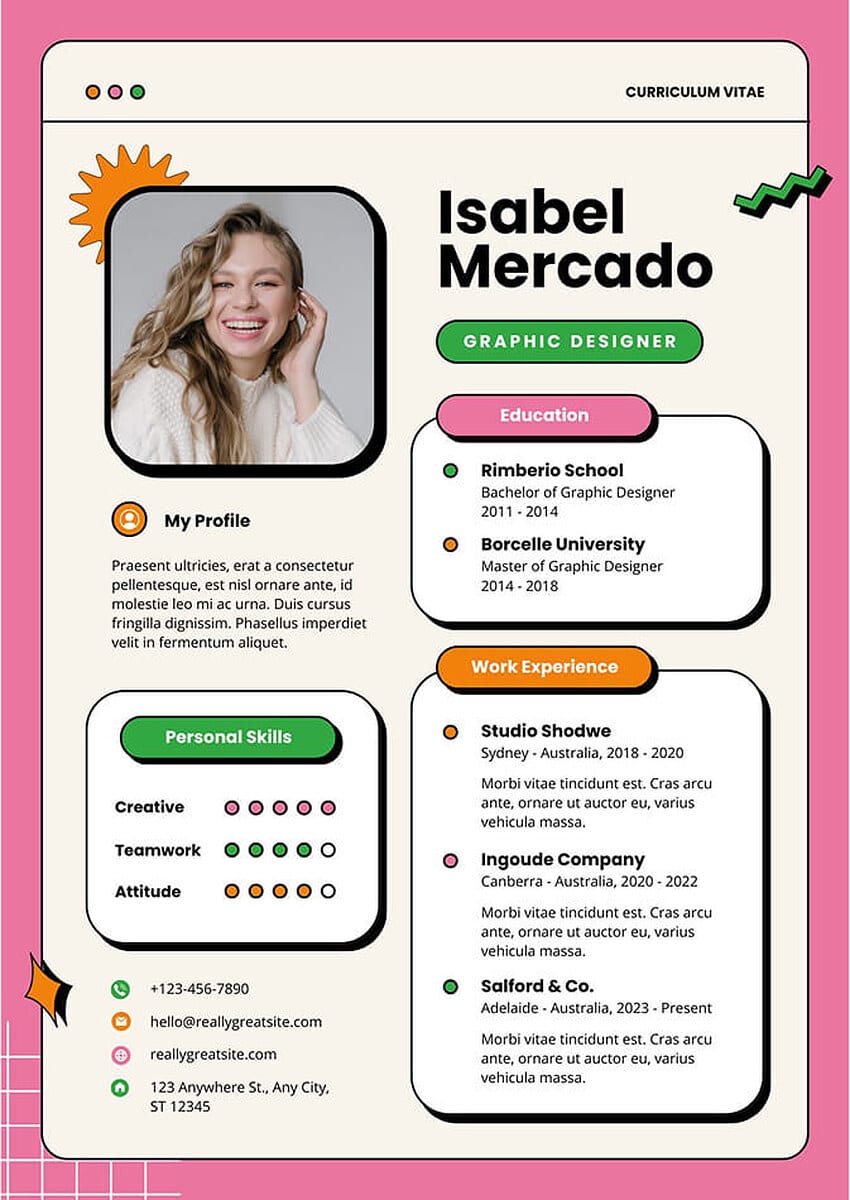
Example 8: Creative CV Photo on a Color-Blocked Template
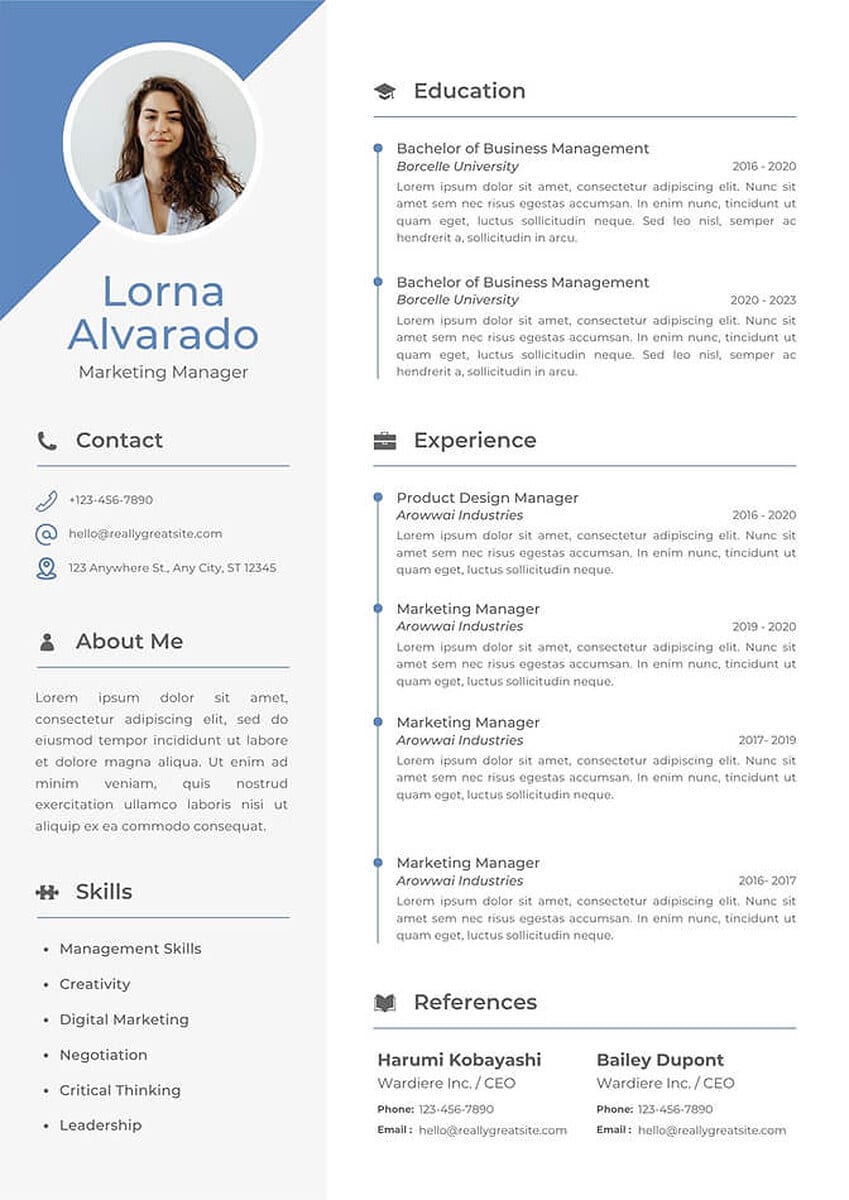
A bold template with colour accents and a framed side photo works for designers, UX professionals, and copywriters, where the CV itself is a work sample.
How to Add a Photo to Your CV
Once the photo is the right size, getting it onto the page is a two minute job in any of the three tools people actually write CVs in.
Microsoft Word
- Put the cursor where the photo belongs, then go to Insert > Pictures > This Device and choose your file.
- Select the image, open the Layout Options icon that appears beside it, and pick Square or Tight so the text wraps instead of pushing the photo onto its own line.
- Drag a corner handle to size it, then set the exact size under Picture Format > Size: 3.5 cm wide by 4.5 cm tall for a European CV, or 5.1 cm square for a 2 x 2 inch photo. Use the corner handle, never a side handle, or you will stretch your face.
Google Docs
- Go to Insert > Image > Upload from computer.
- Click the image, then choose Wrap text in the toolbar that appears underneath it and set a small margin, usually 0.1 inch.
- Open the three-dot menu, choose All image options > Size & rotation, tick Lock aspect ratio, and type the width. Google Docs works in inches or centimetres depending on your locale: 1.38 in or 3.5 cm for a European CV.
Canva
- Open your CV template and drag your photo onto the frame or placeholder that is already in the layout. Canva crops it to the frame automatically.
- Double-click the photo to reposition your face inside the crop. Aim for a little space above the head and the eyes roughly a third of the way down.
- Export with Share > Download > PDF Print so the photo stays at print resolution. Downloading as PDF Standard compresses it, and the compression shows at CV print size.
Circle or square? Use a rectangle, at the country size above, when the CV will be printed or sent as a PDF to a European or Asian employer, because that is the format those readers expect. Use a circle only in modern sidebar templates where the layout is clearly built for one, as in examples 1, 2 and 7 above. A circular crop loses the corners of the frame, so shoot or generate a little wider than you think you need, and never crop a circle out of a photo that is already tight to the head.
One warning for portals. An image inside a document can confuse applicant tracking systems that parse your CV as text. Keep a second, text-only version of the file and submit that one wherever you are uploading into an ATS rather than emailing a person.
Can You Use an AI-Generated Photo on Your CV?
Yes, as long as it still looks like you on interview day. That is the whole rule, and it is the one recruiters care about, because they will meet you in person or on a video call within days of reading the CV. An AI headshot that flatters you is fine. One that quietly changes who you are is not, and the gap gets noticed at exactly the wrong moment.
AI generated headshots are now ordinary in hiring. The objection is never the technology, it is the mismatch. A recruiter who opens a video call and cannot match the face to the CV has learned something about your judgment before you have said a word.
What to avoid
- Heavy skin smoothing that removes texture, lines and pores. It is the single most obvious tell, and it reads as a stock photo rather than a person.
- Changed features. A narrowed jaw, enlarged eyes, a different nose or a slimmer face are all out, even where the tool does it by default.
- A different age. Photos that take ten years off are the most common complaint recruiters raise about AI headshots.
- Hair, glasses or facial hair you do not currently have. Regenerate after you change your look, not before.
- Fake exotic backgrounds. A plain wall or a softly blurred office is credible; a glass tower skyline behind a junior analyst is not.
- Visible artefacts: warped collars, half a pair of glasses, six fingers on a visible hand, a watermark left in a corner. Zoom to 100% and check the edges before you use anything.
How to get a result that holds up
Start with good input. Four to eight recent selfies in soft, even daylight, taken at arm's length or further, with different angles and at least two different tops, will get you closer than twenty photos from the same evening. Then pick the most natural output rather than the most flattering one, and if you cannot decide, show it to someone who sees you every week and ask whether it looks like you. If they hesitate, pick another.
You do not have to declare it. There is no need to tell an employer the photo was AI assisted, any more than you would mention that a photographer retouched a studio shot. The standard recruiters apply is accuracy, not provenance.
How to Create a Professional CV Photo Without a Photographer
You no longer need an expensive studio session for a professional CV photo. With an AI headshot generator like Headshot Photo, you can turn a casual selfie into a studio-quality image without booking anything, shooting the source photos at home on your phone. It adjusts lighting, sharpens your features, cleans up the background, and applies subtle corrections for a polished look.
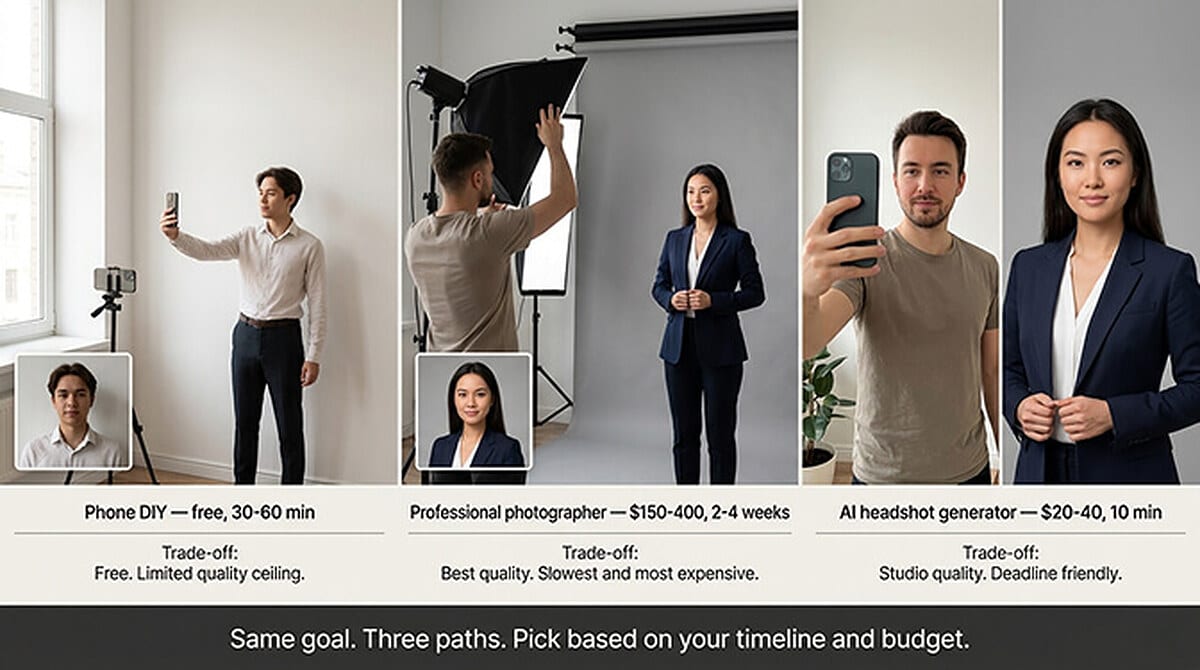
Professionals use Headshot Photo for CV photos because:
- It is convenient. You shoot from home using just your phone.
- It is cost-effective compared with hiring a photographer.
- It is quick. Headshots come back in 1 to 3 hours depending on the plan, not the two to four weeks a studio booking takes.
- It gives you multiple backgrounds and lighting styles, so you can match your industry.
- It exports at the resolution you need, so you are not upscaling a small file to reach 413 x 531 pixels.
For the best result, start with a well-lit selfie in natural light, choose a clean neutral background, and wear professional or business-casual attire. Keep your posture upright and your expression confident and approachable, and let the AI handle the polish. If you already have a shot you like and only need it cropped and sized correctly, our free resume photo maker will do that part.
AI CV Photo Examples
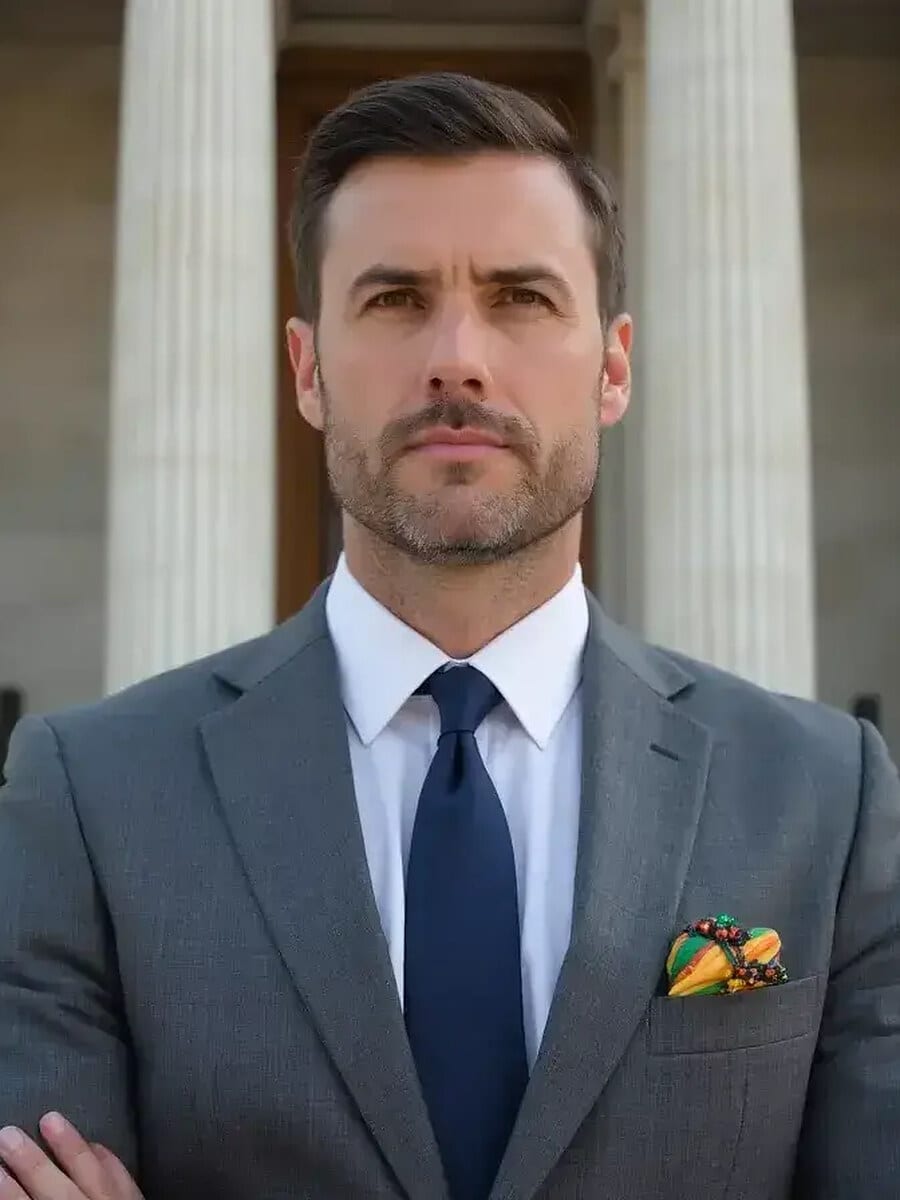
Every photo below was generated from a few ordinary selfies. Each one is a clean, shoulders-up headshot on a plain background, ready to crop to 35 x 45 mm.





Create your CV photo
Upload a few selfies and get studio-quality headshots sized for a CV, a resume, and LinkedIn, ready in 1 to 3 hours depending on your plan.
Create My CV Photo →Plans from $34 · See Headshot Photo pricing · Download at 413 x 531 px or 600 x 600 px
When you are ready, create your headshot and pick the version that fits your CV.
CV Photo Checklist Before You Upload
Six checks, in the order they go wrong. If all six pass, the photo is ready to go on the document.
- Right size for the target country. 35 x 45 mm for most of Europe, 4.5 x 6 cm for Germany, 3 x 4 cm for Japan, Korea and Indonesia, 2 x 2 inch for the Philippines.
- Plain, light background. White or light grey, with nothing behind you that a reader could look at instead of your face.
- Head and shoulders, face centred. A little space above the head, eyes about a third of the way down, head filling roughly 70% of the frame.
- Taken in the last 12 months. Same hair, same glasses, same face the interviewer will meet.
- JPG or PNG under 1 MB. Exported at the pixel size you need, never upscaled from something smaller.
- Text-only version ready for ATS portals. Keep a copy of the CV with no image, and upload that one wherever a system parses the file rather than a person reading it.
Wrapping Up
A well-chosen CV photo can lift your application and create a strong first impression, as long as the region expects one. Check the country rule first, get the size right for where you are applying, keep the background clean, dress for your industry, and place the photo where it supports rather than distracts. With a tool like Headshot Photo, a polished, correctly sized CV photo is a same-day job rather than a studio booking.
FAQs
What size should a CV photo be?
The standard CV photo size is 35 x 45 mm (3.5 x 4.5 cm) in Europe and internationally, which is 413 x 531 pixels at 300 DPI. Where a square format is expected, use 2 x 2 inches, or 600 x 600 pixels. Save as a JPG or PNG under 1 MB and keep the framing to head and shoulders with your face centred and your head filling roughly 70% of the frame.
Should you include a photo on your CV?
It depends on the country. Include one in Germany, Austria, France, Spain, Italy, China, Japan, South Korea, and most of the Middle East, where a headshot is standard practice. Leave it off in the US, UK, Canada, Australia, and Ireland, where anti-discrimination rules mean a photo can get your CV screened out before it is read. When you cannot confirm the local norm, leave it off and keep a strong headshot on your LinkedIn profile instead.
What are the CV photo dimensions in pixels?
413 x 531 pixels is the standard 35 x 45 mm CV photo at 300 DPI. A small 25 x 35 mm photo is 295 x 413 pixels, a large 40 x 50 mm photo is 472 x 591 pixels, and a 2 x 2 inch square is 600 x 600 pixels. For a CV that will only ever be read on screen, anything from 400 x 400 to 600 x 600 pixels is enough. To convert any size yourself, divide the millimetres by 25.4 and multiply by the DPI.
What's the difference between a CV photo and a resume photo?
They are the same type of image used under different conventions. A CV photo is expected across Europe, Asia, and the Middle East and follows the 35 x 45 mm print standard. A resume photo is used mainly in the US and Canada, where it is usually discouraged because it creates bias risk for the employer, and where it is typically square at 2 x 2 inches or 600 x 600 pixels and kept tight to the header so the resume stays on one page.
What background color should a CV photo have?
Plain white or light grey. A neutral, uncluttered background keeps the focus on your face and reproduces cleanly when the photo is printed small on a CV. Very light blue or beige is acceptable, but avoid patterned walls, rooms, outdoor scenes, and anything with strong colour that competes with your face at 35 x 45 mm.
Can you use a selfie for a CV photo?
Not as it comes off your phone. A raw selfie usually has the wrong lighting, a distracting background, and a distorted perspective from being taken at arm's length, and recruiters recognise all three instantly. You can, however, start from a selfie: an AI headshot generator will restage the lighting, replace the background, and output a correctly sized CV photo from a good, well-lit phone shot.
What should you wear for a CV photo?
Wear professional or smart-casual clothing that matches the standards of your target industry, such as a blazer, a collared shirt, or a simple solid top. Stick to clean, solid colours and avoid bold patterns or accessories that pull attention from your face. In healthcare and other uniformed professions, wear the uniform your role expects.
Is 2x2 the same as passport size?
Not everywhere. A 2 x 2 inch photo (51 x 51 mm, 600 x 600 pixels) is the passport size in the United States, the Philippines and India, so in those countries the two terms mean the same thing. In Europe, the UK and most of Asia, a passport photo is 35 x 45 mm, which is a portrait rectangle rather than a square. If a form says "passport size", check which country's passport it means before you crop.
Should a CV photo be 3x4 or 4x6?
Both are used and the job ad usually says which. In Indonesia, 3 x 4 cm is the common default for a job application photo and 4 x 6 cm is asked for when the photo will be printed larger or pasted onto a form. In Japan and South Korea, 3 x 4 cm is the standard for a rirekisho. In Germany, 4 x 6 cm is one of the accepted Bewerbungsfoto sizes alongside 4.5 x 6 cm. At 300 DPI, 3 x 4 cm is 354 x 472 pixels and 4 x 6 cm is 472 x 709 pixels. When nothing is specified, use 3 x 4 cm in Asia and 4.5 x 6 cm in Germany.
What is the CV photo size in cm?
3.5 x 4.5 cm is the standard CV photo size across Europe and most international CVs, which is the same as 35 x 45 mm. Germany and Austria commonly use a larger 4.5 x 6 cm, Japan, South Korea and Indonesia use 3 x 4 cm, and a 2 x 2 inch square is 5.1 x 5.1 cm. To get the pixel size from centimetres, multiply by 10 to get millimetres, divide by 25.4, then multiply by 300.
Does a photo on your CV break ATS?
It can, though it rarely breaks the whole file. Applicant tracking systems read your CV as text, and an image contributes nothing they can parse. The real problem is the layout around it: photos usually sit in a sidebar or a text box, and those are the structures that cause an ATS to scramble or drop the text beside them. Keep two versions of your CV, one with the photo for direct applications and emailed submissions, and a plain single-column text-only version for anything you upload into a portal.